

A retractable roof gazebo usually means one of two systems: a fabric canopy that slides shut on tracks, or aluminum louvres that rotate open and closed. The fabric version gives full sun-block or full shade in one move; louvres let you dial in anything between, and can be left part-open in rain. Neither is a true winter roof.










How a fabric canopy and a louvred roof actually open and close
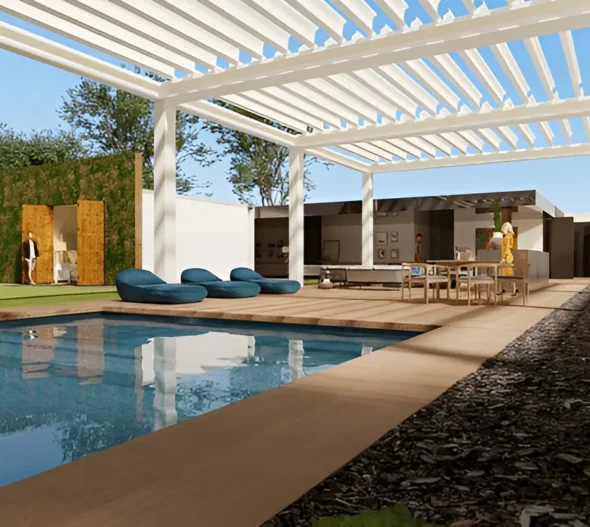
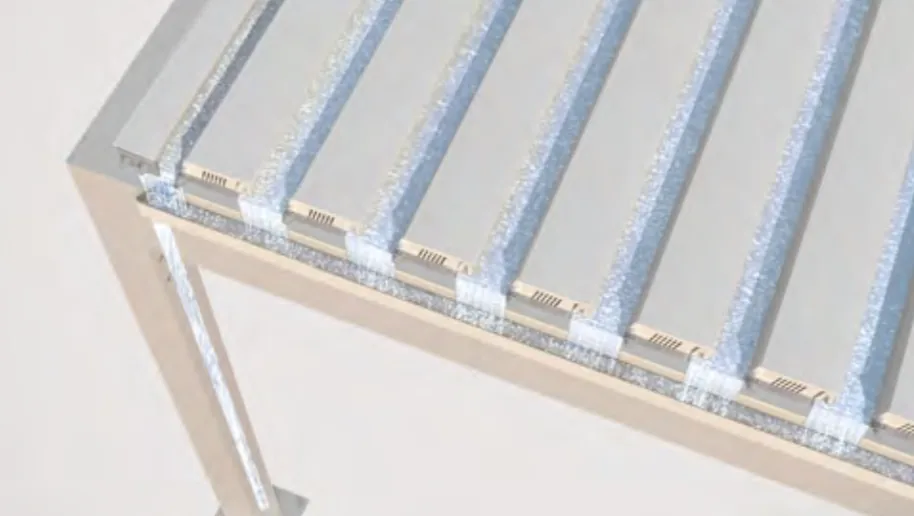
A retractable fabric roof is a length of tensioned fabric riding inside aluminum tracks fixed along the pergola's beams. Pull it closed and the fabric stretches flat into a roof; push it open and it concertinas back into a stack at one end, leaving bare rafters. Most run on a motor wired to a wall switch or remote; a hand-crank version skips the wiring entirely for anyone who would rather not run power to the structure. Either way it has exactly two positions – open or closed – and moves between them in under a minute.
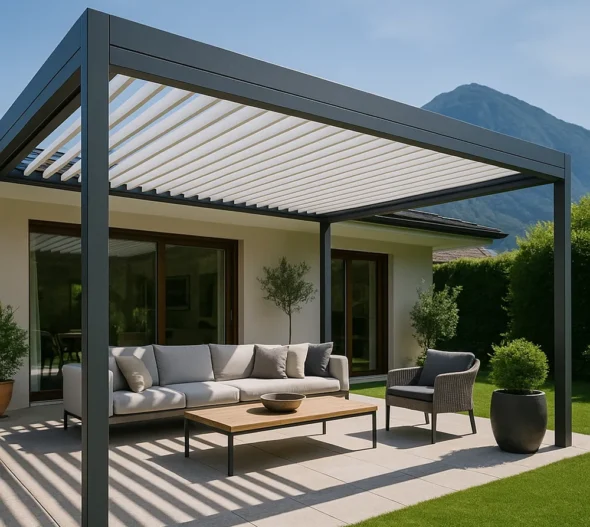
A louvered roof is built from individual aluminum blades that span the frame on a hinge running the length of the structure. Turn the control and every blade rotates together, so the roof can sit anywhere from fully closed and flat, with each blade overlapping the next to seal the top, to fully open and vertical, where the blades almost disappear and the frame lets through nearly all the light. Motorised versions use a remote or an app; simpler fixed-pitch frames use a manual gear crank instead, with no motor or wiring at all.
The practical difference shows up the moment you're standing under either one deciding what to do about the weather. With a fabric canopy you make one decision – open or closed – and that's the whole interaction. With louvres you're choosing an angle, which means more control but also one more thing that can be left in the wrong position by accident (blades cracked open during a downpour, say) if nobody thinks to close them.
Rain: pitch, drainage and what actually stays dry
Fabric needs pitch built into the frame to shed water at all. We set a slope toward one side during install so rain runs off the low edge rather than pooling in the fabric itself. Closed and pitched correctly, a canopy sheds rain fine – but there's no built-in gutter unless we add one, so the water runs straight off the drip edge onto whatever sits below it: a deck rail, a planter, a walkway. Wind-driven rain can also find its way under the side edges where the fabric meets the track, which is normal for a tensioned fabric system and not a defect.
A louvered roof handles rain differently because the aluminum blades overlap when closed flat, and the water they catch is routed through concealed channels built into the posts rather than dumped off an edge. That's the single biggest practical gap between the two systems – a louvered roof behaves like an actual roof with real drainage, while a fabric canopy behaves like a very good umbrella. Cracking the louvres a few degrees in a light rain can still move air through the structure while shedding most of the water off the leading face of each blade, something a fabric canopy simply can't do since it only has the two positions.
Snow: which one is built to carry a winter load
A fabric canopy has to be retracted before snow sits on it. Stacked tight at one end, fabric holds no load and stays fine; left open and flat under snow, it can pool meltwater, sag, or tear under weight it was never engineered to carry. We tell every canopy customer the same thing: open it before the first real snowfall and leave it open until spring, exactly the way you'd treat a retractable awning.
The aluminum louvre roof is the one of the two that's actually engineered to sit under winter load when the blades are closed flat – that's the whole point of building the roof out of aluminum instead of fabric. We still don't recommend leaving heavy snow stacked against the house line indefinitely; clear it back the way you would a deck roof if drifting builds up past a sensible depth. The honest line is simple: a louvered roof is the closer thing to a true winter roof, and a fabric canopy never is, no matter how it's pitched.

Fabric canopy vs louvred roof vs a fixed roof
A fixed solid roof is included here only for comparison – we design, supply and install the fabric canopy and louvered systems, not a fixed roof structure.
| Fabric canopy (retractable) | Louvred roof (aluminum) | Fixed solid roof | |
|---|---|---|---|
| Opens for full sun | Yes, fully retracts | Yes, louvres rotate open | No |
| Shade control | All or nothing | Any angle, open to flat-closed | Fixed, always full shade |
| Snow load when closed | Must be retracted first | Rated to carry snow closed | Rated for winter |
| Rain handling | Sheds off a pitched edge | Routed through concealed post drains | Routed through roof and gutter |
| Noise in wind | Fabric can flutter in gusts | Aluminum can tick if misaligned | Quiet |
| Typical add-ons | Screens, lighting | Screens, lighting, heaters, rain sensors | Screens, lighting |
| Upkeep | Retract and clean fabric seasonally | Occasional hinge and track check | Minimal |
A fixed roof row is shown for context only; it is not a product line we install.
Shade control: louvre angle versus all-or-nothing fabric
Because the blades rotate through a range rather than just sliding, a louvred roof lets you match the angle to the sun rather than just blocking it. Low morning or evening sun comes in flat and is hard to stop with an overhead canopy either way, but with louvres you can tilt the blades to cut the glare without closing the roof completely, keeping airflow moving underneath. Close flat for a sudden shower or a scorching afternoon, open fully in the shoulder seasons when you want warmth and light – the same structure covers all of it.
A fabric canopy doesn't offer that middle ground. It's open or it's closed, full sun or full shade, with nothing in between. For some patios that's exactly right – a clean architectural look, a lower profile, and a simple decision every time you step outside. For a patio that gets used at different times of day with different sun angles, or where airflow matters as much as shade (a hot tub area, a dining table used through a whole afternoon), the louvred roof's range of angles tends to earn its keep.
Neither system is a substitute for a solid, permitted roof over a living space – both are shade and weather control for a patio, not a four-season room, unless the frame itself is engineered and permitted as one.
The honest verdict by use
There's no single right answer – it comes down to how the space gets used.
- Backyard dining and lounge patio you want to look finished year-round: a louvered roof, because closed flat it reads as a real roof even through winter.
- Pool deck where getting full sun fast on most days matters most: either system works, though a fabric canopy is usually the simpler route to full retraction.
- Hot tub or an area used after dark in changeable weather: a louvered roof, for the built-in drainage and the option to crack the blades without getting rained on.
- Covering an existing wood pergola you already like: a retrofit fabric canopy keeps the structure you have, provided the beams can take a loaded track; a louvered roof almost always means a new aluminum frame.
- Condo or townhouse patio with tight rules on structures: check with your board and municipality before ordering either – we can provide drawings for a permit application, but filing it is on you.
- Budget-driven decision: ask for both quotes in writing after the same site visit. Footprint, motorisation, and site access move the price of either system, and only a real on-site measure gives you a number worth comparing.
If a sliding fabric roof over an existing or new pergola sounds like the better fit for your patio, see how retractable pergola canopies are measured, built and installed.
Frequently Asked Questions
EL
Eugene Ladizinsky
CFO & COO, co-owner of ROLLerUP
Eugene co-owns ROLLerUP, the Newmarket company behind Shading Solutions by ROLLerUP. Every guide on this site is written with our installers and checked against our own job records before it is published. About ROLLerUP.
More about louvered pergolas
Louvered pergolas guides
Compare options
Read next
- Aluminum pergolas in Ontario: what to know before you buy
- Louvered pergolas and Ontario snow: how a roof that opens handles winter
- Motorized louvered pergola features: sensors, lighting, heaters, screens
- Pergola vs gazebo for a Toronto backyard
- Pergola with screens: the closest thing to an outdoor room
- Adding privacy screens to a pergola or gazebo
Get a free on-site estimate
We'll measure your patio, walk through both roof types, and put a price in writing after the visit.