

A louvered roof pergola handles Ontario snow by acting as a solid roof when closed: the aluminum louvres, frame and posts carry the load and drain meltwater through concealed gutters. We close the louvres for heavy snow, open them to shed it faster once it stops, and never run the motor while the roof is iced over.












How closed louvres carry and shed a snow load
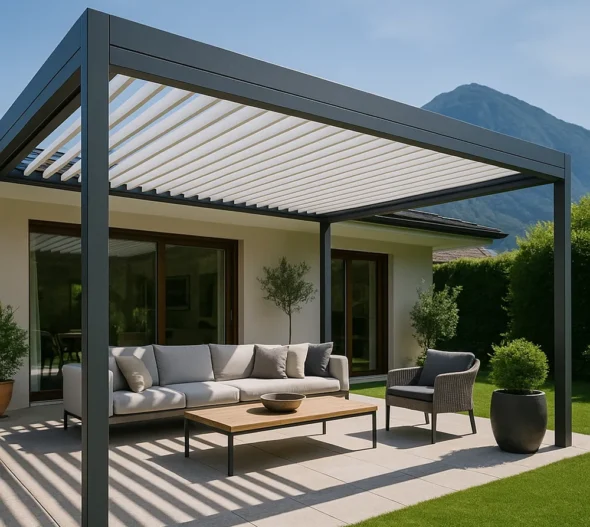
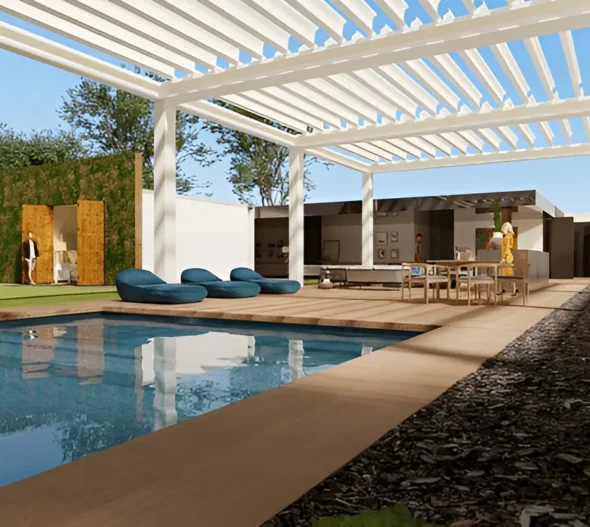
A louvered roof pergola is built from extruded aluminum louvres that overlap when closed, so the roof becomes a solid plane rather than a set of shade slats. The frame, beams and posts are the parts actually carrying a snow load, not the thin skin of a fabric canopy, which is why we close the louvres before a heavy wet snow rather than leave them cracked open to vent heat from the house.
Each louvre has a built-in channel on its underside, so when the roof is closed the panels shed water, or meltwater, toward the main beam instead of pooling on top of a flat slat. That channel runs the water into a gutter built into the beam itself, not a separate add-on, and down through the inside of the posts to grade or a storm connection. It is the same path whether it is a summer thunderstorm or a January thaw.
We do not treat the roof as flat. The louvres sit on a slight pitch even when fully closed, enough that water and slush move toward the drainage channel instead of sitting on the aluminum. That pitch is also why we tell clients not to expect the roof to hold snow indefinitely the way a flat deck roof might; it is designed to move water, and heavy wet snow behaves like water once it starts to melt against the aluminum underneath.
Our winter routine: when to open, when to close, when to clear
Our standing advice for an Ontario winter is simple: close the louvres before a storm, leave them closed while snow is actively falling and sticking, then open them once the snow has stopped to let the load slide or melt off faster. A closed roof during the storm keeps furniture, a barbecue or a hot tub cover dry underneath; an open roof afterward gets rid of the weight instead of leaving it to compress against the frame overnight.
We tell owners not to shovel or broom a closed louvred roof from above. Standing on a ladder clearing a pergola roof is how people get hurt, and a metal shovel edge will mark the finish. If snow has built up in the open gaps of a partly open roof, a soft push broom used from the ground, working upward, is the only tool we recommend. Anything heavier is a call to us, not a DIY job.
Freezing rain is the one event where we say leave it alone completely. Ice bonds louvre to louvre and louvre to seal; trying to force the motor to open a roof that is iced shut is the single most common way an owner strips a drive gear in winter. Wait for a thaw, or call us, before touching the remote.
Motors, sensors and cold-weather limits
The motor and gearbox sit inside the beam, out of direct weather, and are rated for outdoor use through an Ontario winter. Cold alone does not stop them. What stops them is ice: if frozen precipitation has welded the louvre edges together, the motor can have enough torque to try and open anyway, and that is what cracks a seal or strips a gear, not the temperature itself.
Most of our installs include a rain sensor so the roof closes automatically if it starts to rain with nobody home. Through an Ontario winter, that same sensor can occasionally be triggered by frost or condensation. We usually recommend switching to manual control for the stretch of the season when temperatures are hovering around freezing and precipitation is mixed, rather than leaving an automatic sensor in charge of a roof that might be iced shut.
Wind sensors are more useful in winter than people expect, closing or stopping the louvres before a gust catches an open roof. We set the sensitivity on installation and can adjust it on a service visit if a specific site is more exposed than most, for instance a deck at the top of an open lot.

Louvered roof versus fabric canopy versus fixed roof in winter
The same backyard question comes up every fall: which of these actually works through an Ontario winter without extra effort.
| Winter behaviour | Louvered roof pergola | Fabric canopy | Fixed solid roof |
|---|---|---|---|
| Snow load | Closed louvres and aluminum frame carry it like a roof | Pooling wet snow can tear or sag the fabric | Rated as a permanent roof year-round |
| Clearing snow | Open louvres to let it slide or melt off | Must be rolled in before heavy snow or swept by hand | Sheds off the pitch, no action needed |
| Ice build-up | Concealed gutters move meltwater away from the posts | Ice can form in the folds and on the frame | Standard eavestrough and downspouts handle it |
| Motor in cold | Left idle while iced; motor is not the weak point, ice is | Motor only moves the fabric hem, less exposure | No motor to think about |
| Off-season use | Usable year-round, open for sun, closed for shelter | Usually retracted and stored for winter | Usable year-round but no airflow control |
Every site is different; access, exposure and existing drainage change how much of this matters in practice.
Gutters, downspouts and ice at the posts
The posts on a louvered roof pergola are not just structural, they are also the downspout. Water collected in the beam gutters runs down a channel inside each post and exits near the base, either to grade, a drain, or a connection tied into existing site drainage during the install. In winter, that exit point is where ice shows up first, usually as a small icicle or a frozen puddle right at the foot of the post.
If a post sits near a walkway or a step, we route that discharge away from foot traffic during the install specifically to avoid a skating rink forming every thaw cycle. On an existing structure, the fix is usually a short splash block or a flexible extension on the outlet, not a change to the pergola itself. Clearing leaves and debris out of the beam gutters before the first freeze also matters; a clogged channel backs water up over the edge of the beam instead of down the post, which is where ice dams on the structure actually start.
We've installed louvered roofs in snow-heavy parts of Ontario, including 5 installs in Toronto and 1 installs in The Blue Mountains since 2022, and the drainage questions above are the ones that come up on nearly every one of those sites.
Rule of thumb for winter: closed and still means protected, open with bare aluminum showing means clear to run, iced shut means wait or call us, and never force the motor.
If you are weighing a louvered roof pergola against a fixed structure for a specific backyard, our louvered pergolas page walks through the framing options, add-ons and what we check on a free on-site measure.
Frequently Asked Questions
EL
Eugene Ladizinsky
CFO & COO, co-owner of ROLLerUP
Eugene co-owns ROLLerUP, the Newmarket company behind Shading Solutions by ROLLerUP. Every guide on this site is written with our installers and checked against our own job records before it is published. About ROLLerUP.
More about louvered pergolas
Louvered pergolas guides
Compare options
Read next
- Aluminum pergolas in Ontario: what to know before you buy
- Motorized louvered pergola features: sensors, lighting, heaters, screens
- Pergola vs gazebo for a Toronto backyard
- Pergola with screens: the closest thing to an outdoor room
- Adding privacy screens to a pergola or gazebo
- Retractable-roof pergolas vs louvered roofs
Get a free on-site estimate
We'll measure your space, talk through louvre and drainage options for your site, and put the price in writing.