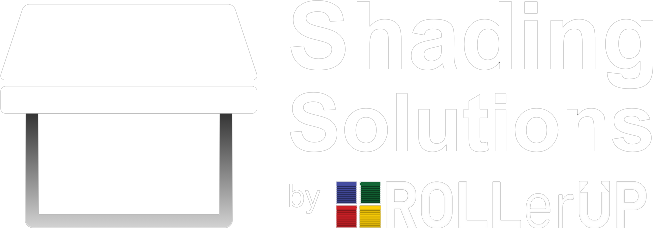

A motorized louvered pergola lets you open or close aluminum roof louvres with a remote or app, and add rain, wind and snow sensors, LED lighting, infrared heaters or retractable side screens. We recommend starting with a rain sensor and app control, then adding heat or screens as your budget allows.












What a motorized louvered pergola actually does
A motorized louvered pergola is an aluminum roof structure where each slat, or louvre, tilts on a shared axle driven by a single motor, so you can go from fully closed and watertight to fully open and airy with a remote or an app. People search for this as a bioclimatic pergola or sun louvre pergolas because the louvres let you manage sun and airflow like a thermostat for the patio, rather than blocking light at one fixed angle the way a fixed-roof structure does.
At the base, every pergola we install is the structure itself: posts, beams, and the louvred roof. Everything else – sensors, lighting, heat, side screens – is an add-on that wires into or bolts onto that same frame and motor. You don't need any of them to get a working pergola, but each one changes what the roof can do without you touching a switch.
We get asked constantly which features are worth adding. The honest answer depends on how the space gets used. A pergola over a hot tub used mostly at night wants light and heat before it wants a wind sensor. A pergola over a dining set left unattended during a thunderstorm wants a rain sensor first.
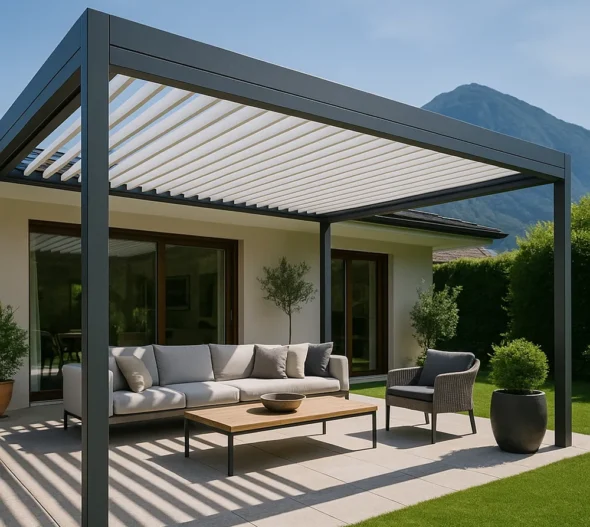
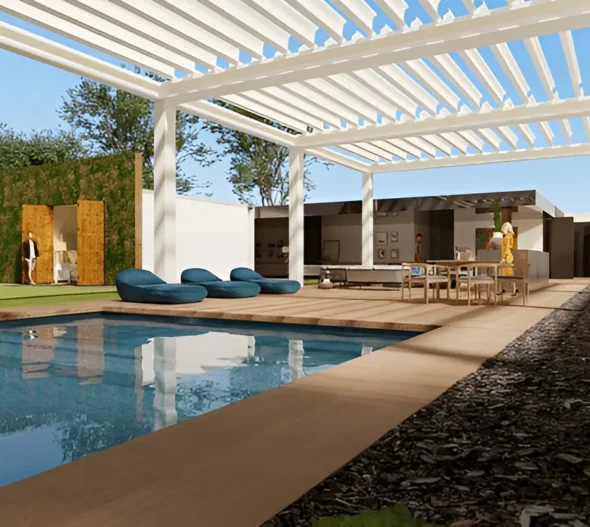
Sensors: rain, wind and snow – what each one triggers
A rain sensor sits on the roof and detects moisture, sending a signal to the motor to close the louvres automatically. This matters in Ontario because downpours arrive fast – the sensor closes the roof before anyone notices it's raining, which protects furniture and whatever's cooking on the grill underneath.
A wind sensor measures wind speed and opens the louvres flat once gusts cross a set point, so the roof stops acting like a sail. This is the sensor we push hardest on exposed sites – open backyards, hilltop lots, or second-storey decks that catch wind the ground floor never feels.
A snow sensor is less common and mainly useful if you plan to leave the pergola open through winter; it flags accumulating weight and can prompt the louvres to open so snow sheds instead of pooling. Most of our clients close the louvres fully for the season and skip this one – manual control is usually enough once the structure is in place.
All three sensors wire into the same low-voltage control box as the motor. None of them need a separate electrical circuit, but each one needs a wire run from its mounting point back to that box, so it's worth deciding on sensors before the beams close up.
Lighting and heaters: what they need, what they add
LED strips are usually built into the underside of the beams or the louvre edges and run on low-voltage wiring from the same transformer as the motor. They add usable evening light without a separate switch – most people run them off the same remote or app that controls the roof.
Infrared heaters mount to the beams or posts and need their own dedicated electrical circuit, not the pergola's low-voltage system, because they draw real power. If you want heat, tell us before the structure goes up so the electrician can run the right wire and a switch, assuming panel capacity allows for it.
Both lighting and heat change the shoulder-season use of a pergola. Without them it's a shade structure, strongest from late spring to early fall. Add heat and light and the same roof keeps hosting into fall and starts earlier in spring, which is the main reason people add them.
What they don't do: no light or heater turns a louvered roof into a fully enclosed, heated room. If you want a pergola to be comfortable in deep winter, the better move is closing the louvres and treating it as a sealed outdoor room, not expecting heaters to fight an open roof.

Side screens: privacy, bugs and wind
Retractable screens mounted between posts turn an open-sided pergola into a bug-free, more private space on demand, then roll away out of sight when not needed. They run on their own tracks with their own small motor or hand crank – a separate product that bolts onto the pergola frame rather than part of the louvre system.
Screens help cut a cross-breeze that would otherwise blow napkins and candles around, but they're not built to hold back a storm gust. We still recommend a wind sensor on the roof itself rather than relying on side screens to protect the structure in weather.
The trade-off is sightlines: screens close off some of the open feel that's a big part of why people choose a louvered pergola over a solid-roof structure in the first place. Most clients screen one or two sides – the one facing a neighbour, or the one that catches the prevailing wind – and leave the rest open.
Feature options at a glance
What each option needs electrically, and what it actually controls.
| Feature | What it needs | What it controls or adds |
|---|---|---|
| Rain sensor | Low-voltage wire to control box | Closes louvres automatically when it rains |
| Wind sensor | Low-voltage wire to control box | Opens louvres flat above a wind threshold |
| Snow sensor | Low-voltage wire to control box | Flags snow load; can trigger louvres open |
| LED lighting | Low-voltage wire, shared transformer | Evening light, same app or remote |
| Infrared heaters | Dedicated electrical circuit | Shoulder-season warmth |
| Retractable side screens | Own motor or crank, separate track | Privacy, bug control, wind-break |
| App control | Wi-Fi or hub at the pergola | Phone control, scheduling, away mode |
Sensors and lighting share the pergola's low-voltage circuit; heaters always need their own dedicated line.
Our recommended order of priorities
If budget means phasing these in, here's the order we'd add them.
- Rain sensor first – it protects the structure and anything underneath even when nobody's home.
- App or remote control second – the sensors above are only as useful as your ability to also override them yourself.
- Wind sensor if the site is exposed – open backyards, hilltops, or waterfront lots.
- Lighting next if you use the space at night – it's low-voltage and simple to add at install time.
- Heaters if you want the season extended on both ends – plan the circuit before the posts go in.
- Side screens last, and only on the sides that actually need privacy or a wind-break.
- Snow sensor only if you plan to leave the roof open through winter; most owners don't.
Decide on heaters and screens before the posts go in – the wiring and track mounts are far cheaper to plan for than to retrofit later.
What these options do to the price
We don't quote a figure until we've measured the site, because the same list of options costs different amounts depending on the footprint of the structure, whether the louvres are motorized with a remote or app versus a simpler fixed-pitch design, and which of lighting, heat, screens or sensors you add. Site prep also moves the number – a bare patio slab is a different job than a structure that needs new footings or anchoring.
Access for the crew and equipment during installation, and the frame and louvre finish you choose to match the house, round out the list of what changes the price. We put the number in writing after a free on-site measure, with every option above itemized so you can see exactly what each one adds.
If you're ready to see these options on a real structure and get a written price for your own space, our louvered pergolas page covers the base design and what's included.
Frequently Asked Questions
EL
Eugene Ladizinsky
CFO & COO, co-owner of ROLLerUP
Eugene co-owns ROLLerUP, the Newmarket company behind Shading Solutions by ROLLerUP. Every guide on this site is written with our installers and checked against our own job records before it is published. About ROLLerUP.
More about louvered pergolas
Louvered pergolas guides
Compare options
Read next
- Aluminum pergolas in Ontario: what to know before you buy
- Louvered pergolas and Ontario snow: how a roof that opens handles winter
- Pergola vs gazebo for a Toronto backyard
- Pergola with screens: the closest thing to an outdoor room
- Adding privacy screens to a pergola or gazebo
- Retractable-roof pergolas vs louvered roofs
Get a free on-site estimate
We'll measure your space, walk through every option above, and put a firm price in writing.