

An outdoor privacy screen for a pergola is a retractable mesh panel that runs in a track fixed to the inside face of the posts. It works on any structure with solid, properly anchored posts and a straight beam. Light tube-frame gazebos cannot hold one. We measure on site and tell you which you have.












Which structures can actually carry a screen
A retractable screen is not a curtain. When it is down and the wind pushes on it, the whole panel behaves like a sail, and every bit of that load goes into the track, the fasteners and whatever the fasteners are screwed into. So the first question we ask on site is never about mesh colour. It is whether the structure can take the pull.
Structures that work: an aluminum pergola with a real extruded post, a cedar or pressure-treated post of 6×6 or heavier that is bolted to a footing or a properly anchored post base, and a covered porch with framed openings. In all three cases there is something solid to screw a track into every foot or so, and the post is not going to twist when the screen loads up.
Structures that do not work: the thin tube-frame gazebos sold flat-packed for a deck, anything with a fabric or polycarbonate roof held on by elastic clips, and freestanding pergola kits whose posts simply sit on the slab under their own weight. We have turned these jobs down more than once. A screen bolted to a tube frame will pull the frame out of square, and on a windy night it can lift the whole thing. If your gazebo moves when you push a post with one hand, it is not a candidate.
The in-between case is a wood pergola that is solid but not straight. Timber moves. If the gap between two posts is wider at the top than at the bottom by more than a finger's width, a side-channel screen will bind or leave a light gap down one edge. We can sometimes pack the track out and hide the difference behind a trim strip. Sometimes we cannot, and we say so at the measure rather than after.
- Good: aluminum posts, 6×6 or heavier timber, framed porch openings
- Marginal: older wood pergolas that are solid but out of square
- No: tube-frame gazebos, unanchored kit posts, fabric-roof canopies
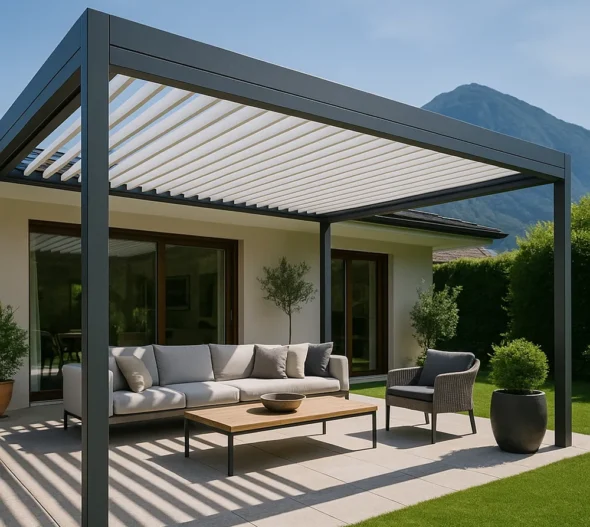
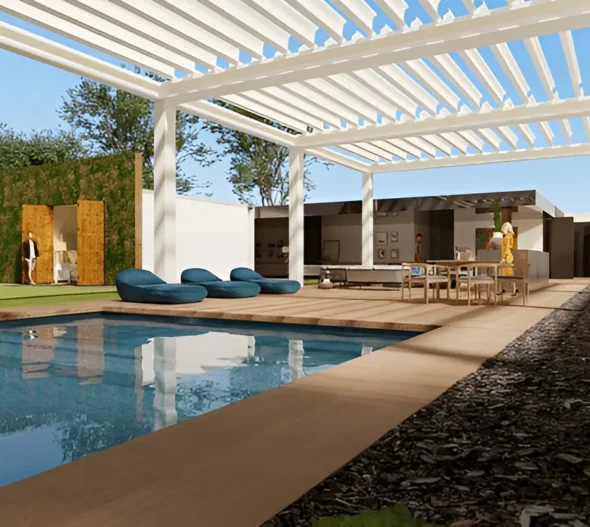
How the tracks fix to posts and beams
On a retrofit, the screen comes in three parts: a housing with the roller tube, a side channel on each post, and a bottom bar that drops into a sill or rests on the deck. The housing goes up under the beam, screwed through its back wall into solid framing, not into trim and not into a fascia board that is only nailed on. Where the beam is doubled timber, we fix into the inner member. Where it is a hollow aluminum section, we through-bolt it.
The side channels then run down the inside face of each post. They catch a reinforced edge on the mesh, which is what stops the screen blowing out of the track in a gust. Open channels with a loose hem look tidier and cost less, but they let go in wind, so we only use the retained type. If the posts are not plumb, the channels are shimmed until they are parallel to one another, because the mesh will not forgive a taper.
On our own aluminum louvered pergolas the channel is already part of the post. There is no separate track bolted on afterward and no box hanging under the beam — the screen housing lives inside the frame, so when the screens are up you see posts and louvres and nothing else. The louvre motor, the screen motor and the drainage all run through the same hollow posts, which is also why we prefer to set the structure first and run the wiring before anything is closed in.
Motor or crank is a separate decision from the structure. A crank is fine on a single opening you reach easily. Once you are closing three or four sides, or the bottom bar is above head height, a motor on a remote is the only version people actually use. We run low-voltage wiring in the post on a new pergola; on a retrofit it has to come from somewhere, and finding a tidy route for that cable is often the fiddliest part of the whole day.
Screen on your existing pergola versus a new pergola with screens
Same mesh, very different install. This is the comparison we end up drawing on a notepad at most measures.
| What matters | Retrofit on an existing structure | New louvered pergola with screens |
|---|---|---|
| Track | Surface-mounted channel on the post | Channel built into the post |
| Look when open | Housing visible under the beam | No visible box or track |
| Wiring | Routed on site, sometimes surface conduit | Run inside the posts |
| Roof | Stays whatever it is now | Adjustable aluminum louvres, drainage in the posts |
| Fit | Limited by how square the structure is | Built square, screens sized to it |
| Disruption | One to two days, no demolition | Footings or anchoring, then the frame |
| Best when | Structure is solid and you like it | Structure is tired, flimsy or the wrong size |
Both carry the same 5-year warranty, in writing.
Privacy mesh, insect mesh and solar mesh
People say privacy screen and mean one of three fabrics. Insect mesh is the open weave that stops mosquitoes and flies at dusk; you can see straight through it and so can the neighbours. Privacy mesh has a much tighter weave that breaks up sightlines from a yard or a sidewalk while still passing air. Solar mesh sits in between and is aimed at glare and heat on a west-facing side.
The honest limit on privacy mesh: it works by brightness. In daylight, when it is brighter outside than under the pergola, someone outside sees a flat panel and you see out reasonably well. After dark with your lights on, that reverses — you become the lit side, and silhouettes show. If you want privacy for evening entertaining, the answer is lower light under the roof, not a tighter mesh. No mesh is opaque from both sides at once, and anyone telling you otherwise has not stood under one at ten at night.
Nor is any of this soundproofing. A tight weave takes a little edge off road noise and that is all. It will not stop conversation carrying to the yard next door, and it is not a wall for a hot tub you want fully enclosed. For that you want a solid panel on one side and screens on the rest.
Most jobs mix fabrics. Insect mesh on the side that catches bugs off the garden, privacy mesh on the neighbour side, solar mesh where the afternoon sun lands. Each opening is its own screen on its own channel, so mixing costs nothing extra in complexity.

If a push with one hand moves a gazebo post, no screen belongs on it — a loaded screen pulls harder than you do.
Winter, wind and what we tell people to do in October
In Ontario the screens are a three-season thing. Mesh and a roller tube do not care about cold, but they do care about ice and about snow sliding off a roof onto a bottom bar. Our rule is simple: roll them up for the winter and leave them up. Rolled into the housing, the mesh is out of the weather and out of the way of anything falling off the roofline.
Wind is the other limit and it is the one that ends warranty arguments. Every retractable screen has a wind rating, and no screen is a storm shutter. A motorised screen can be fitted with a wind sensor that sends it up on its own, which is worth having if the pergola is somewhere you are not — a cottage, a rental, a property you visit on weekends. Without a sensor, the rule is to retract before you leave and before a storm.
Snow load belongs to the roof, not the screens. An aluminum louvered roof with its louvres closed sheds and holds snow by design and drains through the posts; a fabric canopy or an old wood lattice does not. If you are retrofitting screens onto a structure whose roof you already worry about in February, you are spending money on the wrong half of the problem.
What moves the price on a pergola with screens
We put the figure in writing after the free on-site measure, because these are the things that actually change it:
- Footprint of the structure — a bigger roof needs more louvre panels and a stronger frame
- Motorised louvres on a remote or app control versus a simpler fixed-pitch design
- Integrated extras: lighting, heating, screens, rain sensors
- Site preparation — a sound patio slab versus new footings or anchoring
- Frame and louvre colour or finish chosen to match the house
- Access for the crew and equipment on install day
- Number of openings screened, and whether each is motorised or crank
How the job runs
On-site measure
We check the posts, the beam, how square the structure is and where power can come from. If the structure cannot take screens, you hear it that day.
Written quote
Openings, mesh types, motor or crank, colours and the warranty, all on paper. Nothing is priced over the phone from a photo.
Build and install
New pergolas get posts, anchoring, drainage and wiring first, then screen channels. Retrofits are usually one to two days with no demolition.
Handover and service
We run every screen with you, set the limits, and show you the retract-before-wind habit. Parts and service visits stay in Ontario.
When a new structure is the cheaper answer
We retrofit screens onto other people's pergolas often and we are happy to. But there is a point where the retrofit is the expensive option: when the posts need bracing or re-anchoring before a track can go on, when the beam has to be sistered, when the roof is at the end of its life anyway, and when the structure is simply the wrong size for the patio under it.
At that point you are paying to fix a frame that will still be a fixed roof afterward. A new aluminum structure gives you the adjustable louvres, drainage hidden in the posts, screen channels built into the frame and one remote running all of it. We have done 5 installs in Toronto on this product line, plus work in Newmarket and farther north, and the pattern is consistent: the people happiest a year later are the ones who replaced a tired structure rather than bolting hardware to it.
If you want to see the frame and the channel before you decide, the showroom is at 1151 Gorham St, Unit 8 in Newmarket, Monday to Friday. Push on the post, look at how the channel is machined, and the choice usually makes itself. Everything we fit is aluminum and made in Canada, and we design, measure, install and service it ourselves.
If a new structure is where you are landing, the pergola-with-screens page shows how the louvred roof and the side screens work on one remote. Call (289) 270-5747 and we will book a free on-site measure.
Frequently Asked Questions
EL
Eugene Ladizinsky
CFO & COO, co-owner of ROLLerUP
Eugene co-owns ROLLerUP, the Newmarket company behind Shading Solutions by ROLLerUP. Every guide on this site is written with our installers and checked against our own job records before it is published. About ROLLerUP.
More about louvered pergolas
Louvered pergolas guides
Compare options
Read next
- Aluminum pergolas in Ontario: what to know before you buy
- Louvered pergolas and Ontario snow: how a roof that opens handles winter
- Motorized louvered pergola features: sensors, lighting, heaters, screens
- Pergola vs gazebo for a Toronto backyard
- Pergola with screens: the closest thing to an outdoor room
- Retractable-roof pergolas vs louvered roofs
Get a free on-site estimate
We measure your structure, tell you honestly whether it can carry screens, and put the price in writing.