
Aluminium patio covers split into two families. Fixed roofs and louvered pergolas stay up all year and handle rain. Retractable awnings fold away, so you get sun in April and shade in July. Fabric canopies and shade sails cost less, do sun only, and come down before winter.










The three aluminum options, one paragraph each
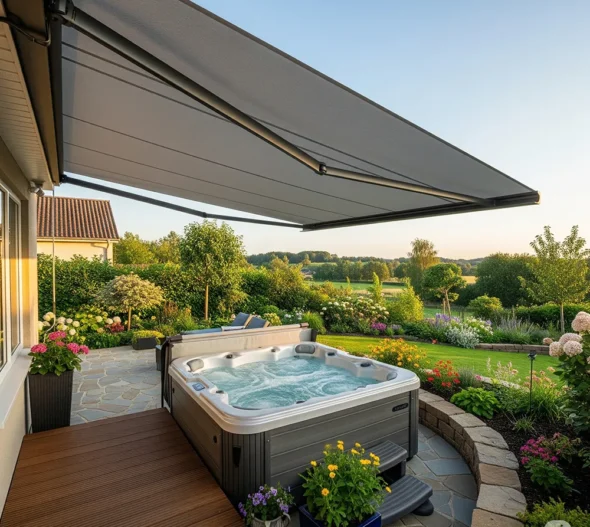
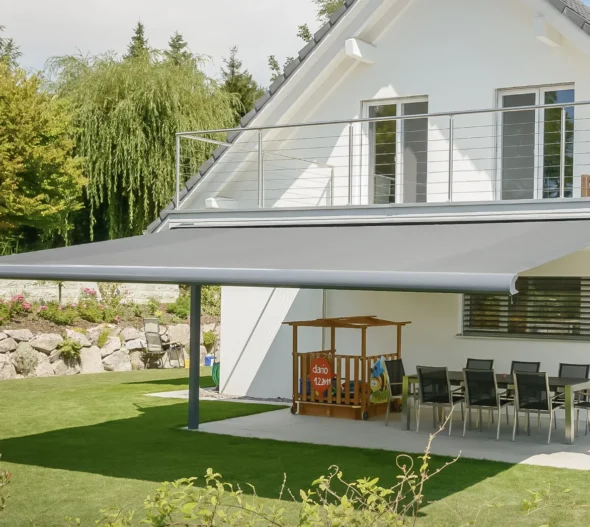
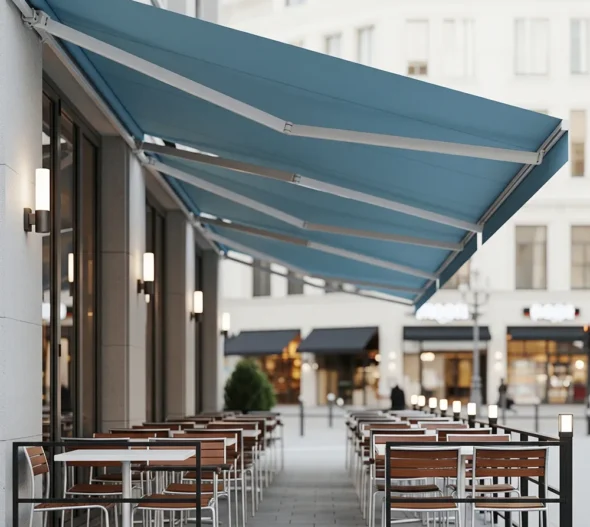
A retractable awning is a folding-arm system bolted to the wall or the fascia above your patio. The fabric rolls onto a tube inside a housing, and two spring-loaded arms push it out over the patio. It runs on a motor with a remote, or on a hand crank if you would rather keep it simple. Widths run from 6 feet up to 22 feet 11 inches on a single unit, and the fabric can project out to 19 feet 8 inches, which covers a full dining set and then some. Nothing stands on your patio, so the floor stays clear and the view is unchanged the moment it rolls back in.
A louvered pergola is a free-standing or wall-attached aluminum frame with rotating blades in the roof. Open the louvers and heat escapes straight up; close them and the roof becomes solid, with rain running along the blades into a gutter and down through the posts. It is the only option here that lets you change your mind about rain without changing your plans. Posts and beams are structural, so it needs a proper footing or a deck frame that can take the load, and it can carry screens or glass on the sides later.
A fixed aluminum roof is exactly what it sounds like: a permanent panelled roof on posts, usually with a slight slope, sometimes insulated. It is the darkest and the most weatherproof of the three. The trade-off is permanence. That patio is shaded in May when you wanted sun, and the room behind it loses light for good. We ask people to stand under a sheet of plywood on a grey April afternoon before they commit to one.
Fabric canopies and shade sails
A fabric canopy on posts is the cheapest structure that still looks like a structure. It blocks sun well and light rain tolerably, but the fabric is fixed, so it collects water in the middle unless the pitch is right, and standing water is what kills them. Expect to replace the fabric long before you replace anything on an aluminum system.
A shade sail is a tensioned triangle or square of mesh, anchored to posts or to the house. It is sun control and nothing else. Rain goes straight through the weave, snow load is not a conversation anyone should have about a sail, and in an Ontario autumn it has to come down. For a play area or a pool deck on a budget it is honest value. For a dining patio you plan to use in a drizzle, it is the wrong tool.
How the options compare
Cost and life are relative to each other on this list, not to any one quote.
| Option | Sun and rain | Snow and wind | Retracts | Cost and life |
|---|---|---|---|---|
| Retractable awning | Full sun, light rain | Roll it in | Yes, motor or crank | Mid cost, long life |
| Louvered pergola | Full sun, full rain | Stays up, louvers open | Roof opens, frame stays | Highest cost, longest life |
| Fixed aluminum roof | Full sun, full rain | Stays up all year | No | High cost, longest life |
| Fabric canopy | Sun, light rain | Take fabric down | No | Low cost, short life |
| Shade sail | Sun only | Take it down | No | Lowest cost, shortest life |
Permits follow the posts: anything with footings or a solid roof is more likely to need one than a wall-mounted awning.
What Ontario weather actually does to each one
Wind is the thing that ends awnings, not sun. A folding-arm awning is a sail with no back wall, and a gust that lifts the leading edge can bend an arm or pull a bracket. That is why we fit wind and sun sensors on most motorised jobs: the awning retracts itself while you are at work. If you are on an open lot north of the city with nothing between you and the fields, treat the sensor as part of the product, not an upsell.
Snow is the thing that ends everything else. A louvered pergola and a fixed roof are engineered to hold a load; a canopy and a sail are not, and neither is an extended awning. The rule in this province is simple. Fabric on arms comes in before the first real snow and stays in until spring. We get calls every February from people who left one out under a heavy, wet fall, and the repair is always an arm or a tube, never just the fabric.
Rain is where the louvered pergola earns its price. Closed louvers shed water into the frame and out through a post, so you can sit under it in a thunderstorm with a dry table. An awning will shed a light shower if it is pitched steeply enough, but it is not a roof, and water pooling in a sagging fabric panel is how a tube gets bent. Ice is nobody's friend: we tell people not to run a motor when the fabric is frozen to itself.
If you cannot promise to bring a fabric cover in before the snow, buy a louvered pergola or a fixed roof instead – the structure should match the habits you actually have.
What we install, and what we turn down
We design, measure, install and service retractable awnings, louvered pergolas, retractable screens and screen doors. Everything we sell is aluminum and Made in Canada, every job is measured on site before it is priced, and the price comes in writing with a 5-year warranty behind it. We also sell individual parts and can source almost any part for almost any brand, though lead time depends on where it is made. Product ships across North America; our install and service trucks stay in Ontario.
We do not install shade sails, and we do not install post-and-fabric canopy kits from a big-box aisle. That is not snobbery, it is warranty. We cannot stand behind a fabric panel we did not specify or a post footing we did not pour. If a sail is the right answer for your yard, we will say so on the visit and leave you to it.
We also turn down mounts that will not hold. A folding-arm awning pulls hard on its brackets, so we need solid masonry, a proper rim joist, or blocking behind the siding. If the fascia is thin or the wall is a veneer with nothing behind it, we either reinforce it first or we move the mount up onto the roof line. Occasionally the honest answer is that the wall will not take the projection you want, and a free-standing pergola on its own posts is the only safe version of the idea.
Permits and condo rules, in plain words
Rules vary by municipality, so confirm with your own building department – but this is the pattern we see across the region.
- A wall-mounted retractable awning with no posts is usually treated as an attachment, not a structure, and usually needs no permit.
- Anything with footings in the ground or a solid roof over a seating area is more likely to need a permit and a site plan.
- Setbacks from the lot line matter more than height on most suburban patios – check before you choose the projection.
- Heritage districts and some newer subdivisions have colour and frontage rules, which is why fabric and frame colour comes up early in our visits.
- Condos and townhouse corporations almost always need board approval, and they care about what the unit looks like from outside.
- A commercial patio on a sidewalk is its own process with the city, and it usually comes with fire-rated fabric requirements – we can supply fire-rated fabrics.
The verdict, by patio
Same five options, different right answers.
Small city patio or balcony
A retractable awning, almost every time. It takes no floor space, it comes off the wall rather than the ground, and when it is in, your small patio is back to full size and full light.
Big backyard patio you use for dinner
A louvered pergola if rain is the problem, a wide awning if sun is the problem. If the patio is wider than a single awning will span, two units side by side on one control is cleaner than stretching one.
Raised deck with railings
Wall-mounted awning, usually. A pergola on a deck is possible, but the deck frame has to be checked for the post load first, and sometimes the footings underneath are the real project.
Hot tub
A louvered pergola, with screens on the sides if bugs are the complaint. You want to use the tub in October rain and January cold, and a fabric cover you have to retract is the wrong partner for that.
Restaurant or café patio
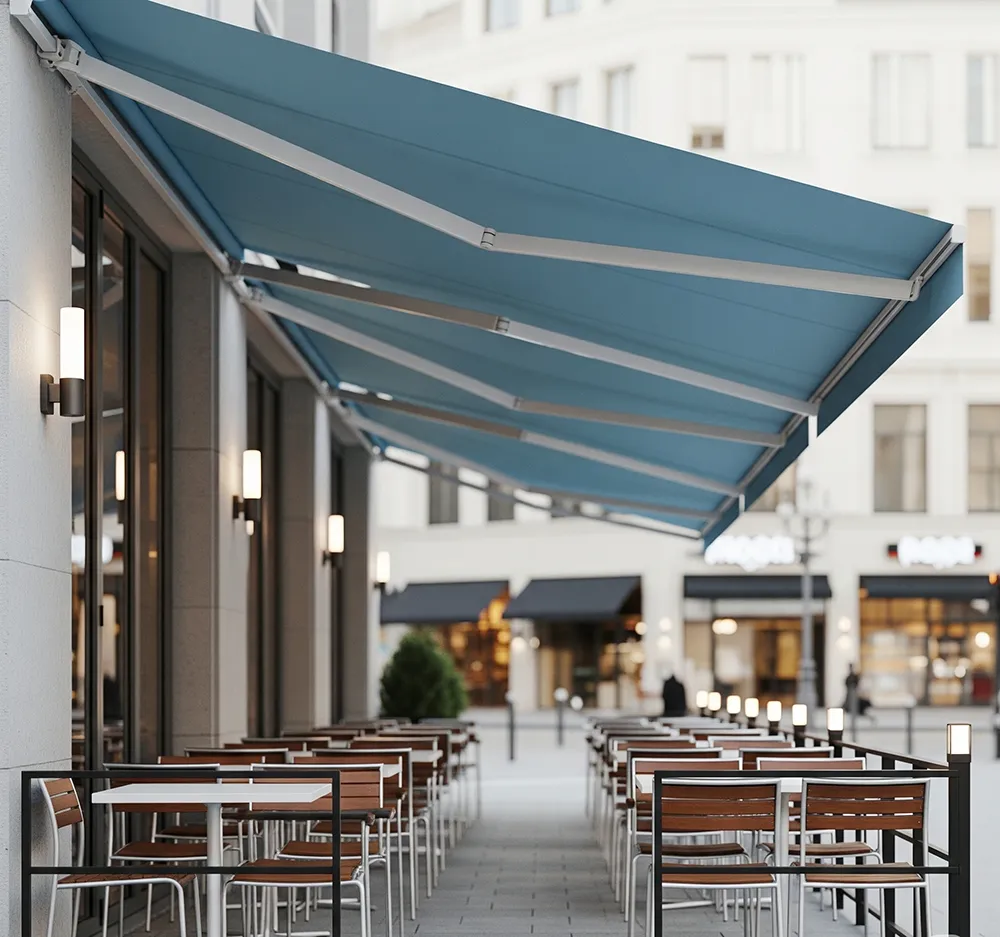
Retractable awnings with fire-rated fabric, sized to the sidewalk permit. Retractability matters commercially: you can open the patio to sun at lunch, cover it at two, and roll everything in before a wind warning.
If the comparison lands you on fabric that folds away, the awning page covers sizes, motors, sensors and what the install day looks like.
Frequently Asked Questions
EL
Eugene Ladizinsky
CFO & COO, co-owner of ROLLerUP
Eugene co-owns ROLLerUP, the Newmarket company behind Shading Solutions by ROLLerUP. Every guide on this site is written with our installers and checked against our own job records before it is published. About ROLLerUP.
More about retractable awnings
Retractable awnings guides
Compare options
Read next
- Awning fabric guide: acrylic, polyester, colours and how long it lasts
- Awning maintenance: cleaning the fabric and winter storage
- Awnings for decks: retractable options and what fits
- Awnings over doors and entries: fixed or retractable?
- Awnings for balconies and condos
- Benefits of retractable awnings, and their limits
Get a free on-site estimate
We measure your patio, tell you which option actually fits it, and price it in writing – call (289) 270-5747 or visit the Newmarket showroom at 1151 Gorham St, Unit 8, weekdays.