
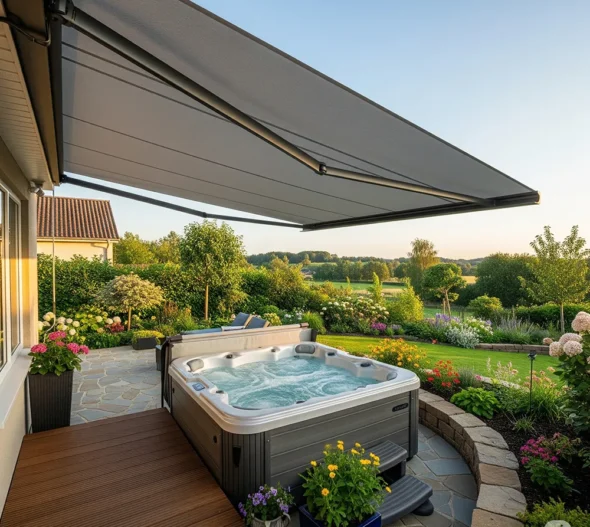
A retractable awning gives you shade on demand over a patio or deck, keeps the room behind the glass cooler through the hottest part of the day, and protects furniture and flooring from sun fade. It is not a rain roof, it is not built for winter loads, and it needs a sound wall or fascia to mount to.










Shade on demand, and what that actually buys you
If you're researching retractable awnings for your home, the real question isn't just what they do, it's what they still won't do once installed. An awning is the fastest way to turn a bright, unusable patio into a shaded one. Push a button or turn a crank and the fabric extends over the space in moments; retract it just as fast when the sun moves or a storm rolls in. Compare that to a fixed structure that commits you to shade, or sun, in one spot, whether you want it or not.
The caveat: an awning only shades what it covers, in the direction it's aimed. A south-facing awning does nothing for a west-facing window two walls over, and a narrow awning over a wide patio leaves the edges bright by mid-afternoon. We measure the sun's actual path across the property before we quote width and projection, not just the size of the opening.
A retractable house awning also protects what's underneath it – furniture, cushions, a wood deck, a hot tub cover – from the kind of sun fade that bleaches fabric and dries out finishes over a few summers. That's a real, visible benefit, but it's passive protection, not insurance. An awning left extended in a windstorm can still take damage, and fabric still fades eventually, just slower than it would with no cover at all.
Cooling the room behind the glass
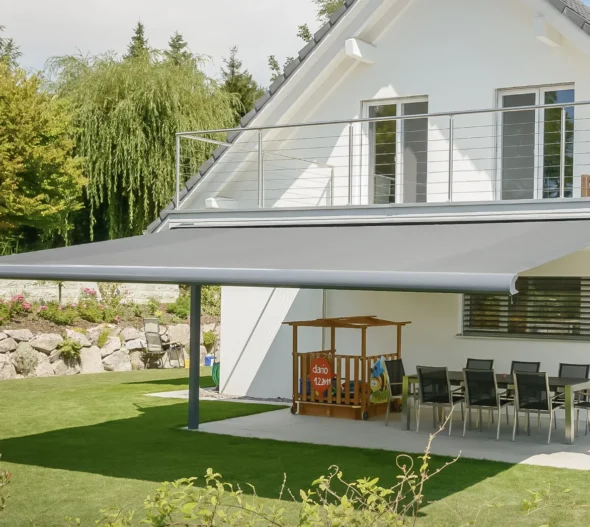
Most of the heat that turns a living room into a greenhouse in July comes through south- and west-facing glass in the afternoon. An awning mounted over that glass intercepts the sun before it reaches the pane, instead of relying on the glass or blinds to deal with heat that's already inside. The room behind a well-placed awning is noticeably cooler by mid-afternoon on a hot day – most homeowners notice it the first sunny stretch after install.
We won't quote a temperature drop or an energy-savings figure here, because it depends on the glass, the orientation, the depth of the awning's projection, and how long it's actually extended during the day. What we can say: the effect comes from blocking direct sun before it hits the window, and the farther the awning projects over the glass, the more of the afternoon it covers.
It won't touch heat that's already radiating off a hot roof or laneway, and it does nothing for east-facing morning sun unless you also cover the east side. If the goal is cooling the whole house, an awning over the worst-offending windows is one piece of that plan, not the whole fix.
An awning shades the glass and the patio directly underneath it – it does not cool a room whose heat is coming from somewhere else.
Awning versus pergola versus no shade
A quick side-by-side for the two structures we install most, across the seasons that matter in Ontario.
| Factor | Retractable awning | Louvered pergola | No shade |
|---|---|---|---|
| Summer shade | On demand, retracts when not needed | Fixed coverage, always there | None |
| Winter | Retracted and stored, no snow load on fabric | Aluminum structure stays up year-round | Not applicable |
| Rain | Not built to hold water weight; retract before real rain | Sheds rain when louvres are closed | None |
| Footprint | Folds flat against the wall when retracted | Permanent posts and footings | None |
| Wind | Retracts in wind; sensors available on motorized units | More stable in wind, it's a fixed structure | Not applicable |
| Upfront cost | Lower than a permanent structure | Higher, it's a built structure with footings | None |
A louvered pergola is the better pick if you want something that stays up and sheds rain without you doing anything.
The limits: what an awning will not do
It is not a rain roof. A fully extended fabric awning can take a light shower, but pooling water on the fabric is exactly what shortens its life and can bend the arms. We tell every customer to retract it before a real rain, not just a drizzle. If you want something to sit out in all weather, that's a different product – a louvered pergola with closable slats, not a fabric awning.
It is not a winter product. We recommend retracting a retractable awning for the season in our service area. Left open, snow load on the fabric will stretch or tear it and can bend the arm mechanism, and ice collecting on an open awning is its own hazard.
It needs a wall or fascia that can actually carry the load. Retractable awnings mount to the building, usually bolted into the wall framing or a reinforced fascia board. Stucco, brick veneer or a weak fascia sometimes need backing added before the bracket goes on – we check this on site before we quote, because a mount that fails is worse than no awning at all.
It is not a bug solution and not a privacy screen. A retractable awning blocks sun and rain falling close to straight down; it doesn't close off the sides, so wind-blown rain, bugs and a neighbour's sightline all still get through underneath it.
Fabric, motorization and projection – what actually changes the quote
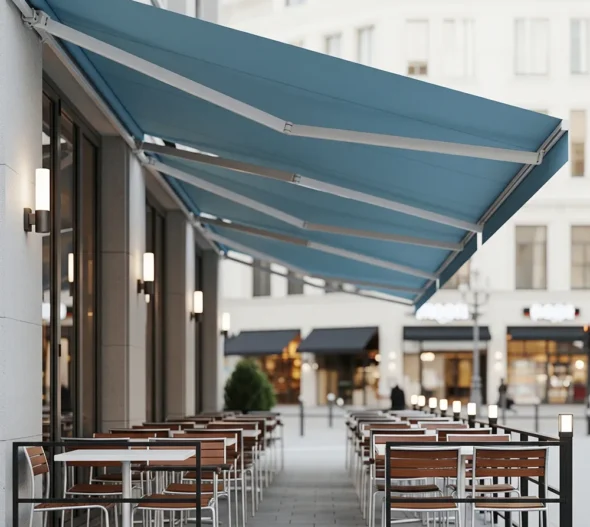
Fabric grade and pattern matter more than most people expect: acrylic and solution-dyed fabrics hold colour differently in Ontario sun, and some options are fire-rated for closer proximity to a barbecue or firepit. We walk through fabric samples on site rather than off a screen, because colour reads differently under real daylight.
Motorized versus manual (hand-crank) is a real trade-off, not just a convenience upgrade. A motor with a wind or sun sensor will retract the awning automatically before a gust does damage, which matters if nobody's home to crank it in. The honest limit: every motorized unit still needs a manual override for when power or the motor fails, so it's never fully hands-off.
Projection and width decide how much of the patio actually ends up shaded, and that's what moves the price more than anything else – a deeper reach over a bigger space needs a stronger arm system. We measure this against the sun's path on your specific property, not a standard chart, before anything is quoted in writing.
Who should buy a retractable awning, and who should not
- Buy one if you want shade over a specific patio, deck or window for most of the year, with the flexibility to retract it.
- Buy one if the wall or fascia you'd mount to is solid, or can be reinforced.
- Buy one if you're prepared to retract it ahead of storms and for the winter.
- Skip it if you want a structure that stays up and sheds rain all year without you doing anything – look at a louvered pergola instead.
- Skip it if there's nowhere solid to mount it and reinforcing the wall isn't an option.
- Skip it if what you actually want is privacy or bug control rather than sun – a screen does that job better.
If the trade-offs make sense for your patio, the next step is seeing sizes, projection and fabric options and getting a real measurement booked.
Frequently Asked Questions

EL
Eugene Ladizinsky
CFO & COO, co-owner of ROLLerUP
Eugene co-owns ROLLerUP, the Newmarket company behind Shading Solutions by ROLLerUP. Every guide on this site is written with our installers and checked against our own job records before it is published. About ROLLerUP.
More about retractable awnings
Retractable awnings guides
Compare options
Read next
- Awning fabric guide: acrylic, polyester, colours and how long it lasts
- Awning maintenance: cleaning the fabric and winter storage
- Awnings for decks: retractable options and what fits
- Awnings over doors and entries: fixed or retractable?
- Awnings for balconies and condos
- Commercial awnings for restaurants and storefronts in the GTA
Get a free on-site estimate
We'll measure your wall, your patio and the sun's path, then give you a written quote – no guessing.