
A balcony awning works well on most condo balconies, but almost always needs board approval before we touch the building envelope. Compact cassette awnings suit tight balconies, side awnings add privacy and cut wind, and if the board won't allow fasteners, a freestanding or screen option is often the honest answer.










What condo and co-op boards usually allow
Most condo and co-op declarations treat the balcony's exterior face, railing and slab as common elements, even though you're the only one who uses them. That means anything that touches the building envelope, a bracket screwed into the fascia, a track fixed to the railing cap, an anchor drilled into the slab, usually needs board sign-off before we touch a drill to it.
What boards tend to approve: awnings that attach with existing railing clamps rather than new penetrations, fabric colours that match or are close to the building's approved palette, and projections that stay inside the balcony line so nothing overhangs the unit below. What they tend to push back on: anything that changes the sightline from the street or courtyard, bright or patterned fabric, and brackets that go into structural concrete without an engineer's letter.
We send the board whatever they'll ask for up front rather than waiting for a second request: a spec sheet with weight and anchor loads, a colour swatch, and sometimes a short engineering letter confirming the load the slab or railing can carry. That paperwork is usually the slow part of a balcony job, not the install itself.
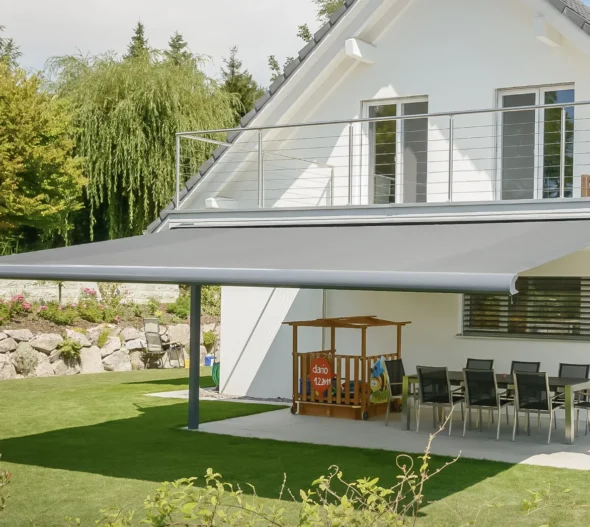
Compact cassette awnings for small balconies
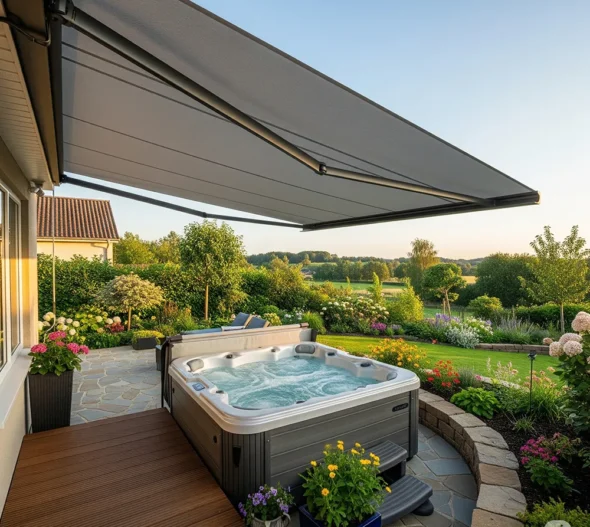
A cassette awning folds the fabric and arms fully inside a closed aluminum housing when it's retracted, so there's no exposed roll sitting on a bare bracket collecting leaves, bird mess and snow. On a narrow balcony that's the difference between an awning that still looks tidy in November and one that looks like a liability the board will eventually ask about.
These mount two ways on a balcony: bolted to the wall above the sliding door, or fixed under the balcony above if you're not on the top floor and the board allows it. Wall mounting is the more common route because it doesn't touch a neighbour's slab or require anyone else's sign-off. The closed housing keeps the fabric dry and out of the wind when it's not in use, which matters more at height than it does on a backyard patio.
They won't give you backyard-size coverage. A cassette unit sized for a balcony shades the table and a couple of chairs, not the whole slab. If full coverage of the balcony is the goal, that's an open-arm system trade-off, and it's a conversation we have honestly at the site visit rather than after the quote.
Side awnings for privacy and wind at height
A side awning, sometimes called a retractable side screen, runs out sideways on a track rather than down and out from the wall. On a balcony that shares a sightline with the unit next door, or sits above a courtyard with foot traffic, it does two things a horizontal awning can't: it blocks the neighbour's view in, and it cuts the crosswind that otherwise makes a horizontal awning flap.
Wind is the real design problem at height, more than it is at ground level. A balcony on the eighth floor sees gusts a backyard patio never will. We spec side screens and arm awnings with that in mind, and above a few storeys we lean toward smaller projections, reinforced brackets, and manual retraction you control yourself rather than relying on an automatic wind sensor alone.
A side awning retracts into a slim case on the railing or wall, so it doesn't block the view or airflow when you don't need it. It's not a wall and it won't stop wind-driven rain; it cuts the sightline and softens a direct gust, nothing more.
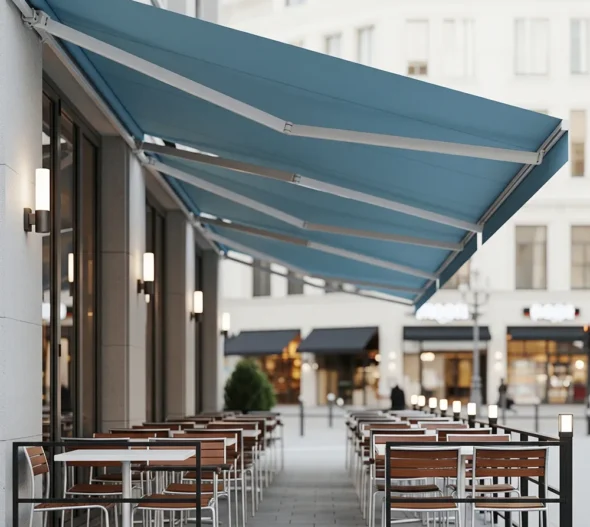
Awning types for balconies, compared
What fits a balcony depends on size, exposure and what the board will sign off on.
| Type | Best for | How it mounts | Honest limit |
|---|---|---|---|
| Compact cassette awning | Small balconies, condo units | Wall above the door, or ceiling where allowed | Shades a table, not the whole slab |
| Open-arm retractable awning | Larger balconies and terraces | Wall or fascia bracket with folding arms | Needs more wall space than a tight balcony usually has |
| Retractable side awning | Privacy and crosswind at height | Track on the railing or wall, runs sideways | Doesn't stop wind-driven rain |
| Freestanding shade | Boards that won't allow any wall fixing | Weighted base, no building attachment | Takes up usable balcony floor space |
When we say no
We'd rather tell you an awning is the wrong fit than sell one that comes back as a complaint to the board.
- The board won't approve any penetration of the slab, railing or façade, and there's no clamp-on option that works for the unit's layout.
- The balcony faces open wind with no adjacent building for a break, and the exposure is high enough that even a reinforced arm system becomes a maintenance headache.
- The façade is under a heritage or design covenant that restricts anything visible from the street, awning included.
- The only available mounting point is a shared slab between two units and the strata won't allow an anchor that crosses the property line.
- The balcony is too narrow for any arm to open without striking the railing or the neighbouring unit's wall.
What balcony awnings cost
Supplied and installed, real jobs since 2022 have ranged from $2,900 to $21,900 for retractable awnings, condo and balcony installs included. Every project is different, and a balcony job usually lands toward the lower half of that range because the openings are smaller than a backyard patio. We've completed 3 installs in Newmarket alone, several of them on condo and townhome balconies.
What moves the number up or down on a balcony job in particular: the projection and width needed, whether it's motorised or hand-crank, whether the board requires an engineering letter for the bracket, the fabric grade chosen, and how much access our crew has to the unit.
- Opening size and projection
- Motorised vs. manual operation
- Board-required engineering sign-off
- Fabric grade and colour
- Site access and height of the balcony
A balcony awning is not a replacement for a wall: it blocks sun and softens crosswind, it does not stop wind-driven rain or carry snow load, and every unit we install still needs to be retracted before a storm.
If your balcony can take a wall-mounted arm system, our retractable awnings page covers sizing, motorisation and fabric options in full.
Frequently Asked Questions

EL
Eugene Ladizinsky
CFO & COO, co-owner of ROLLerUP
Eugene co-owns ROLLerUP, the Newmarket company behind Shading Solutions by ROLLerUP. Every guide on this site is written with our installers and checked against our own job records before it is published. About ROLLerUP.
More about retractable awnings
Retractable awnings guides
Compare options
Read next
- Awning fabric guide: acrylic, polyester, colours and how long it lasts
- Awning maintenance: cleaning the fabric and winter storage
- Awnings for decks: retractable options and what fits
- Awnings over doors and entries: fixed or retractable?
- Benefits of retractable awnings, and their limits
- Commercial awnings for restaurants and storefronts in the GTA
Get a free on-site estimate
We'll measure your balcony, flag what the board will likely ask for, and quote everything in writing before anything is installed.