

A tracked retractable canopy can turn an existing wood or aluminum pergola into shade on demand, but only if the beams are spaced and anchored to carry a loaded aluminum track. We check the frame first, fit waterproof or shade fabric to match the use, and build in pitch so rain runs off instead of pooling on the fabric.












Fitting a canopy to an existing pergola: what we check
A retractable canopy is only as good as what it is bolted to. Before we quote anything, we measure the opening and look hard at the beams themselves: species and condition on a wood pergola, wall thickness and post spacing on an aluminum one. The tracks that guide the fabric carry real load once wind catches an extended canopy, and that load has to go somewhere solid, not into a beam that is already cupping or checked from years of weather.
On a wood pergola we look for rafters spaced closely enough and sized deep enough to take a through-bolted bracket, and we check whether the beams are structural or just decorative trim sitting on a ledger. On an aluminum pergola the question is usually post-to-post width and whether the top rail was ever meant to carry anything beyond its own roof slats. Either way, the retrofit has to anchor into the pergola's real structure, not into whatever happens to be on top.
Where the spacing or the timber will not hold a loaded track, we say so before we quote rather than after we install. Sometimes that means adding a cross-member or sistering a rafter to get the structure to where it needs to be; sometimes it means the retrofit is not the right answer and a new aluminum frame, built with the canopy engineered in from the start, is the straighter path.
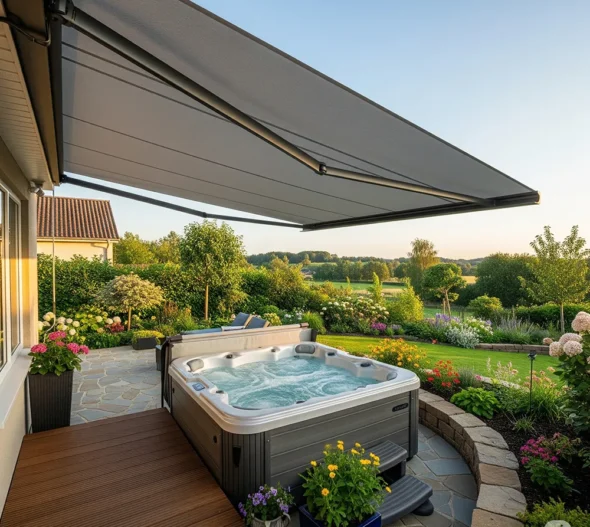
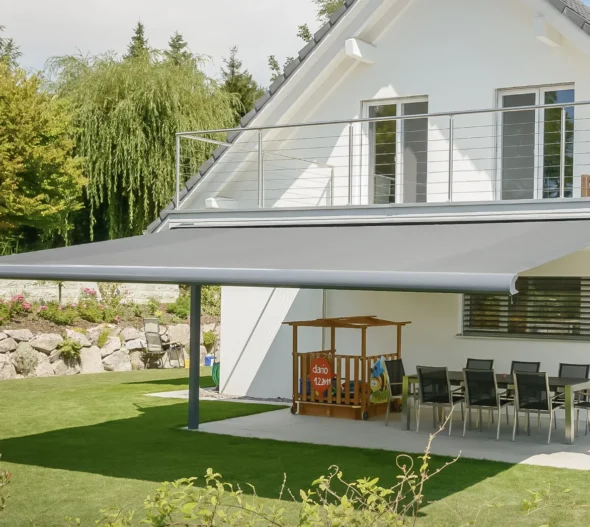
Waterproof versus shade fabric: what waterproof honestly means
Shade fabric and waterproof fabric solve different problems and they are not interchangeable. A shade fabric, whether it is a mesh or a solution-dyed acrylic, blocks sun and lets air pass through. It will shrug off a light drizzle but it is not built to hold water, and it will let a steady rain through eventually. A waterproof canopy uses a coated or laminated fabric with welded or taped seams, built to be a true roof rather than a sunscreen.
Here is what we will not oversell: even a genuinely waterproof fabric is only as waterproof as the pitch, the side channels, and the seams around it. Flat fabric with nowhere for water to go will pool, stretch, and eventually find a way through a seam. The fabric is one part of the system; the track, the slope, and the edge channel are the rest of it, and all three have to work together before we call anything waterproof.
There is also a condensation reality worth knowing before you buy. A sealed waterproof canopy over a humid Ontario patio in July can sweat on the underside the same way a cooler lid does, especially right after a hot afternoon cools into evening. That is not a leak, it is physics, and it is one more reason we talk through actual use with every homeowner before recommending which fabric type to run.
Pitch and drainage: getting the slope right
A canopy fabric needs a slope to shed water, and on a pergola that slope is built into the track height, not the fabric. We set one end of the track run higher than the other so that closed fabric sheds toward a gutter channel instead of lying flat. Without that pitch, water sits on the fabric in a shallow pool after every rain, and a pool that sits long enough will find the lowest stitch or seam.
The drainage channel at the low edge matters as much as the pitch itself. A channel that is too shallow overflows in a heavy downpour; one with no downspout just dumps water along the pergola's edge onto whatever is underneath, which is usually a dining table or a hot tub. We route the channel to an existing downspout or a discreet new one wherever the structure allows it.
Leaves, pine needles, and the odd tennis ball collect in that channel too, especially under trees in fall. A channel that cannot be reached to clear out becomes a dam instead of a drain, so access for a quick clean each season is part of how we plan the install, not an afterthought.
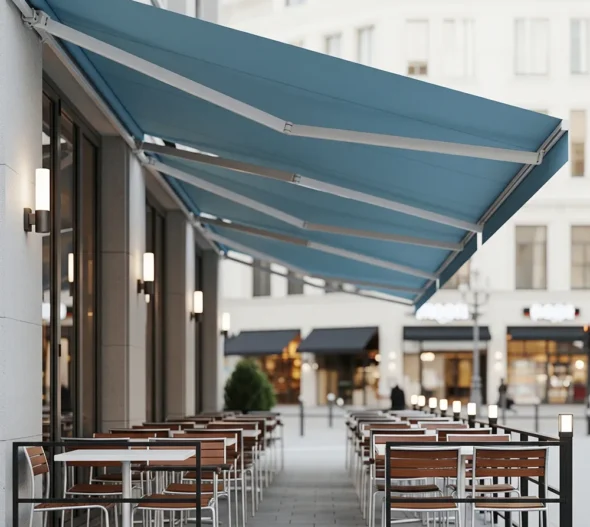
Canopy on an existing pergola versus a new louvered pergola
Both turn an open structure into controllable cover. The right one depends on what your current frame can take and how much weather control you actually want.
| Factor | Canopy on existing pergola | New louvered pergola |
|---|---|---|
| Structure needed | Must already be sound and correctly spaced | Built to the canopy's tolerances from the start |
| Rain performance | Good with pitch and channels, not a sealed box | Angled aluminum louvers seal closed against rain |
| Look when open | Fabric stacks at one end, rafters bare | Louvers rotate flat, structure stays visible |
| Winter handling | Retract fabric before snow load | Louvers close or retract depending on the design |
| Install complexity | Depends on retrofitting brackets to existing beams | Simpler, tolerances matched to the system |
| Best fit | A sound pergola that just needs shade on demand | A tired or undersized frame, or year-round use |
Retract the canopy before the first real snowfall; loaded fabric sitting under snow is the single most common cause of torn seams and bent track we see each spring.
Signs your pergola will not take a retrofit canopy
A few things we flag on site before we ever write a quote.
- Rafters that flex noticeably when you push up on them by hand
- Beam spacing wider than the track system is engineered to bridge
- Visible rot, cupping, or splitting at the ends of wood beams
- A lattice or decorative top that was never meant to carry weight
- Posts that are already out of plumb or a base that has shifted
- A structure built for looks rather than to hold a loaded roof system
Winter: retract it
The fabric on a retractable canopy is engineered to flex open and shut, not to carry a snow load while extended. Leave it open through an Ontario winter and wet, heavy snow will stretch the fabric past its memory, strain the arms or track hardware, and in a hard freeze-thaw cycle can crack a seam that was fine all summer.
Retracting takes under a minute once the structure is set up right, whether it runs on a wall switch, a remote, or a hand crank. We set every canopy up so that closing it for winter, or just for an overnight storm, is something the homeowner can do without a toolbox or a ladder.
If your pergola is sound and you want to see what a tracked canopy looks like on a frame like yours, our pergola canopy page covers the fit, the fabric options, and how we measure for an existing structure.
Frequently Asked Questions
EL
Eugene Ladizinsky
CFO & COO, co-owner of ROLLerUP
Eugene co-owns ROLLerUP, the Newmarket company behind Shading Solutions by ROLLerUP. Every guide on this site is written with our installers and checked against our own job records before it is published. About ROLLerUP.
More about retractable awnings
Retractable awnings guides
Compare options
Read next
- Awning fabric guide: acrylic, polyester, colours and how long it lasts
- Awning maintenance: cleaning the fabric and winter storage
- Awnings for decks: retractable options and what fits
- Awnings over doors and entries: fixed or retractable?
- Awnings for balconies and condos
- Benefits of retractable awnings, and their limits
Get a free on-site estimate
We measure your pergola in person before we quote a canopy, with a 5-year warranty, in writing, on every install.