

Commercial awnings cover two jobs: a fixed, branded canopy over a storefront entrance that stays up year-round, and a larger retractable awning over a restaurant patio that opens for shade and closes for wind, rain or winter. Which one you need depends on your sign bylaw, your lease, and how much patio season matters to your business.










What counts as a commercial awning
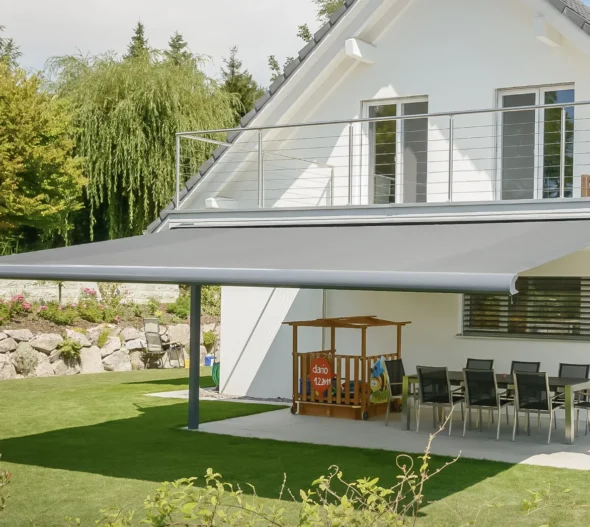
People use the phrase commercial awning for two very different products, and mixing them up is where most budgets go sideways. A storefront awning is almost always fixed: a frame bolted to the building, fabric stretched over it, your logo on the valance, up all year. A restaurant patio awning is almost always retractable: a wide span of fabric on an arm system that extends for shade and pulls back when the wind rises or the season ends.
Plenty of businesses need both. A coffee shop might run a small fixed canopy over the door for weather protection and branding, and a separate retractable awning over the patio seating so it can close completely in November. Treating them as one product leads to the wrong quote and, sometimes, the wrong structure for the opening.
In Ontario the climate makes the choice sharper than it looks in a brochure. A fixed canopy sees snow load and ice all winter with no way to relieve it. A retractable awning over a patio has to come down before a storm, which means someone, or a sensor, has to make that call every time the sky changes.
Fixed storefront awnings: frame, fabric and graphics
A fixed storefront awning starts with an aluminum frame cut and squared to the exact opening, then anchored into solid backing behind the cladding. We check what is actually holding the bracket before we commit to it: brick, block and wood framing all take fasteners differently, and a thin fascia board over nothing will not hold a canopy through a windy spring. Where the substrate is weak we reinforce it first. The frame is Made in Canada aluminum, not steel, and nothing about it is painted to look like something it is not.
The fabric is stretched over the frame and locked into a channel so it sits drum-tight rather than sagging after a season of rain. For a store awning, the fabric is also the sign: most storefront awnings carry a logo, a name and sometimes a tagline, either heat-applied as a graphic panel or worked into the valance seam. Large, busy graphics on a small awning read as clutter from the sidewalk; we size type and logo marks to the valance depth, not to what looks good on a screen.
There is no motor and nothing to operate on a fixed canopy, which is the whole appeal for a storefront that just wants weather protection and a sign that never needs charging or servicing beyond a wash. The trade-off is that it cannot retract: it takes whatever the season brings, which is why pitch, drainage and anchoring matter more here than on almost any other product we install.
Retractable awnings over a dining patio: span, motor, sensors
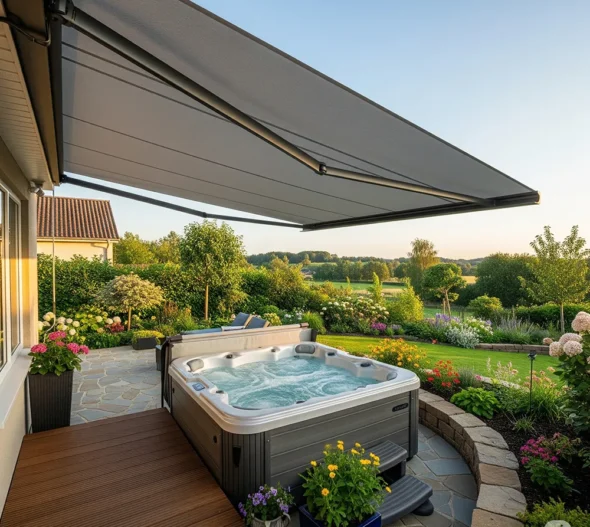
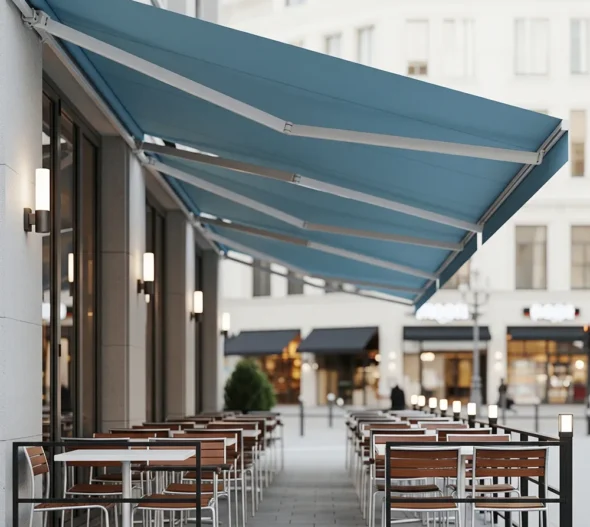
A patio awning for a restaurant has to cover real seating, so the span and the projection both matter: a deeper reach over a larger patio needs a stronger arm system, full stop. We measure the opening on site, check what the mounting wall or fascia can actually carry, and size the arm system to the load before we talk about colour or fabric.
On a commercial patio we rarely recommend hand-crank operation. Staff need to open and close a wide awning quickly between services, often more than once a day, and a motor with a wall switch or remote is the practical choice. Wind and sun sensors are worth adding on any patio awning that will be left unattended overnight or during a shift change, since they retract the awning automatically before a gust does it for you, badly.
Fabric for a restaurant patio works harder than fabric on a backyard deck: more sun hours, more grease and smoke drift if there is a grill nearby, more hands brushing past it. Solution-dyed acrylic fabrics hold their colour and resist mildew better than printed ones under that kind of use. Lighting can be integrated into the awning housing for evening service, which is a real feature, not a gimmick, on a patio that turns over tables after dark. What a retractable awning will not do is replace a permanent roof: it is shade and light weather cover, not a four-season room.
Fixed versus retractable for a business
The honest comparison, not the sales pitch.
| Fixed storefront awning | Retractable patio awning | |
|---|---|---|
| Movement | None, stays extended year-round | Extends and retracts on demand |
| Best for | Entrances, windows, branding | Dining patios, seating areas |
| Wind handling | Takes the load as-is | Retracts before a storm or gust |
| Signage space | Primary branding surface | Secondary at best |
| Winter | Left up, carries snow load | Usually retracted and closed |
| Daily operation | None required | Motor switch, or automatic by sensor |
| Typical upkeep | Wash, re-tension fabric over time | Wash, check motor and arms, re-tension |
Permits, signage and your landlord
The questions worth asking before you order anything.
- Your local sign bylaw usually governs the size, lighting and wording allowed on a storefront awning, separate from the awning structure itself.
- If the awning projects over a public sidewalk, the municipality may require an encroachment agreement before anything is installed.
- If you lease the space, your landlord almost always has to approve the install in writing, since the frame is bolted to the building, not the tenant's fit-out.
- Plazas and condo-anchored retail blocks often layer their own design rules on top of the municipal bylaw, covering colour, frame style or signage placement.
- A retractable patio awning over outdoor seating may also trigger a separate patio permit from the municipality, which is unrelated to the awning permit itself.
- We do not file the permits for you, but we give you the measurements, drawings and spec sheet your landlord or the municipality will ask for.
Maintenance and the service plan
A commercial awning sees more grime in a season than a residential one does in several: street dust, exhaust from traffic, grease from a nearby kitchen vent. A monthly rinse with a hose and a soft brush keeps most of that from setting into the fabric, and it is worth doing more often on a patio right beside a grill or fryer.
Every install we do, storefront or patio, carries a 5-year warranty, in writing, and we come back to service it: re-tensioning fabric as it ages, checking motor and sensor function on a retractable, and replacing covers or hardware when they wear out rather than waiting for a failure during a dinner rush. Who covers which part of that upkeep under a lease is worth settling with your landlord before the install, not after the first storm.
What we will not do is install a wide retractable patio awning without wind protection, whether that is a sensor or a strict staff procedure for closing it, because a business that forgets to retract it once in a real wind event usually only forgets once.
If a patio awning cannot come down before a wind event, by sensor or by someone's job description, it is not ready for commercial use yet.
If what you actually need is a permanent, branded canopy over a door or window rather than a retracting patio structure, read our full page on fixed awnings for the frame, fabric and mounting detail.
Frequently Asked Questions

EL
Eugene Ladizinsky
CFO & COO, co-owner of ROLLerUP
Eugene co-owns ROLLerUP, the Newmarket company behind Shading Solutions by ROLLerUP. Every guide on this site is written with our installers and checked against our own job records before it is published. About ROLLerUP.
More about retractable awnings
Retractable awnings guides
Compare options
Read next
- Awning fabric guide: acrylic, polyester, colours and how long it lasts
- Awning maintenance: cleaning the fabric and winter storage
- Awnings for decks: retractable options and what fits
- Awnings over doors and entries: fixed or retractable?
- Awnings for balconies and condos
- Benefits of retractable awnings, and their limits
Get a free on-site estimate
We measure your storefront or patio on site and give you a written quote before anything is ordered.