
A motorized awning swaps the hand crank for a tube motor hidden inside the roller, so you open and close it with a remote, wall switch or app. Add a wind sensor and it retracts itself before a gust hits. The trade-off: it needs power, an electrician, and a manual override for outages.












What the motor actually changes
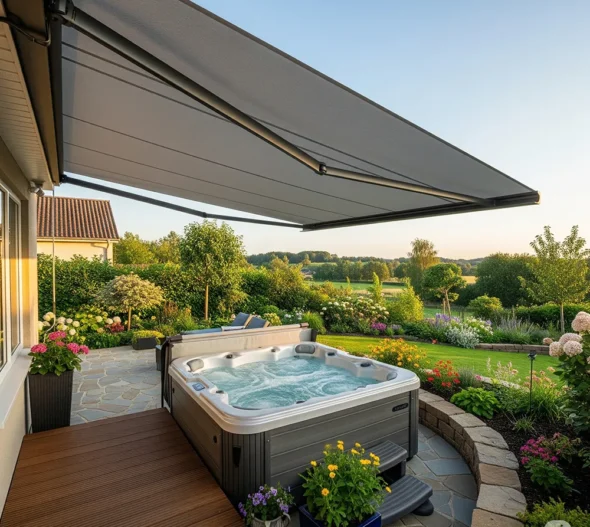
The motor sits inside the roller tube itself – the same aluminum tube the fabric winds onto – so from the outside you cannot tell an awning is motorized except that there is no crank handle sticking out of the end cap. It is a tubular motor, not a separate gearbox bolted somewhere, and it runs on standard household voltage through a cable that exits the housing and runs to a junction box or outlet.
Motors are sized to the job, not sold as one-size-fits-all. A narrow, shallow awning needs less torque than a wide one with a deep projection, because the arms have more fabric and more leverage to pull against as they open and close. We match the motor to the width and projection we are actually installing, not to whatever unit happens to be in stock, because an undersized motor strains, runs hot, and fails early.
What we will not do is bolt an aftermarket motor kit onto an existing manual awning that was never designed to carry one. The arm springs, the fabric tension and the end caps on a hand-crank unit are built around a person turning a crank slowly – add a motor and you can rack the fabric or snap a cassette. If you want to go electric, it is almost always a new unit, not a retrofit.
Remotes, wall switches and app control
Every motorized awning we install comes with at least a basic handheld remote. From there, most homeowners add one of two things: a wall-mounted switch wired into the same circuit as the motor, which is the simplest option for a single awning on a patio door, or a multi-channel remote that also runs a retractable screen or a second awning from one handset.
App control adds a small hub that talks to the motor over radio frequency and bridges it to your home Wi-Fi. From the app you can open or close the awning from anywhere, set a schedule, or group it with other shading on the same account. The honest limit here is that it depends on your home network and the hub staying powered – if your router is down, the app loses the awning until it comes back, though the physical remote and wall switch keep working regardless.
- Handheld remote – standard with every motorized unit
- Wall switch – hardwired, no batteries, good for a single fixed location
- Multi-channel remote – one handset for several motorized products
- App control via hub – schedules, remote access, voice assistant pairing
- Keypad or timer accessories – less common, available on request
Wind and sun sensors, and their honest limit
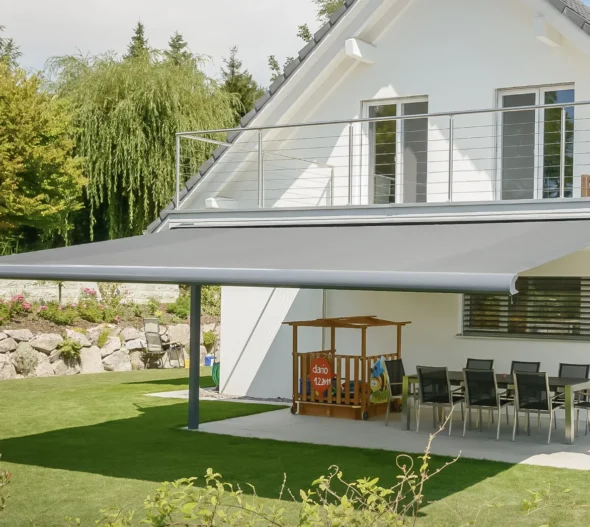
A wind sensor is the one add-on we recommend to almost everyone who motorizes an awning. It reads wind speed continuously and sends a retract signal once gusts cross a threshold you set, so the awning pulls itself in before the fabric and arms take a hard load. This matters most when nobody is home to see the wind come up, which in Ontario can happen fast on a summer afternoon.
A sun sensor works the other way – it reads light level and extends the awning automatically once direct sun hits a set intensity, then retracts it again as the sun drops or clouds roll in. It is a comfort feature more than a protection one, and in our experience it gets used less consistently here than in climates with longer unbroken sun, simply because Ontario skies change often enough that the awning can end up cycling more than people want.
The honest limit on both sensors: they react to current conditions, they do not predict a storm. A sudden downburst can outrun the retract cycle on a very wide awning, and a sensor does nothing during a power outage. We still treat the wind sensor as close to mandatory on anything over roughly four metres wide, because the cost of one torn fabric panel after a storm is more than the sensor itself.
Manual versus motorized awning
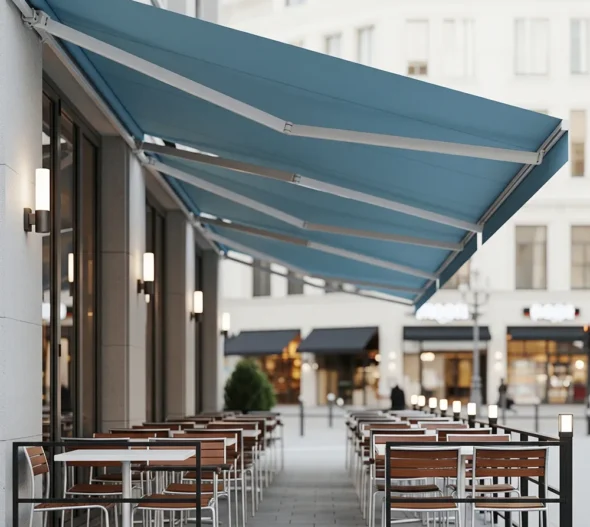
The frame, fabric and arm system are the same either way – this is purely about how you operate it.
| Factor | Manual (hand-crank) | Motorized |
|---|---|---|
| Everyday operation | Crank handle, a bit of arm effort | Push a button, remote, switch or app |
| Wind response | You have to notice and retract it yourself | Wind sensor can retract it with nobody home |
| Install complexity | No wiring, faster install | Needs a power run, sometimes an electrician |
| Upfront cost | Lower | Higher – motor, wiring, sensors add cost |
| Power outage | Works the same regardless | Needs the manual override crank |
| Best suited to | Small to mid awnings, simple budgets | Wide awnings, hard-to-reach cranks, daily use |
Power, the electrician, and the manual override
A motorized awning needs a dedicated power source near the housing – either a weatherproof outlet or a hardwired junction box, run to code. We measure and position the motor and cable exit on site, then coordinate the run with a licensed electrician; we install and wire the awning itself, but the permanent electrical connection into your home's panel is electrical work and we treat it that way rather than cutting a corner.
Every motorized awning we sell keeps a manual override built into the motor tube – a small crank point that lets you retract the awning by hand if the power is out or the motor fails. It is slower and stiffer than turning a true manual crank, but it means a storm during an outage does not leave the fabric stuck out with no way to bring it in.
Nobody we install for has asked for battery backup on an awning motor, and we do not sell it as a line item – these are hardwired units built to run off household power, not off a battery that needs its own maintenance cycle.
What motorization adds to the cost
Supplied and installed, real jobs since 2022 have ranged from $2,900 to $21,900. Every project is different, and where yours lands in that range depends on a handful of real factors, not a flat per-foot rate.
- Projection and width – a deeper reach over a larger patio needs a stronger arm system
- Manual versus motorized operation, and whether wind or sun sensors are added
- Fabric grade and pattern – acrylic and solution-dyed fabrics carry different costs
- Whether the mounting wall or fascia needs reinforcement before the bracket goes on
- Access and height of the install on the building
- Frame colour or finish chosen to match the home
- Whether lighting or heating is built into the awning housing
If you only add one accessory to a motorized awning, make it the wind sensor – it is the one feature that protects the fabric and arms when nobody is there to react.
If you are ready to see widths, projections and finishes side by side, our retractable awnings page has the full lineup and specs.
Frequently Asked Questions
EL
Eugene Ladizinsky
CFO & COO, co-owner of ROLLerUP
Eugene co-owns ROLLerUP, the Newmarket company behind Shading Solutions by ROLLerUP. Every guide on this site is written with our installers and checked against our own job records before it is published. About ROLLerUP.
More about retractable awnings
Retractable awnings guides
Compare options
Read next
- Awning fabric guide: acrylic, polyester, colours and how long it lasts
- Awning maintenance: cleaning the fabric and winter storage
- Awnings for decks: retractable options and what fits
- Awnings over doors and entries: fixed or retractable?
- Awnings for balconies and condos
- Benefits of retractable awnings, and their limits
Get a free on-site estimate
We'll measure your space, talk through motor and sensor options, and put a real quote in writing.