
When you search for awning installers near me, you want someone who measures on site, checks your wall and power before the day, and stands behind the work in writing. We design, sell, install and service retractable awnings across Ontario – every job starts with a site visit and ends with a tested, 5-year warranty in writing.










Before installation day: the measure, the wall, the power
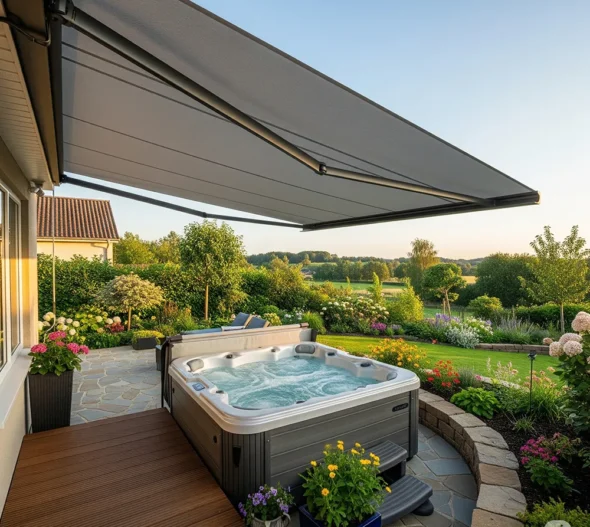
Nothing gets scheduled until we've stood on the actual patio. The measure confirms the opening width, the projection the arms need to clear furniture or a hot tub, and the clearance above the awning when it's retracted so it doesn't foul a gutter, a soffit light, or an eavestrough downspout. We also check what's directly above and below the mounting line – overhead wiring, a low roof overhang, or a walkway that the fabric would hang over once extended.
The wall itself gets as much attention as the opening. Brick, siding, stucco and fascia all take an awning bracket differently, and we're looking for the structure behind the finish, not just the finish. If a header or band board looks soft, undersized, or waterlogged, we flag it before quoting – adding backing or reinforcement is a normal part of the plan, not a surprise invoice later.
Power comes up early too. A motorized awning needs a standard household outlet within reach of the motor housing, or a hardwired run if the homeowner prefers no visible cord. If a sun or wind sensor is going in, it needs its own power or a clean line of sight, and that's worth deciding before the install crew shows up rather than on the day itself. Once the measure, wall and power are settled, the quote is written, and the installation gets booked.
Installation day, step by step
A single retractable awning is usually a one-visit job. Here's the order it happens in.
Walkthrough and final check
We re-confirm the opening matches the original measure, mark the exact bracket locations in chalk, and lay down protection over the patio surface, deck boards or planting bed below the work area.
Mounting the brackets
Brackets go in according to the wall type – brick, siding, stucco or fascia each take a different anchor and a different depth, which is why the pre-visit assessment matters more than the install itself.
Hanging the awning body
The roller tube and arms are lifted into the mounted brackets, levelled, and secured so the awning hangs square to the wall rather than tilted toward one side.
Wiring the motor
The motor is connected to the prepared power source and the rotation direction is tested before the fabric is ever fully extended, so nothing runs backward under load.
The test cycle
We run the awning open and closed repeatedly, watching for drooping, binding, or uneven arm tension, and adjust the pitch so water sheds off the front rather than pooling in the fabric.
Clean-up and handover walkthrough
Debris and packaging leave with the crew, and the homeowner gets a hands-on walkthrough of the remote, the manual override, and basic care before anyone signs off.
Wall types and how we fix to each
The fastener is never one-size-fits-all – it's chosen for what's actually behind the finish surface.
| Wall type | What we check | Fastener approach |
|---|---|---|
| Brick or block | Mortar joint condition, header depth | Masonry anchors set into solid brick or block, never into mortar alone |
| Vinyl or aluminum siding | The structural wall behind the siding | Brackets go through the siding into the framing or sheathing behind it; siding itself is never the fix point |
| Stucco or EIFS | Depth of the foam layer, condition of the lath | Long anchors through the stucco into solid framing, sometimes with a backer board added first |
| Wood fascia or trim | Fascia thickness and any rot | Lag fasteners into the rafter tails behind the fascia, not into the fascia board alone |
| Poured concrete | Surface flatness, rebar location | Concrete anchors set with a hammer drill, after checking for rebar in the drill path |
If none of these come back solid, we add reinforcement before the bracket goes in – a loose fix point is the single most common cause of a sagging awning later.
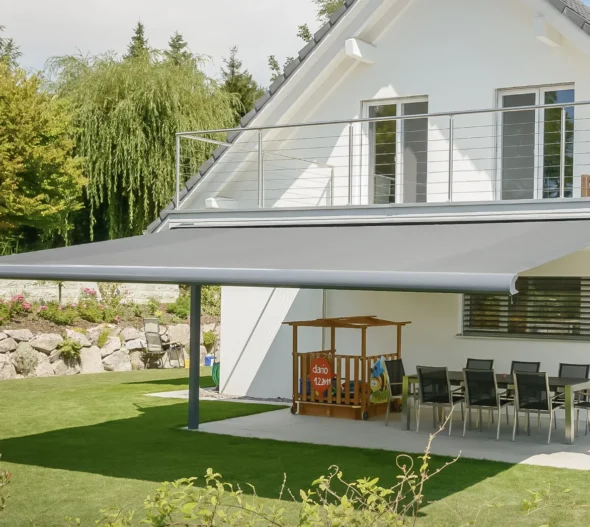
The handover: remote, sensor and warranty in writing
Once the test cycle looks right, we walk through the controls with whoever will actually use the awning day to day. That means programming the remote, setting up the sun or wind sensor if one was ordered, and showing the manual crank override for the rare case the motor loses power. Nobody should be guessing at a button layout a week after we've left.
Paperwork follows the hardware. The homeowner gets the measurement sheet matched to the actual opening, the written quote that was agreed to before work started, and the 5-year warranty in writing covering the components and the installation itself.
We're candid about what the warranty doesn't cover. It doesn't cover an awning left extended through a windstorm, fabric fading that's purely cosmetic and within normal range, or damage from someone other than our crew adjusting the arms or motor settings after install. Those limits are spelled out on the handover paperwork, not buried in fine print.
What can delay installation day
Weather is the most common one. Wind strong enough to make it unsafe to fully extend the fabric for the test cycle, or rain heavy enough to soak the mounting surface, means we reschedule rather than rush a bracket into a wet wall.
Wall surprises are the second. Even with a careful pre-visit assessment, opening up a fascia or stucco surface sometimes reveals rot, old wiring, or framing that isn't where the drawings say it should be. When that happens, we stop, explain what we found, and agree on the fix before drilling continues.
Access is the third. A second-storey mount that needs a lift, dense landscaping right under the work area, or a condo board that requires a booked elevator and a certificate of insurance can all push a start time later in the day. None of this is unusual – it's just worth knowing about before the crew is standing on the daneway.
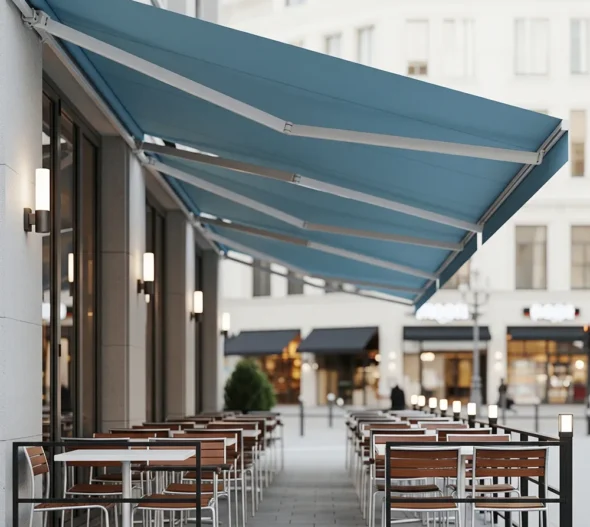
If the wall won't hold a fastener without flexing, we stop and reinforce the structure first – a loose bracket, not the fabric or the motor, is the thing that eventually fails.
If you're ready to see sizes, arm options and what actually moves the price on a retractable awning, that's laid out in full on the product page.
Frequently Asked Questions
EL
Eugene Ladizinsky
CFO & COO, co-owner of ROLLerUP
Eugene co-owns ROLLerUP, the Newmarket company behind Shading Solutions by ROLLerUP. Every guide on this site is written with our installers and checked against our own job records before it is published. About ROLLerUP.
More about retractable awnings
Retractable awnings guides
Compare options
Read next
- Awning fabric guide: acrylic, polyester, colours and how long it lasts
- Awning maintenance: cleaning the fabric and winter storage
- Awnings for decks: retractable options and what fits
- Awnings over doors and entries: fixed or retractable?
- Awnings for balconies and condos
- Benefits of retractable awnings, and their limits
Get a free on-site estimate
Book a measure at our Newmarket showroom or on site – call (289) 270-5747.