

Awning cleaning means brushing off debris, hosing the fabric fully extended with mild soap and water, and letting it dry completely before retracting. Never use bleach, a pressure washer up close, or a stiff brush on acrylic fabric. Clean twice a year and after pollen or bird mess; mildew needs a specific mix, not harsher soap.









Cleaning the fabric without wrecking it
Extend the awning fully and start with a soft brush or broom to knock off loose leaves, pollen, and bird droppings. Most of what stains acrylic fabric is debris left to bake in the sun, not the fabric itself failing. Do this before you add any water.
Mix a mild soap (dish soap works, nothing with bleach or ammonia) in lukewarm water and sponge the fabric on both sides, working from the top down. Rinse with a garden hose on a normal setting, not a pressure washer held close – the force can drive water into the stitching and push dirt deeper into the weave instead of lifting it out.
The step everyone skips: let the fabric dry fully, extended, before you retract it. Rolling up damp fabric is the single biggest cause of mildew and musty smells we see on service calls. If it is humid out, run a fan nearby or wait for a dry afternoon.
The frame and arms get a wipe with a damp cloth. Don't spray cleaner into the joints or the motor housing – moisture there is what corrodes connections and trips limit switches. Aluminum arms don't rust, but the hardware and electronics inside them are not sealed against a direct hose stream.
- Mild soap and water only – no bleach, no ammonia, no all-purpose cleaners
- Soft brush or broom for debris, never a stiff wire brush
- Rinse on a normal hose setting, not a pressure washer held close
- Dry fully extended before retracting
- Wipe the frame with a damp cloth, keep water out of the motor housing
Mildew, mould, and stains that soap alone won't shift
Black speckling on acrylic fabric is almost always mildew that got a foothold while the fabric was stored damp or shaded and wet for too long. A mix of warm water with a small amount of mild soap and a cup of white vinegar, left on the spot for ten to fifteen minutes before rinsing, lifts most of it. Scrub gently with a soft brush, rinse thoroughly, and dry fully in the sun – UV helps kill what the cleaning missed.
What we don't recommend: bleach. It can strip colour and break down the fabric's water-repellent coating faster than mildew ever would. If mildew keeps coming back in the same spot, the real problem is usually drainage or airflow – a sagging section pooling water, or a spot that never gets full sun to dry – not the cleaning method.
Fabric that is torn, badly faded in patches, or stiff and cracking at the folds is past the cleaning stage. Acrylic fades gradually with UV exposure over years; that's wear, not something a cleaner fixes.
A seasonal checklist
Four habits, done on a schedule, catch most problems before they become a service call.
Spring: wake it up
Extend fully and inspect the fabric for mildew spots or new tears before the season starts. Check that the awning opens and closes smoothly on the remote or crank, and that it is sitting level – not sagging to one side.
Early summer: clean before the heavy-use season
Do the full soap-and-water clean now, while pollen season is winding down and before patio season peaks. Check the wind sensor if one is fitted – it should trigger retraction in a stiff gust, not just a full storm.
Fall: last clean, then decide on winter
Clean again before putting it away for the season – fabric stored dirty is fabric that mildews. This is also when we decide whether to retract-and-cover, or remove the fabric, based on the site.
Winter: check in periodically
Brush snow load off a protective cover if one is fitted, and don't let ice build up against the housing. If the awning is retracted and uncovered, a quick visual check after heavy snow or ice storms is worth the five minutes.
Common problems: symptom, cause, fix or call
Most of what goes wrong with a retractable awning falls into one of these buckets.
| Symptom | Likely cause | Fix or call a tech |
|---|---|---|
| Fabric sags on one side | Arm tension uneven, or frame shifted at mount | Call – arm tension adjustment is not a DIY job |
| Musty smell, black spots | Rolled up damp or stored dirty | Fix at home – clean and dry fully before next use |
| Torn seam or small rip | UV wear over years, or a branch caught the fabric | Call – seam repair or fabric replacement, done on site or at the shop |
| Won't respond to remote | Dead battery, lost pairing, or a tripped motor limit | Try battery and re-pair first; call if the motor limit needs resetting |
| Jerky or noisy extension | Dry or dirty arm joints | Fix at home – a light lubricant on the joints, not the fabric |
| Motor runs but fabric doesn't move | Clutch or gear issue inside the motor tube | Call – this is an internal motor fault, not user-serviceable |
| Awning retracts on its own in light wind | Wind sensor set too sensitive, or working as intended | Check the sensor setting before assuming it's broken |
Winter in Ontario: retract, cover, or remove
Retract and leave it is fine for most installs through a normal Ontario winter, provided the housing is a boxed cassette that fully seals the fabric when closed. An open-roller awning left retracted all winter is more exposed – snow, ice, and freeze-thaw cycling can work into the roll.
Retract and cover with a fitted protective cover is the middle option, and it's what we recommend for open-roller awnings or anyone in a heavier-snow area. It keeps ice and debris off the fabric without the labour of a full removal.
Remove the fabric entirely is the most protective option and the one we suggest for a first winter after install, or for a fabric that's already a few seasons old and showing wear. It's more work in the fall and spring, but it takes the fabric out of freeze-thaw cycles completely.
What we won't do is leave fabric extended over winter. Snow load on an extended awning is a frame failure waiting to happen – the arms are built to hold tension, not bear a snow load, and a wet, heavy snowfall can bend or snap an arm overnight.
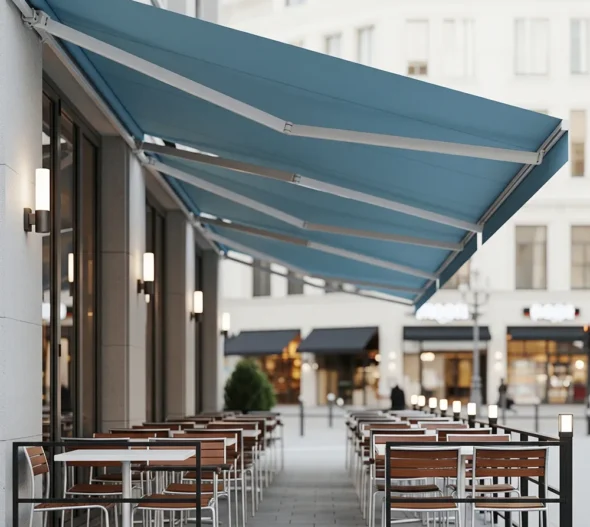
Never leave the fabric extended for winter – snow load is the single fastest way to bend an arm or tear a seam, and it happens overnight, not gradually.
What a service visit actually covers
A service call starts with the whole system, not just the fabric: we check arm tension and alignment, test the motor through a full cycle, inspect the mounting brackets and the wall or fascia they're anchored to, and look at the fabric for tears, stretching, or mildew that cleaning won't fix.
Common repairs are arm realignment after a season of uneven tension, motor limit resets when an awning stops short or runs past its travel, bracket tightening if the mount has started to work loose, and fabric replacement when tears or UV wear have gone past the point of patching.
We also carry and can source parts for awnings we didn't originally install, including older units – lead times depend on where the part comes from. If you're not sure whether your awning needs a clean, an adjustment, or a repair, that's exactly what a service visit is for.
If you're shopping for a new retractable awning rather than maintaining an existing one, our product page covers fabric grades, sizing, and motorisation options.
Frequently Asked Questions
EL
Eugene Ladizinsky
CFO & COO, co-owner of ROLLerUP
Eugene co-owns ROLLerUP, the Newmarket company behind Shading Solutions by ROLLerUP. Every guide on this site is written with our installers and checked against our own job records before it is published. About ROLLerUP.
More about retractable awnings
Retractable awnings guides
Compare options
Read next
- Awning fabric guide: acrylic, polyester, colours and how long it lasts
- Awnings for decks: retractable options and what fits
- Awnings over doors and entries: fixed or retractable?
- Awnings for balconies and condos
- Benefits of retractable awnings, and their limits
- Commercial awnings for restaurants and storefronts in the GTA
Get a free on-site estimate
Book a measure and quote in writing, or ask us about servicing the awning you already have.