
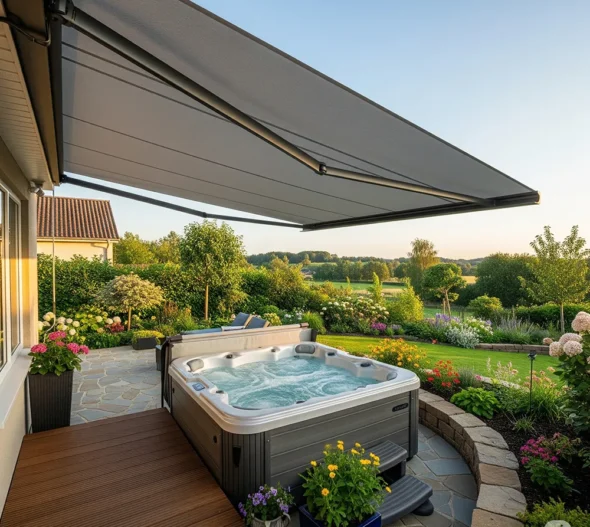
A deck awning is usually a wall-mounted or roof-mounted folding-arm retractable awning that extends over the deck on demand and retracts flat against the house. If there's no sound wall or roofline to mount to, a freestanding frame works instead. The right choice depends on your deck's depth, wall strength, and how much wind exposure the space gets.










How a deck awning mounts: wall, roof, soffit, or freestanding
A folding-arm retractable awning only works as well as what it is bolted to. A wall mount is the most common choice for a deck that sits against the house – the bracket bolts into masonry or into wood sheathing behind the siding, not into the siding itself. If your wall is stucco, EIFS, or thin vinyl with nothing solid behind it, we add blocking first or move the bracket to a better spot. We will not bolt a loaded bracket into a wall we cannot confirm is sound.
A roof or fascia mount is for decks under a roof overhang or a covered porch, where the arms hang off the fascia board or the roof structure instead of the wall below. It needs the same structural check – a thin aluminum fascia with nothing behind it will not hold an extended awning in a gust, so we confirm there is a rafter tail or solid header to anchor to.
Soffit mounting tucks the cassette up under a deep overhang for a cleaner look from below, but it needs solid blocking installed behind the soffit before the bracket goes in – you cannot bolt into a hollow soffit panel.
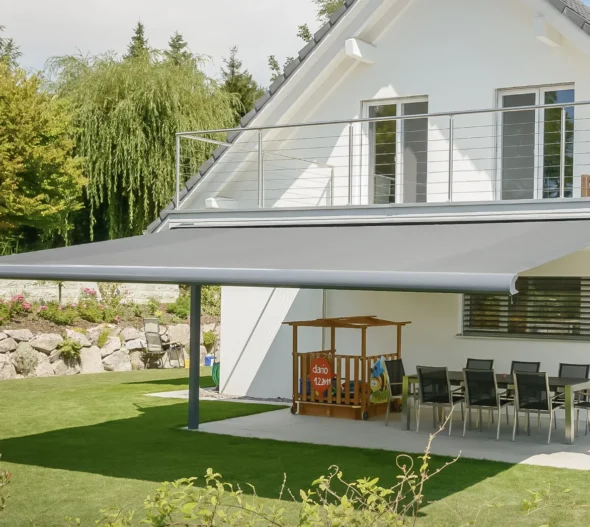
Freestanding frames are for decks with no usable wall at all: floating decks, pool decks, decks ringed by glass or cable railing. The frame is self-supporting, anchored into the deck surface or footings, and does not touch the house. It costs more because you are paying for a structure as well as an awning, but it is the only honest answer on a deck with nothing to bolt to.
Sizing: width versus projection
Width is the horizontal span across the opening you want shaded. Projection is how far the arms reach out over the deck – and this is the number people get wrong most often. A wide awning with shallow projection shades the wall, not the dining table ten feet out from it.
Our retractable awning line runs from a 6 feet minimum width up to 22 feet 11 inches, with a maximum projection of 19 feet 8 inches. Most decks do not need the maximum of either – we measure your deck's actual depth on site and size the projection to clear your furniture with a few feet to spare, not to the wall of the house.
The common mistake is ordering too little projection and leaving the back third of the deck – where the table usually sits by mid-afternoon – in full sun anyway. The opposite mistake, ordering maximum projection on a narrow deck, puts the front edge of the fabric past the railing, which is a wind problem as much as a looks problem.
Mounting options versus deck types
A quick way to see which mount suits the deck you actually have.
| Mount type | Best for | What the structure needs | Not ideal for |
|---|---|---|---|
| Wall-mounted folding arm | Decks against the house with a sound wall | Masonry or wood-sheathed wall that can hold a bolted bracket | Stucco or vinyl siding with no solid backing |
| Roof or fascia mount | Decks under a roof overhang or covered porch | A fascia board or roof structure rated to carry the load | Thin fascia with nothing behind it |
| Soffit mount | Decks with a deep overhang where a clean look matters | Solid blocking behind the soffit before the bracket goes up | Soffits with no accessible framing above |
| Freestanding frame | Floating decks, pool decks, decks with glass or cable railing | A level deck surface or footings to anchor the posts | Small decks where the posts would crowd the space |
Wind, the sensor, and what retracts when
Wind is what actually damages an awning, not sun or rain. An extended fabric catches a gust like a sail, and the force goes straight into the folding arms – that is how arms bend. A wind sensor measures gusts and retracts the awning automatically once wind crosses a set speed, with no one home to do it manually.
A manual, hand-crank awning has no protection built in – it only retracts when someone remembers to crank it in before a storm. We tell people honestly: if you travel, work away from the house during the day, or just forget, motorized with a wind sensor is the difference between an awning that lasts and one that gets replaced early.
Ontario's spring and fall storm fronts move in fast, often faster than a forecast updates. We also tell every customer to retract the awning for winter – the frame handles snow load fine when closed in its cassette, but fabric left extended under snow or ice will sag and can tear.
Second-storey decks and condo balconies: the honest answer
A wall-mounted awning on a second-storey deck still works, provided the wall is sound – but the bracket sits higher and the whole system sees more wind at that height. We size projection more conservatively up there and lean harder on the wind sensor, because a second-storey mount is the last place you want an awning that only retracts manually.
Condo balconies are a different question. Many condo corporations restrict what can be attached to the shared facade, and some do not allow exterior bolting at all. We will tell you upfront if your building is the kind that is likely to say no, before you pay for a design – approval is between you and the board, and we will not promise an outcome we do not control.
Freestanding is sometimes the condo answer, but only if the balcony is large enough and the slab can take the point load of the posts – a small balcony with a tight railing often cannot fit one cleanly.
Fabric and frame colour
Fabric comes in acrylic and solution-dyed options, in solids and patterns, chosen for outdoor fade resistance rather than indoor upholstery fabric. Fire-rated fabric is also available where a condo or municipal rule calls for it. We walk you through the swatch book on site against your actual siding, not a screen.
Frame finish is usually matched to the house trim, the fascia, or the window frames – aluminum takes a painted or powder-coated finish well, and we are not limited to one or two stock colours.
Cleaning is simple but matters: brush off debris and rinse with mild soap and water a couple of times a season, and never retract the awning while the fabric is still wet – folding damp fabric into the cassette is how mildew starts.
If you cannot name the wall, roofline, or deck surface the bracket will bolt to, you are not ready to pick a fabric colour yet – start with the mount.
Once you know roughly how your deck wants to be mounted, the retractable awnings page covers the full range, sizing limits, and what an on-site measure looks like.
Frequently Asked Questions

EL
Eugene Ladizinsky
CFO & COO, co-owner of ROLLerUP
Eugene co-owns ROLLerUP, the Newmarket company behind Shading Solutions by ROLLerUP. Every guide on this site is written with our installers and checked against our own job records before it is published. About ROLLerUP.
More about retractable awnings
Retractable awnings guides
Compare options
Read next
- Awning fabric guide: acrylic, polyester, colours and how long it lasts
- Awning maintenance: cleaning the fabric and winter storage
- Awnings over doors and entries: fixed or retractable?
- Awnings for balconies and condos
- Benefits of retractable awnings, and their limits
- Commercial awnings for restaurants and storefronts in the GTA
Get a free on-site estimate
We measure your deck, check the wall or surface it needs to mount to, and give you a written price – no guessing from photos.