

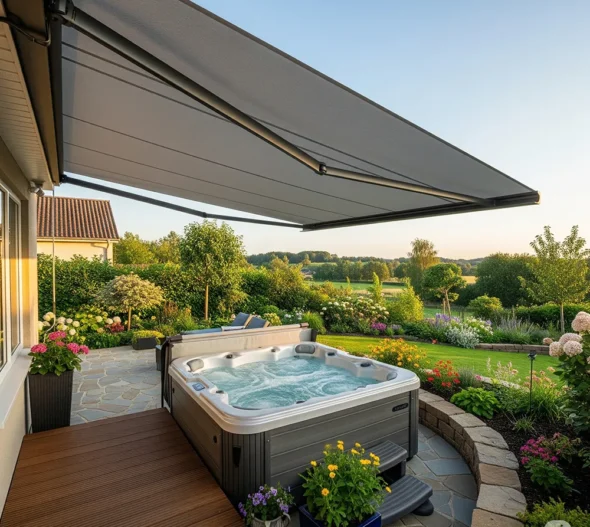
A fixed aluminum awning over a front, side or back door sheds rain and snow off the step and keeps the door itself dry; it's bolted in place and stays up year-round. A small retractable awning makes more sense over a back door that opens onto a patio you want sun on some days and shade on others.










What a fixed entry awning is
A fixed awning over a door is a small aluminum frame, cut and welded to the width of the opening, with an exterior-rated fabric locked into a track so it sits drum-tight across the frame. It's through-bolted to the wall above the door and stays there through every season – there's no motor, no crank and no folding arm to retract it. That simplicity is the point: fewer parts over an entry means fewer things that can fail right where people walk every day.
What it actually carries is more than it looks. The frame has to hold its own through an Ontario winter without sagging, shed wind-driven rain instead of letting it pool on the fabric, and keep its pitch tight enough that water runs off the leading edge rather than dripping straight down onto whoever is standing at the door. The fabric is picked for UV and water resistance, not just colour – a fabric that looks right in a showroom but fades or goes slack over a south-facing door is a bad trade.
Over a door, the job is narrow and specific: keep rain off the person finding their keys, keep snow from drifting against the threshold, and give the entry a bit of definition from the street. It is not shade for a seating area and it is not meant to be adjusted – if you want sun on the step some afternoons and shade on others, that's a different product, which is where retractable comes in.
Sizing and placement over a door
We measure the opening – the door and its trim – and then decide how far past that trim the awning needs to extend on each side so wind-driven rain doesn't just run in around the edges. Over a single door that overhang is modest; over a double door or a door with sidelights it has to be wider, and we check the sightlines from any window above before we commit to a width.
Headroom is the first thing we set, not the last. The leading edge has to clear anyone walking through, clear a storm door swinging open, and still leave enough drop from the top of the frame to the bottom edge that it reads as an awning and not a strip of fabric. Pitch comes next – steep enough that rain and melting snow run off the front edge instead of pooling in the middle of the fabric, which is where a flat-pitched awning fails first.
Then there's where the snow goes. A door awning that sheds its load straight onto the step, a parked car, or the path to the laneway creates a new problem to solve every winter. We look at the roofline above the door too – if there's an eave shedding its own snow onto where the awning would sit, we either move the mounting point or build the frame to take that extra load.
Mounting is a substrate question before it's a design one. Brick and block hold anchors well. Vinyl or aluminum siding and stucco usually do not, and the awning needs to be through-bolted into the framing or masonry behind the cladding, not just screwed into the surface. Where that backing isn't there, we add blocking before the bracket goes up – skipping that step is how awnings come loose in a windstorm.
Fixed versus retractable over an entry
Both are aluminum-framed and both carry a 5-year warranty, in writing – the difference is what each one is built to do.
| What matters | Fixed entry awning | Retractable awning |
|---|---|---|
| Operation | Up year-round, nothing to open or close | Extends and retracts by hand crank or motor |
| Best over | Front door, side door, a window | Back door onto a patio or seating area |
| Snow and winter | Built to carry snow load all winter | Should be retracted before heavy snow |
| Sun control | Shades the same spot always | Open for sun, closed for shade, your choice |
| Moving parts | None – frame and fabric only | Arms, gearbox or motor, fabric roller |
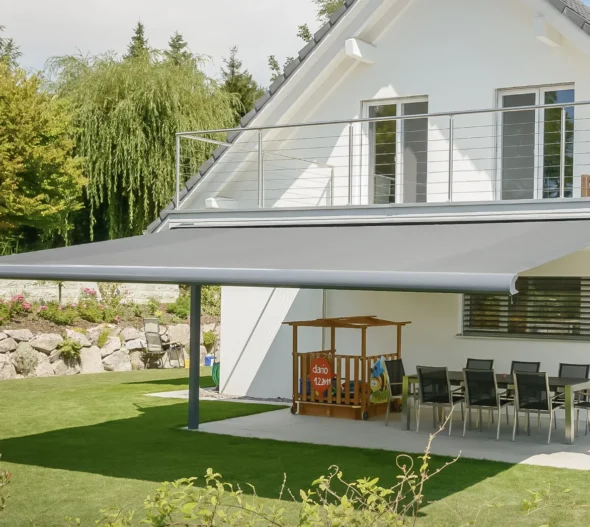
| Typical footprint | Shallow projection over a doorway | Deeper reach to cover a patio or table |
Every project still gets measured on site before either option is quoted.
Colour and finish on brick, siding and stucco
Frame colour is usually the easy call once you've picked a fabric – bronze and black read well against brick, white sits cleanly on light siding, and a custom powder coat can match a specific trim colour if you already have one on the house. We match to what's there rather than pushing a colour that fights the building.
Fabric is where the look actually changes room to room. A solid colour against stucco tends to look clean and architectural; a stripe or pattern against brick can look busy unless the brick is a single plain tone. We bring swatches on site rather than asking you to choose off a screen, because fabric colour shifts under real daylight and against real brick or siding in a way a photo doesn't show.
On siding specifically, we're also matching the shadow line the awning throws across the wall – a deep-pitched awning on a narrow strip of siding between windows can look heavier than the same awning would on a wide brick face, so the sizing conversation and the colour conversation happen together, not separately. Made in Canada frames come in a standard colour range plus the option to custom match, which covers almost every brick and siding tone we run into in Ontario.
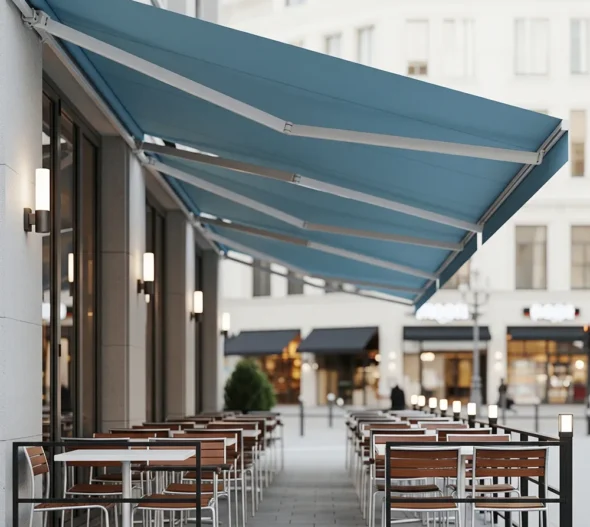
A fixed awning over a door is sized to carry snow and shed rain all winter – it can't be retracted before a storm, so get the pitch and the snow path right at the design stage, not after the first snowfall.
The honest limit
A fixed entry awning does not flex. Once it's up, it's up at that angle, that width and that projection for as long as the fabric lasts – there's no retracting it for a wind event, no opening it wider in summer and narrower in winter. If the look or the coverage you want changes with the seasons, a fixed awning will frustrate you.
It also won't stop wind-driven rain from reaching a door at an angle, and in a true downpour with gusting wind, water can still get under the edge no matter how far we extend it. It sheds normal rain and snow off the step; it is not a storm porch.
And condo and townhouse entries often have rules about anything bolted to a shared facade – balcony or entrance awnings in a condo commonly need board approval before we can even measure, so if you're in a condo or a townhouse with a shared wall, check with the board first. We'll still come out and measure, but we won't install until that approval is in hand.
If a fixed awning sounds right for your entry, our fixed awnings page covers frame options, mounting and what we check on site before quoting.
Frequently Asked Questions

EL
Eugene Ladizinsky
CFO & COO, co-owner of ROLLerUP
Eugene co-owns ROLLerUP, the Newmarket company behind Shading Solutions by ROLLerUP. Every guide on this site is written with our installers and checked against our own job records before it is published. About ROLLerUP.
More about retractable awnings
Retractable awnings guides
Compare options
Read next
- Awning fabric guide: acrylic, polyester, colours and how long it lasts
- Awning maintenance: cleaning the fabric and winter storage
- Awnings for decks: retractable options and what fits
- Awnings for balconies and condos
- Benefits of retractable awnings, and their limits
- Commercial awnings for restaurants and storefronts in the GTA
Get a free on-site estimate
We measure every entry on site before we quote – call (289) 270-5747 or visit the Newmarket showroom.