
A retractable balcony privacy screen can work on a condo, but the board decides what gets attached to the slab, railing or exterior wall. We measure the opening, propose a mount that needs no drilling into shared structure where possible, and tell you plainly when a board or a high-wind exposure means a screen is not approved.












What condo boards usually require
Most condo corporations treat a balcony as a limited common element – you have exclusive use of it, but the slab, the railing and the exterior wall belong to the corporation. That means nothing gets drilled, bolted or fastened to the ceiling, the wall or the balcony floor without the board's written approval, and most boards require an architectural alteration form before any contractor is allowed on site.
We've filled out enough of these forms to know the pattern: a drawing of the screen and exactly how it mounts, confirmation of who's doing the install, proof of insurance, and sometimes a note confirming the mounting method won't affect the building envelope or a fire route. We prepare that package and send it to property management directly, rather than leaving you to translate technical details back and forth.
Approval timelines vary a lot by corporation – some property managers sign off quickly, others wait for a board meeting. We build that uncertainty into the schedule instead of promising an install date before the approval is actually in hand.

Mounting options on a balcony
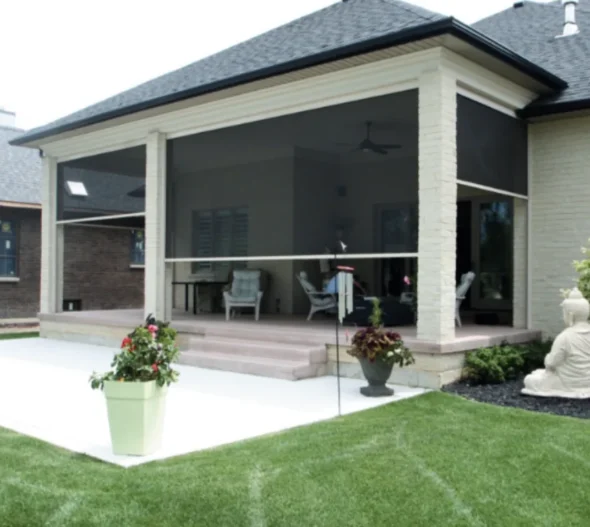
A ceiling-to-floor track is the cleanest look: a slim housing runs along the underside of the balcony ceiling, with a track fixed to the floor or railing so the mesh is captured on both edges when it's down. This gives the most wind resistance but needs an attachment point in the ceiling slab, which is exactly what some boards won't allow without an engineer's sign-off.
Side-mounted tracks fasten to the wall or the structural columns at either end of the opening instead of the ceiling, which is often an easier approval because it touches less of the shared structure. This works well on balconies with a column or a solid wall section on each side of the opening to anchor to.
A freestanding frame is the option that needs no fastening to the slab, wall or railing at all – the whole screen system is self-supporting within its own frame, set against the opening. It gives up some of the wind resistance of a fully tracked system, but on a board that refuses any attachment, it's often the only route to a working screen at all.
Wind at height: what changes above the lower floors
Wind load goes up with height, and a balcony on a higher floor behaves differently than a ground-level patio even on the same building. A side-track system keeps the leading edge of the mesh captured in a channel, which stops it ballooning or flapping – on an exposed balcony this isn't optional, it's what keeps the screen usable at all.
Mesh choice matters here too. A tighter privacy or solar weave presents more surface area to the wind than an open insect mesh, so it loads up faster in a gust. On very exposed balconies we sometimes recommend a slightly more open weave specifically to reduce wind load, even if it gives up a little privacy.
On windy days, the right answer is often simply to retract the screen. A motorized unit can be fitted with a wind sensor that retracts it automatically past a set wind speed, which protects the fabric and the track from strain you'd never notice until something tears.
Screen types for balconies
The right mesh depends on what you're trying to block and how exposed the balcony is.
| Screen type | What it blocks | Typical balcony use | Honest limit |
|---|---|---|---|
| Privacy mesh | Direct sightlines in daylight | Facing a neighbour's deck or window | Lit room behind it is visible in silhouette at night |
| Insect mesh | Bugs, not much visual privacy | Keeping a sliding door open in summer | Doesn't stop a direct view through |
| Solar mesh | Glare and heat, moderate privacy | West- or south-facing balconies | More wind load than open insect mesh |
| Fixed panel | Full sightline, no retraction | A wall-mounted screen with no moving parts | Can't be opened for airflow or view |
All of these are aluminum-framed; housing and track colours are matched to the building trim.
A privacy screen hides what's behind it in daylight, but a lit room behind a lowered screen at night reads the same as behind a sheer curtain – we tell every balcony customer this before they buy.
The honest answer: when we say no
Some boards simply won't permit any attachment to the exterior wall, railing or balcony ceiling, full stop, and the balcony itself is too small or too open-sided for a freestanding frame to sit securely. In that situation we'd rather tell you a screen isn't a fit than install something that won't hold.
A very exposed, high-floor balcony with sustained wind can make even a side-tracked, motorized screen impractical – if it needs retracting most days to avoid strain on the track, it stops doing the job you bought it for. We say so rather than selling a system that will frustrate you within a season.
And if a building's own rules require an attachment method or an engineering review we can't reasonably get approved or warranty, we'll say that too. A 5-year warranty, in writing, only means something if the install is one we're confident will hold up.
If your balcony or patio opening is a straightforward fit, the full breakdown of how outdoor privacy screens work – mesh grades, mounting and what they don't do – is worth a read before you book a measure.
Frequently Asked Questions
EL
Eugene Ladizinsky
CFO & COO, co-owner of ROLLerUP
Eugene co-owns ROLLerUP, the Newmarket company behind Shading Solutions by ROLLerUP. Every guide on this site is written with our installers and checked against our own job records before it is published. About ROLLerUP.
More about retractable screens
Retractable screens guides
Compare options
Read next
- Are retractable screens worth it? An honest answer
- Deck privacy screens: fixed panels or a retractable screen?
- Garage door screens: turning a garage into a screened room
- How much wind can a retractable screen take?
- How to choose a retractable screen door in Canada
- Keeping mosquitoes off the patio: what actually works
Where we install
- Retractable screens in King City
- Retractable screens in Newmarket
- Retractable screens in Oakville
- Retractable screens in Richmond Hill
- Retractable screens in Stouffville
- Retractable screens, awnings and louvered pergolas in Toronto
- Retractable screens in Uxbridge
- Retractable screens in Vaughan, Woodbridge and Maple
- Retractable screens in Whitby
Get a free on-site estimate
We measure the balcony, confirm what your board will likely approve, and put the mounting plan and price in writing before anything is ordered.