
A retractable screen's wind resistance comes from how the edges are held, not one blanket number: a zipper-track edge locked into an aluminum channel resists far more gust than a loose-edge mesh. On exposed sites we spec zip track and a weighted bottom bar, and we always recommend retracting before a severe wind warning.












What actually holds a screen in wind
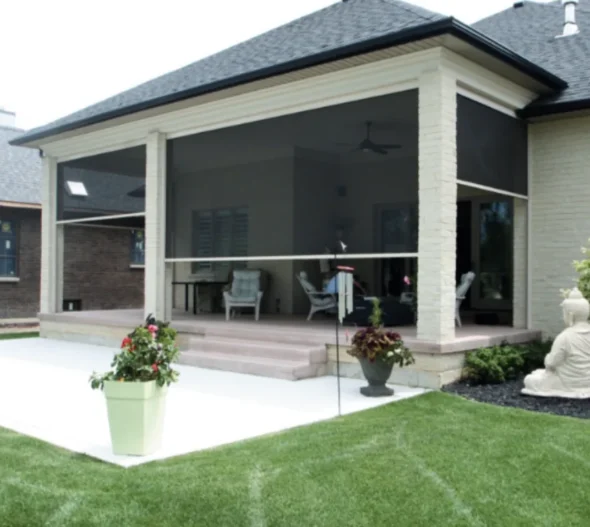
A retractable screen stays flat under wind because of three parts working together, not one magic feature. The vertical edges run inside aluminum guide rails fixed to the structure on both sides of the opening. The bottom bar adds weight and keeps the mesh under tension as it unrolls, so the fabric doesn't flap like a loose curtain. And on a zipper-track screen, the mesh edge itself is sewn or welded into a bead that locks inside the rail, rather than just sliding in a groove.
That last part is the difference that shows up in a real gust. On a plain side-channel screen the edge sits loosely inside the rail, so a strong cross-wind can pull it sideways, bow the fabric outward, or work it right out of the track, leaving a gap. On a zip track screen the bead is captured along the full height of the rail, so the edge can't pull free – the fabric can still flex a little in the middle of a wide span, but it stays anchored top to bottom.
We've pulled screens off decks where the bottom bar had lost its weighting, or the guide rail had come loose from a wood post that moved with the seasons – both failures look like "the screen isn't rated for the wind" when the real problem is the mounting. A screen is only as good as what it's bolted to, which is why we check the substrate before we quote, not after.
- Guide rails: fixed aluminum channel on both sides of the opening
- Bottom bar: adds weight and keeps the mesh under tension
- Zipper edge: locks the mesh bead inside the rail so it can't pull free
- Mounting substrate: the rail is only as strong as what it's fastened to

Why we don't quote one wind number for every screen
Every zip track screen we install is built to a published wind rating from the brand whose hardware we use, but that single number on a spec sheet doesn't travel straight to your deck. The rating assumes a specific width and height, a specific mesh grade, and a specific mounting method – change any of those and the real-world performance changes with it. A narrow zip track opening on a solid brick wall behaves very differently from the same hardware stretched across a wide garage opening on a wood-framed structure.
This is also where motorized versus hand-crank matters: a motor with wind sensing can retract the screen automatically once gusts pass a set threshold, which is a real safety margin a manual crank doesn't have unless someone is home to wind it in. We spec the track, the mesh grade, and the operation type to the opening and the site – we don't sell the same screen for a sheltered courtyard and an open rooftop terrace, even if the opening size is identical.
The honest limit here: even a zip track screen has a point past which we'll tell a client not to install one at all, or to look at a fixed screen or a different shading product instead. We'd rather say no to an opening than install something that's going to fail in the first windstorm and come back as a warranty call.
Exposed sites: lake-facing decks, high balconies, open fields
Wind exposure is about what's around the opening, not just the forecast for the day. A deck facing open water gets a steady, unobstructed wind that a sheltered backyard three streets inland never sees, even on the same "windy" day. A balcony above the first few storeys of a building sits in faster-moving air than ground level, because there's nothing – no fence, no hedge, no neighbouring structure – to slow it down before it hits the screen. And a property on open farmland or a cleared new-build lot has the same problem: nothing breaks the gust before it arrives.
On any of these sites we walk the opening in person before we quote. We're checking what's upwind, how high the opening sits, and whether the structure it would mount to can actually take the load. On a lake-facing or high-balcony job we default to zip track with a reinforced rail and we'll say plainly if hand-crank operation isn't a good fit – a motorized screen with automatic wind retraction is the safer call once a site is genuinely exposed.
We also tell clients when a retractable screen isn't the right answer at all. A very wide, very exposed opening with nothing around it may be better served by a fixed screen that never has to resist a gust while retracting, or by rethinking the opening itself. That's not a sales pitch for the bigger job – it's the same honesty we'd want if we were the ones buying.
Loose-edge versus zipper-track versus fixed screens
The three ways a screen's edge can be handled, and where each one actually belongs.
| Screen type | How the edge is held | Best for | Honest limit |
|---|---|---|---|
| Loose-edge (channel) screen | Mesh edge slides freely in an open groove | Sheltered patios, smaller openings, low exposure | Edge can bow or pop out of the track in a strong gust |
| Zipper-track screen | Mesh edge bead is locked inside the aluminum channel | Wide patios, garage conversions, exposed balconies | Costs more per opening; still should retract in severe wind |
| Fixed screen | Mesh is stretched and clipped permanently in place | Very wide or very exposed openings where retracting isn't practical | No pack-away – it stays in the weather all year |
"Exposed" means lake-facing, an open field, or a balcony with nothing nearby to slow the wind.
If there's a severe wind warning, an ice storm advisory, or a forecast gust that worries you, retract the screen first and ask questions later – a screen stowed in its housing can't be damaged by wind.
If your opening is wide, faces open wind, or is a garage conversion, a zipper-track screen is almost always the right spec – here's how the track, housing and bottom bar actually go together.
Frequently Asked Questions
EL
Eugene Ladizinsky
CFO & COO, co-owner of ROLLerUP
Eugene co-owns ROLLerUP, the Newmarket company behind Shading Solutions by ROLLerUP. Every guide on this site is written with our installers and checked against our own job records before it is published. About ROLLerUP.
More about retractable screens
Retractable screens guides
Compare options
Read next
- Are retractable screens worth it? An honest answer
- Balcony privacy screens for condos and apartments
- Deck privacy screens: fixed panels or a retractable screen?
- Garage door screens: turning a garage into a screened room
- How to choose a retractable screen door in Canada
- Keeping mosquitoes off the patio: what actually works
Where we install
- Retractable screens in King City
- Retractable screens in Newmarket
- Retractable screens in Oakville
- Retractable screens in Richmond Hill
- Retractable screens in Stouffville
- Retractable screens, awnings and louvered pergolas in Toronto
- Retractable screens in Uxbridge
- Retractable screens in Vaughan, Woodbridge and Maple
- Retractable screens in Whitby
Get a free on-site estimate
We'll walk your opening, check what it can mount to, and tell you honestly whether a retractable screen is the right call for that site.