

A privacy screen for deck use is either a fixed, railing-height panel bolted to your deck railing, or a retractable, full-height mesh screen that rolls down between posts or under a roofline. Panels block a sightline permanently; a retractable screen only blocks it when you lower it, then disappears when you don't want it there.












Two ways to put up a privacy screen for a deck
A railing-mounted panel is a fixed aluminum frame sized to fit between two railing posts, or bolted flat onto the top rail itself. It usually runs about railing height, sometimes a bit taller for more coverage, and it does not move. Once it is up, it blocks the same sightline whether you want it blocked or not – noon sun, evening barbecue, or the middle of winter.
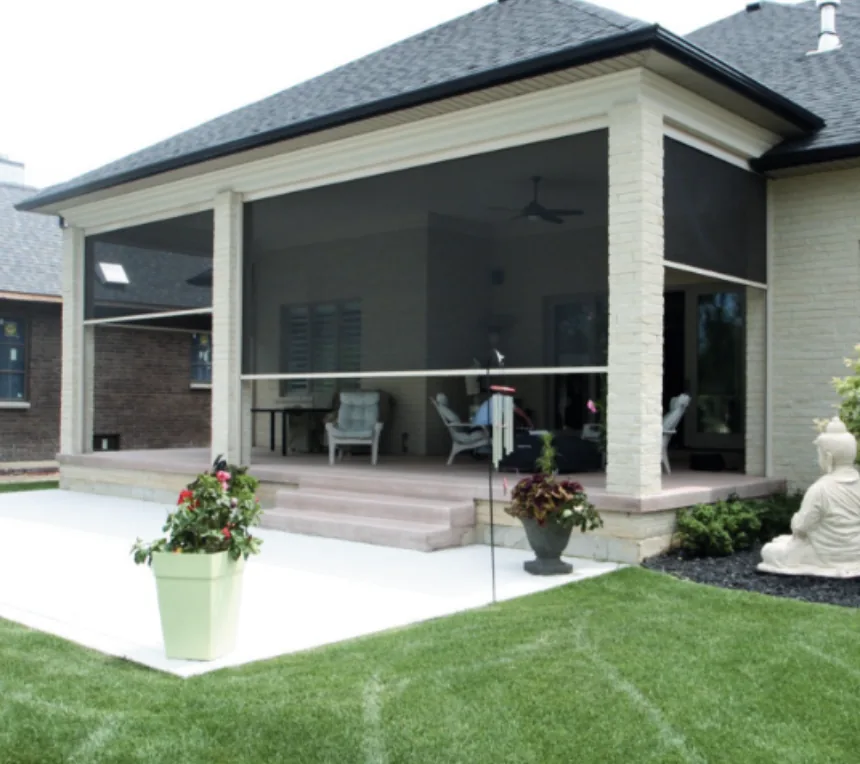
A retractable deck privacy screen is a mesh panel that sits rolled up inside a slim aluminum housing above the opening, then drops down a side track when you want the view blocked. The housing mounts to something solid overhead – a deck roof fascia, a pergola beam, or a header bar we add between two posts – and the fabric retracts fully when you want the deck open again.
The honest trade-off is permanence versus flexibility. A panel is simpler hardware and nothing to operate, but it is there every day, in every season, whether you need the privacy or not. A retractable screen does double duty – open most of the time for the view and the breeze, closed on the evenings a neighbour's deck is ten feet away and lit up – but it needs a real structure above and beside it to mount to, which a panel does not.

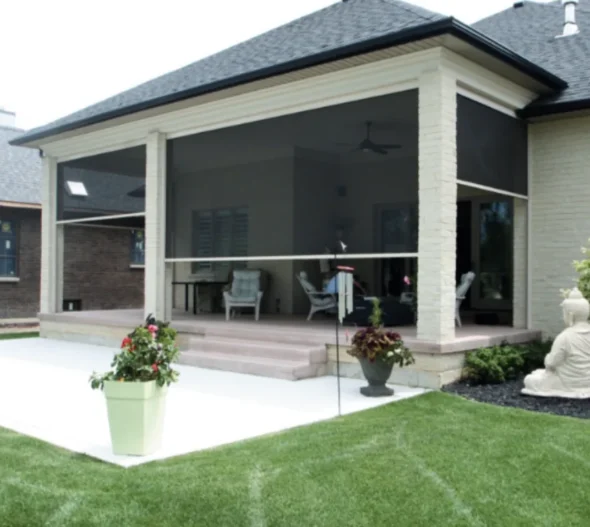
How a retractable screen actually attaches to a deck
The housing carries the full weight of the rolled fabric plus the motor or crank gearbox, and it takes wind load on the fabric whenever the screen is lowered. That means it needs to be lagged into something structural – a fascia board, a roof overhang, or a pergola beam – not just screwed to thin trim. We check what is behind the board before we mount anything.
Side tracks run down the two uprights that frame the opening. If your existing deck posts are sound and close to the right spacing, the track mounts straight to the post face. If the posts are decorative, undersized, or spaced wrong for the opening, we add new aluminum posts sized for the job rather than force a track onto something that will flex in wind.
A deck with no roof and no pergola has nothing to hang a housing from, which is the question we get most often. The fix is to build a header – either a small freestanding aluminum frame that spans the opening on its own footings, or posts tied into the deck framing below the decking boards, not just screwed to the surface boards. Wind pulling on a lowered screen puts load at the base of the post, so the post has to be anchored into the structure, not just standing on top of it.
Wind, side tracks, and the honest limit
A screen with no edge control is close to a flag. On an exposed or elevated deck, loose edges flap in gusts, stretch the fabric weave over time, and work the fasteners at the housing loose faster than anywhere else on the system. This shows up first on waterfront decks and second-storey decks with nothing to break the wind.
A side-track system captures both vertical edges of the screen in an aluminum channel, so the fabric can't billow out away from the opening. It behaves much more like a wall than a curtain once it's tracked in, which is the whole reason we install tracks on anything exposed rather than leave an edge free.
Even tracked, a retractable screen is fabric on a motor, not a solid panel. It has a rated wind limit, same as any retractable product, and it is meant to retract before a real storm, not ride one out. On a windy deck we push customers toward motorized operation with a wind sensor so the screen pulls itself in rather than relying on someone remembering to do it. A panel does not have this limit – it is rigid and bolted down – but it also cannot be put away.
Panel, retractable screen, or planting: what each one actually does
A quick side-by-side before you decide which approach fits your deck.
| Option | Blocks sightline | Wind | Winter |
|---|---|---|---|
| Fixed railing panel | All the time, same spot | Rigid once bolted down, does not flex or flap, but can't be retracted if wind picks up | Usually stays mounted; a panel under heavy roof snow-shed should come down for the season |
| Retractable screen (tracked) | Only when lowered, full height | Side track controls flapping; still has a rated wind limit and should retract before a storm | Fabric retracts into the housing for storage; housing and track stay mounted |
| Hedge or lattice with vines | Partial, builds in over a few growing seasons | Unaffected by wind once established | Dies back or needs wrapping; blocks little in winter |
Winter: what stays up and what comes down
Ontario winters change the answer for every option on a deck.
- Retractable screen housing and track stay mounted year-round – aluminum does not rust or crack in freeze-thaw.
- The mesh fabric itself should be fully retracted into the housing before the first heavy snow, rather than left sitting at a mid-point where a side track can ice up.
- A railing panel in an aluminum frame can usually stay in place through winter, with one exception: if it sits directly under a roof edge that sheds snow, take it down for the season so it isn't hit by a sliding snow load.
- Motor heads are rated for cold operation, but we still recommend one full retract-and-check before winter so nothing is frozen mid-travel on the first cold snap.
If you can't say what the screen is protecting the moment the wind picks up, retract it – that's the rule we give every customer with a retractable screen on an exposed deck.
If you're weighing a fixed panel against a retractable screen for your own deck, our outdoor privacy screens page walks through mesh grades, mounting options, and motorization in more detail.
Frequently Asked Questions
EL
Eugene Ladizinsky
CFO & COO, co-owner of ROLLerUP
Eugene co-owns ROLLerUP, the Newmarket company behind Shading Solutions by ROLLerUP. Every guide on this site is written with our installers and checked against our own job records before it is published. About ROLLerUP.
More about retractable screens
Retractable screens guides
Compare options
Read next
- Are retractable screens worth it? An honest answer
- Balcony privacy screens for condos and apartments
- Garage door screens: turning a garage into a screened room
- How much wind can a retractable screen take?
- How to choose a retractable screen door in Canada
- Keeping mosquitoes off the patio: what actually works
Where we install
- Retractable screens in King City
- Retractable screens in Newmarket
- Retractable screens in Oakville
- Retractable screens in Richmond Hill
- Retractable screens in Stouffville
- Retractable screens, awnings and louvered pergolas in Toronto
- Retractable screens in Uxbridge
- Retractable screens in Vaughan, Woodbridge and Maple
- Retractable screens in Whitby
Get a free on-site estimate
We measure your deck in person and tell you honestly whether a panel, a retractable screen, or both fits what you need – call (289) 270-5747 or visit our Newmarket showroom.