

A garage door screen is a motorized or manual zipper-track mesh that drops across a single or double garage opening, mounting above the door track so it clears the garage door completely. It keeps bugs and sun out while you use the garage as a workshop, gym or party room, and retracts fully when you need the door back.












How a garage screen mounts above the opening
A garage door screen mounts on the outside face of the garage opening, above the existing door track, inside its own slim aluminum header box. The header holds the rolled-up mesh and the motor; it sits proud of the opening so the garage door's track, torsion spring and opener rail are never touched. When the screen is retracted, the garage door operates exactly as it did before we arrived.
We fix a side track to the brick, siding or trim on each side of the opening, running from the header down to the floor. That track carries the zipper bead that locks the mesh edge in place, and it has to clear the garage door's vertical rails and any security bar or sensor eye mounted nearby. On a lot of garages that means offsetting the track an inch or two off the face of the opening rather than mounting it flush, which we check on site before anything is ordered.
At the bottom, a weighted or keyed bar seals the screen to the floor or a shallow sill track. Garage floors are rarely perfectly flat, so we either set a thin aluminum sill to bridge the low point or accept a small gap and tell the homeowner which one we're doing, and why, before the screen is built.

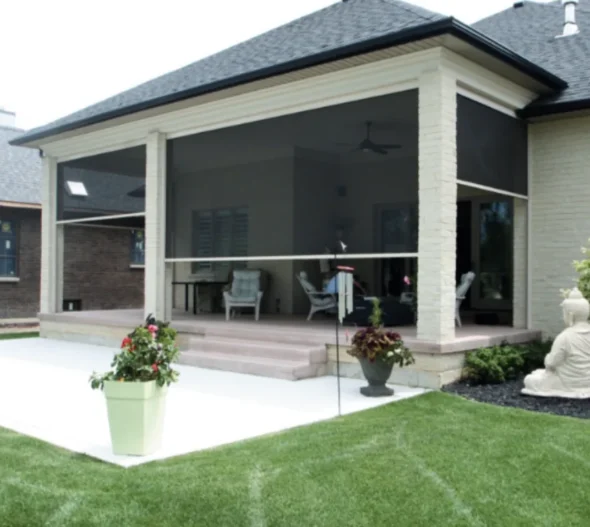
Single versus double garage openings and why the zipper track matters
A single garage opening is the simple version: one zipper track, one motor, one remote. A double, two-car opening is a different job. At that width a screen edge that just rides in a plain groove starts to bow in wind and can pop out of the track entirely, so we specify zipper track as standard on anything wider than a single door; the zip bead stays mechanically captured along the full height no matter how wide the span gets.
Where a double opening is wider than one piece of mesh can span cleanly, we either split it into two screens meeting at a centre post, or build a single wide screen with a reinforced centre guide if the opening and the intended use justify it. That decision gets made on site against the actual width and wind exposure of the garage, not read off a price list.
Before we commit to a layout we also check what's above and beside the opening: the garage door opener and its rail, a security floodlight, an electrical panel on the house wall, or a gas meter near the track line can all change where the header and side tracks are allowed to go.
Motor, wiring and the remote
Motorized garage screens use a tubular motor built into the roller tube inside the header box, the same hardware we use on patio and balcony screens. Low-voltage wiring runs from the motor to a wall switch or a small junction box, and on a finished garage that usually means an electrician fishing wire through the wall rather than running it along the surface.
The remote is a standard handheld unit; we can also wire the screen to a wall switch beside the garage door opener, or add it to an existing garage or home automation system. Manual, crank-operated versions exist for a single opening and cost less, but we don't recommend a crank on a wide double opening, the mesh is heavy enough across that span that a motor is the sensible choice, not a luxury.
We never wire through the garage door itself or its opener rail, and the screen never shares a circuit with the opener. It gets its own low-voltage run, so a problem with the opener never takes the screen down with it, and a screen fault never touches the door. Every garage screen we install carries a 5-year warranty, in writing.
How we measure and install one
Same process whether it's a single door or a double bay:
Site visit
We measure the opening, check what the header and side tracks can actually fasten to, and note anything in the way, a floodlight, a panel, an uneven floor.
Mesh and mechanism decision
We walk through insect, solar and privacy mesh samples, and confirm motorized versus manual based on the opening's width and how it will be used.
Build to the opening
The header, side tracks and bottom bar are built to that exact opening, not trimmed down from a stock size.
Install day
Tracks go up, the header is set, wiring is tied in, and the screen is tested through a full cycle before we leave.
Zipper-track screen vs a magnetic mesh curtain vs a built screen wall
Three ways to close off a garage opening, and what each one actually gives you.
| What matters | Zipper-track screen | Magnetic mesh curtain | Built screen wall |
|---|---|---|---|
| Mounting | Fixed aluminum header and side tracks, professionally installed | Hung with magnets or hook-and-loop, no fixed track | Framed wall built into the opening |
| Wind performance | Zip bead stays locked in the track in wind | Billows and can detach in wind | Not affected, it's a wall |
| Opening width it suits | Single or double garage openings | Best on a single door, struggles on wide spans | Any width, but it's permanent |
| Retracts fully away | Yes, rolls up into a slim header box | No, has to be unhooked and stored | No, it's a permanent structure |
| Garage stays a garage | Yes, car still parks inside, door still opens | Yes, once the curtain is unhooked | No, the wall blocks a car |
| Main cost driver | Opening width, motorization, mesh grade | Mesh grade only | Framing, drywall, a door |
We install zipper-track screens; the other two columns are included so you know what you're comparing against.
Privacy and solar mesh for a street-facing garage
A garage that faces the street and doubles as a gym or a party room usually wants more than plain insect mesh. A solar-weave fabric cuts glare and lets us see out while making it harder to see in during the day; a tighter privacy-weave mesh blocks the view almost completely in both directions, which matters if the garage is used as a change room or a home gym facing the sidewalk.
The trade-off is airflow and visibility: a tighter weave moves less air and looks darker from inside at night with the lights on. We walk through fabric samples against the actual opening before ordering, because a privacy weave on a shaded north-facing garage behaves differently than the same fabric on a sun-blasted south wall.
A garage screen keeps out mosquitoes, flies and the occasional bold squirrel; it will not stop a determined raccoon that wants in badly enough to pull at the mesh edge.
If a two-car opening is the job, the zipper-track page covers wind ratings, mesh grades and what install day looks like in more detail.
Frequently Asked Questions
EL
Eugene Ladizinsky
CFO & COO, co-owner of ROLLerUP
Eugene co-owns ROLLerUP, the Newmarket company behind Shading Solutions by ROLLerUP. Every guide on this site is written with our installers and checked against our own job records before it is published. About ROLLerUP.
More about retractable screens
Retractable screens guides
Compare options
Read next
- Are retractable screens worth it? An honest answer
- Balcony privacy screens for condos and apartments
- Deck privacy screens: fixed panels or a retractable screen?
- How much wind can a retractable screen take?
- How to choose a retractable screen door in Canada
- Keeping mosquitoes off the patio: what actually works
Where we install
- Retractable screens in King City
- Retractable screens in Newmarket
- Retractable screens in Oakville
- Retractable screens in Richmond Hill
- Retractable screens in Stouffville
- Retractable screens, awnings and louvered pergolas in Toronto
- Retractable screens in Uxbridge
- Retractable screens in Vaughan, Woodbridge and Maple
- Retractable screens in Whitby
Get a free on-site estimate
We'll measure your garage opening, talk through mesh and motor options, and give you a price in writing.