
Manual retractable patio screens are the better buy on openings up to about ten or twelve feet wide that you open and close a few times a week, with no outlet nearby. Motorized screens earn their cost on wider spans, screens used daily, or anywhere you want sun sensors or smart-home control.












How a manual screen operates
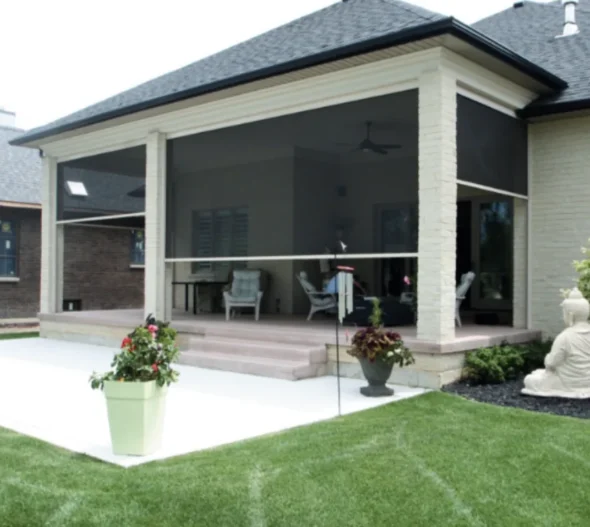
A manual retractable screen is a spring-loaded roller system. The mesh winds onto an aluminum tube inside the head housing, and a crank handle at one end turns a gear that pulls the bottom bar down the guide rails. Let go and spring tension inside the tube takes most of the work back out of retracting it – you guide it up, you don't fight it.
This is where a hand crank is the right call: a single patio door, a window, or a garage-size opening that one person opens and closes a handful of times a week. There's no outlet to run, no wiring to route, and nothing electronic to fail – just a tube, a spring, and a handle.
The honest limit is width. Past a certain span the mesh and bottom bar get heavy enough that retracting by hand starts to feel like work, and the crank mechanism itself takes more wear. Somewhere around ten to twelve feet wide is where we start steering people toward a motor instead of pushing the hand-crank further than it's built for.
What the motor adds
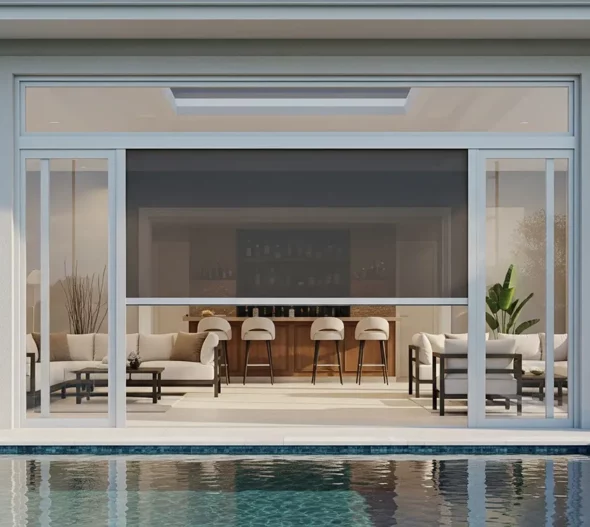
A motorized retractable screen uses the same mesh, guide rails, and bottom bar as a manual one – the only difference is a small tubular motor sealed inside the roller tube in place of the crank gear. That motor is what lets a power screen handle a much wider opening without anyone having to pull on it.
Beyond width, the motor buys convenience: a wall switch, a handheld remote, or – on most of our installs – a sun sensor that extends the screen automatically when direct sun hits the opening and retracts it when the sun moves off. Add a smart-home interface and an automated patio screen can be scheduled, grouped with other openings on the property, or tied into a broader shading routine.
None of that makes the screen smarter than it is. It still only does one thing – mesh up, mesh down. What changes is how much effort and attention that takes from you, and how many openings you can run from one switch or one app instead of walking to each one with a crank in hand.
Power: outlet, hardwire, and who does what
Running a motor means running power to it. On most jobs that's either a dedicated outlet near the housing or a low-voltage transformer hardwired into a junction box. That part is licensed electrical work, and it is not something we do ourselves – an electrician handles it, and we coordinate timing with them so the screen goes in once the power is live.
What we handle is everything downstream of that outlet: mounting the housing and guide rails, connecting the motor, running the low-voltage control line to the switch or remote receiver, and setting the upper and lower travel limits so the screen stops exactly where it should, every time.
On a retrofit – adding power screens to a house that wasn't built with them in mind – finding a route for that control wiring without a visible conduit run is usually the single biggest factor in how long the job takes. On new construction or a renovation where we're involved early, that wiring gets roughed in before the drywall closes, which is simpler and cleaner for everyone.
Manual versus motorized, side by side
The mesh, frame, and finish are identical either way – this is about the roller tube and how you operate it.
| Manual (hand-crank) | Motorized | |
|---|---|---|
| Comfortable width | Up to roughly 10-12 ft | Handles wide and multi-panel spans |
| Daily effort | Crank by hand each use | Switch, remote, or automatic |
| Power needed | None | Dedicated outlet or hardwired low-voltage circuit |
| Cost driver | Opening size and mesh grade | Adds motor, wiring, sun sensor, electrician time |
| What usually fails | Worn crank gear or weak spring tension | Motor, control wiring, or limit settings drifting |
| Best fit | One opening, used occasionally, no nearby power | Wide or frequently used opening, multiple openings, smart-home control |
Mesh grade, access, and site conditions still move the price within either column.
The honest answer, by opening size
Width and how often you use the screen matter more than any feature list.
- A single door up to about six feet: a hand crank is inexpensive, has nothing to go wrong electrically, and will outlast the house siding.
- A wide patio opening or several openings on one property: a motor spreads the mounting and wiring cost across more screen and pays for itself in convenience.
- A second-storey or hard-to-reach opening: a motorized screen removes the awkward reach a crank would need.
- An opening used daily – a main patio, a dog-access door: the convenience of a switch or sensor earns its keep.
- An opening used a few times a season – a side patio, a cottage window: manual is plenty.
- A budget-tight job with no outlet nearby: manual avoids adding an electrician's visit to the project.
What fails on each, and what an Ontario winter does to both
A hand-crank screen's weak point is mechanical wear: the crank gear can loosen or slip after years of use, and spring tension inside the tube gradually weakens. Both are usually a hardware swap at the head housing, not a full teardown.
A motorized screen's weak points are electrical: the motor itself can fail from moisture or worn bearings over time, the control wiring or connection at the switch can come loose, and travel limits can drift so the screen stops short or runs past the bottom bar. A dirty or misaligned sun sensor will also start reading the weather wrong before anything else goes.
Winter changes the calculus for both. Mesh left extended under snow load or ice will tear, so every screen – manual or motorized – needs to be fully retracted before the weather turns, and housing weep holes need to stay clear of ice so meltwater can drain. If you're on a condo balcony, check with the board before ordering an automated patio screen – mounting the housing and running control wiring usually needs approval even when the screen itself is identical to what's allowed for a manual unit. Every install we do, motorized or manual, carries a 5-year warranty in writing, which covers exactly this kind of mechanical or electrical failure, not misuse or storm damage.
Rule of thumb: if you can reach the crank without a step stool and you open the screen less than a few times a week, a hand crank will outlast the extra cost of a motor.
If your opening is wide, used daily, or you want sun sensors and smart-home control, it's worth seeing what a motorized setup actually involves before you decide.
Frequently Asked Questions
EL
Eugene Ladizinsky
CFO & COO, co-owner of ROLLerUP
Eugene co-owns ROLLerUP, the Newmarket company behind Shading Solutions by ROLLerUP. Every guide on this site is written with our installers and checked against our own job records before it is published. About ROLLerUP.
More about retractable screens
Retractable screens guides
Compare options
Read next
- Are retractable screens worth it? An honest answer
- Balcony privacy screens for condos and apartments
- Deck privacy screens: fixed panels or a retractable screen?
- Garage door screens: turning a garage into a screened room
- How much wind can a retractable screen take?
- How to choose a retractable screen door in Canada
Where we install
- Retractable screens in King City
- Retractable screens in Newmarket
- Retractable screens in Oakville
- Retractable screens in Richmond Hill
- Retractable screens in Stouffville
- Retractable screens, awnings and louvered pergolas in Toronto
- Retractable screens in Uxbridge
- Retractable screens in Vaughan, Woodbridge and Maple
- Retractable screens in Whitby
Get a free on-site estimate
We'll measure your opening, tell you honestly whether a crank or a motor fits it, and put the price in writing – call (289) 270-5747 or visit the Newmarket showroom.