

Retractable solar shades and insect screens share the same aluminum housing and guide-rail system; the difference is the mesh. Solar mesh cuts heat and glare while keeping the view, insect mesh keeps bugs out and air moving, and privacy or clear-vinyl options close a space in entirely. The right pick depends on the opening and the problem you're solving.










How mesh openness works, in plain terms
Every retractable screen is a weave stretched across an aluminum head rail, side tracks and a bottom bar. What changes from one job to the next is how tight that weave is. A tighter weave blocks more sun and more sight-line in both directions; a looser weave lets more light, air and view pass through but does less to stop heat or glare. There is no single 'right' tightness – it is a trade-off you choose based on what the opening faces and what bothers you most out there.
We don't quote openness as a marketing number because the feel of a mesh in person matters more than a spec sheet. What we do instead, every time, is bring sample swatches to the on-site measure so you can hold a few weaves up against your own light before anything is ordered.
The housing, track and motor or crank hardware are identical regardless of which mesh goes in the cassette. That means if you start with an insect screen and later decide you want more heat control, we can usually swap the fabric without touching the structure – the aluminum frame and channels stay put.
Four mesh types, four different jobs
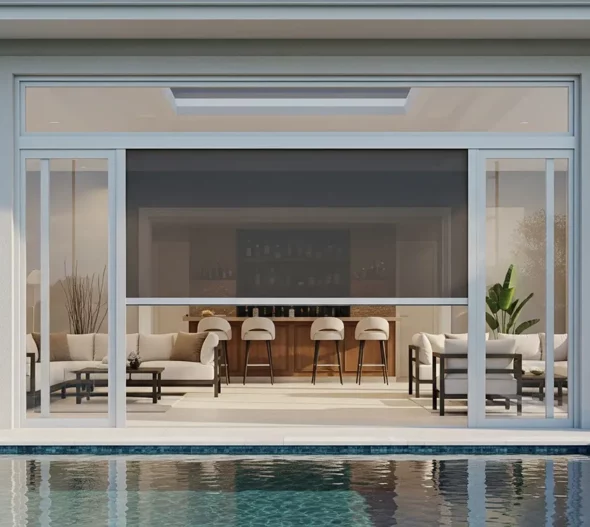
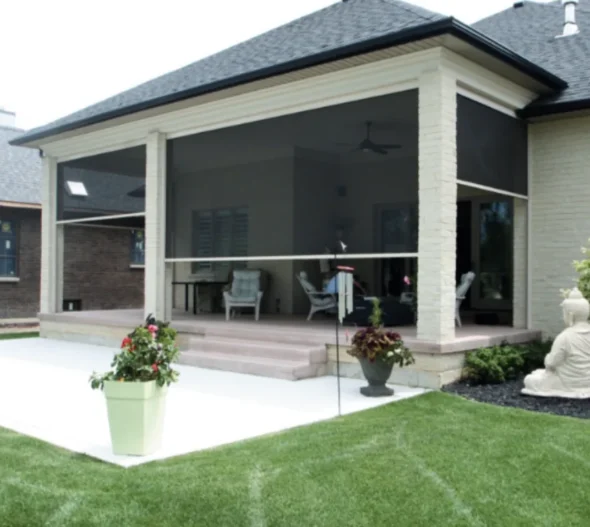
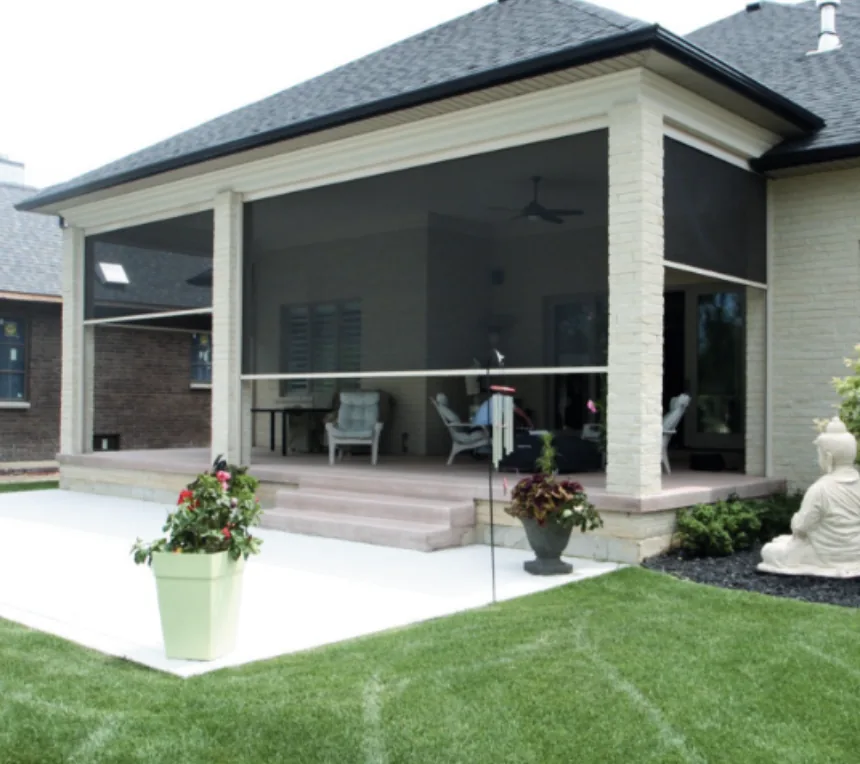
Solar mesh is a tighter, vinyl-coated weave built to cut heat and glare before it reaches the glass or the seating area. It still lets you see out – softened, like good sunglasses – and it's the mesh most people choose for a west- or south-facing opening that gets hammered by afternoon sun.
Insect mesh is the loosest weave of the group. It's made to do one job well: keep bugs out while moving as much air through as possible. It does very little for heat or glare, which is fine on a shaded porch but a poor choice facing direct sun.
Privacy weave sits between the two – tight enough that someone outside can't see in clearly, especially once it's dark and the lights are on inside. It cuts some heat as a side effect but it is chosen for the sight-line, not the temperature.
Clear vinyl isn't a mesh at all – it's a solid, see-through panel that drops into the same track. It blocks wind and rain completely, which makes it the only one of the four that extends a patio into a usable space on a cold or wet day. It also fogs with age, scratches more easily than fabric, and traps heat like a greenhouse if it's left down on a sunny day with no airflow behind it. We won't install vinyl on a track that wasn't built to take the extra wind load of a solid panel – mesh flexes in wind, vinyl pushes back, and the hardware underneath needs to be rated for that.
Colour decides what you can see, from both sides
A dark mesh absorbs more light than a light one, and that changes the view in both directions. From inside, looking out through a dark weave in daylight, the mesh almost disappears and the yard looks close to normal. From outside, the same screen looks close to opaque, which is why dark mesh is the usual pick when privacy from the street or a neighbouring property matters.
Light-coloured mesh does the opposite: it reflects more heat, so it can run a little cooler to the touch, but the view through it is milkier and from outside you can see more of what's happening behind it. Colour is also a style choice – most homeowners match the mesh and housing colour to their trim or siding rather than choosing on performance alone, and that's a reasonable way to decide once the mesh type itself is settled.
Matching the mesh to your site
The same opening on two different lots needs two different meshes. A few patterns we see often:
- West-facing deck that bakes in late afternoon sun: a tighter solar weave, usually in a darker tone, does the most for both heat and glare.
- Bug-heavy ravine or wooded lot: a looser insect mesh keeps airflow high; adding solar weave there often means losing air you didn't need to lose.
- Shaded porch with a street view: privacy weave does more for the sight-line than solar mesh would, since heat was never the problem.
- Three-season room conversion: clear vinyl panels in the same track as the mesh, swapped in for the cold months and out again in spring.
- Condo or townhouse balcony: check with the board before ordering – some buildings restrict exterior mesh colour or visible hardware.
- Several openings on one property: measuring and installing them together in one visit is more efficient than booking separate trips for each.
Mesh types by job
A quick side-by-side of what each weave is actually good at.
| Mesh type | Bugs | Heat & glare | Privacy | View | Wind & rain |
|---|---|---|---|---|---|
| Insect mesh | Blocks well | Little effect | Low | Clear | Not blocked |
| Solar mesh | Blocks most | Cuts most | Medium | Softened, see-through | Not blocked |
| Privacy weave | Blocks well | Cuts some | High | Obscured | Not blocked |
| Clear vinyl | Blocks well | Can trap heat if closed in sun | Low, fully see-through | Clear | Blocks wind and rain |
No mesh type scores high in every column – that's the trade-off, not a flaw.
No single mesh does everything – solar mesh that cuts glare also softens the view a little, and insect mesh that keeps the view sharp lets more heat and sun through.
Ontario seasons, condos and what we won't do
In winter we tell every customer to retract the screens rather than leave them down. Ice can build on a track or bottom bar, and a mesh or vinyl panel left extended through a snow load is more likely to stretch or tear than one that's rolled up and sitting in its aluminum housing. None of our screens are built or sold as storm protection, and none of them replace a window or a door – they're shade and air control for an opening that's already weathertight behind them.
On condo and townhouse jobs, the board's rules usually matter more than the mesh itself: colour, visible hardware and sometimes the housing finish can be restricted. We measure and quote the same way regardless, but we always ask about board approval before the order goes in so nothing has to come back out.
Every install is measured on site, priced in writing before any work starts, and carries a 5-year warranty, in writing. We design, sell, install and service these systems ourselves; the aluminum housings and components are made in Canada.
If you've settled on a mesh type and want it priced against your actual opening, our retractable screens page walks through housing options and what drives the install cost.
Frequently Asked Questions
EL
Eugene Ladizinsky
CFO & COO, co-owner of ROLLerUP
Eugene co-owns ROLLerUP, the Newmarket company behind Shading Solutions by ROLLerUP. Every guide on this site is written with our installers and checked against our own job records before it is published. About ROLLerUP.
More about retractable screens
Retractable screens guides
Compare options
Read next
- Are retractable screens worth it? An honest answer
- Balcony privacy screens for condos and apartments
- Deck privacy screens: fixed panels or a retractable screen?
- Garage door screens: turning a garage into a screened room
- How much wind can a retractable screen take?
- How to choose a retractable screen door in Canada
Where we install
- Retractable screens in King City
- Retractable screens in Newmarket
- Retractable screens in Oakville
- Retractable screens in Richmond Hill
- Retractable screens in Stouffville
- Retractable screens, awnings and louvered pergolas in Toronto
- Retractable screens in Uxbridge
- Retractable screens in Vaughan, Woodbridge and Maple
- Retractable screens in Whitby
Get a free on-site estimate
We'll bring mesh samples to your opening and quote it in writing before anything is ordered.