
We think the best fit depends on your sightline, not a style trend. Six honest options exist: a retractable screen, fixed privacy panels, lattice, planted screening, a fence extension, and a louvered pergola with screens. Each trades privacy, wind resistance and winter performance differently, and the right one usually depends on how often you want the view back.











Why privacy looks different by day and by night
Every privacy option on this page relies on the same bit of physics, so it is worth explaining once before we get into the list. During the day, the outside is brighter than the inside. Anything semi-solid between your deck and your neighbour's line of sight reads as nearly opaque from their side, even if you can still see shapes and movement through it from yours.
After dark, that relationship flips. Interior or deck lighting makes your side brighter than the outside, which means a lit room or patio behind a screen, a lattice panel, or even a hedge with gaps in it becomes visible in silhouette, the same way a sheer curtain glows at night. No fixed screen, mesh, or planting fixes this on its own – the fix is lower interior lighting, warmer bulbs, or closing drapes behind the opening once the sun goes down.
We mention this upfront because it is the single most common misunderstanding we hear in a first conversation about privacy. People assume a product failed them at night when it is actually doing exactly what it did in daylight – it is the light direction that changed, not the screen.
Seven ways to add privacy to a deck, patio or balcony
Here is what each approach actually is, what moves its cost, how it handles an Ontario winter, and what it looks like from the street.
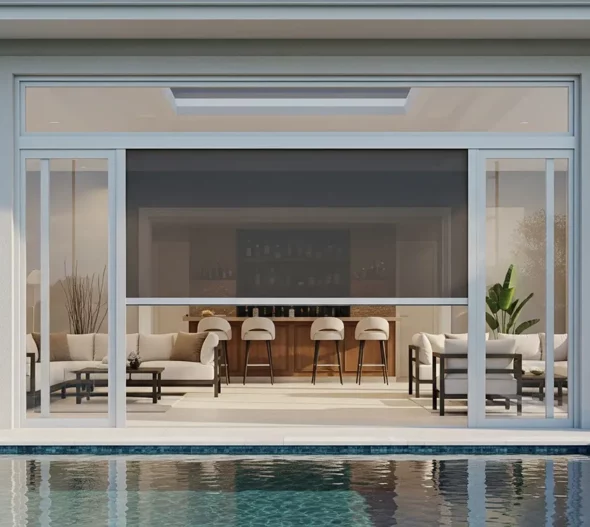
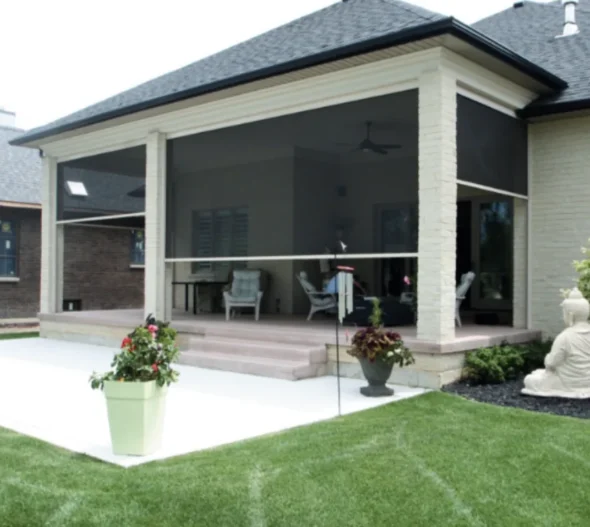
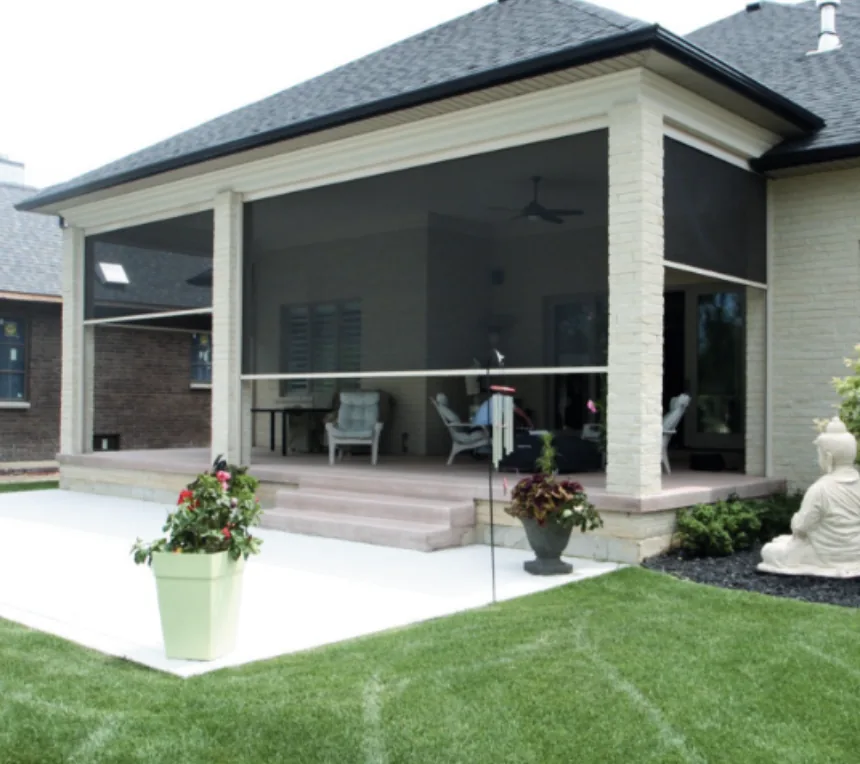
- Retractable privacy screen – a mesh panel in a slim aluminum housing that rolls down a side track to close an opening and rolls back up out of sight. Cost moves with opening size, motorised versus hand-crank operation, and mesh grade. It retracts before snow load builds up, so winter is mostly a non-issue, and from the street it reads as a clean frame line with no visible mesh when it is up.
- Fixed privacy panels – solid or louvered aluminum panels bolted in place across an opening or along a railing. Cost moves with panel height, finish, and how many bays you cover. They take wind and snow fine because nothing moves, but you lose the view and the airflow permanently, and from the street they look like a wall, not a deck.
- Lattice panels – a criss-cross wood or aluminum grid, usually added to an existing fence or pergola post. It is one of the lower-cost options per section, filters sightlines rather than blocking them, and in wind it can rattle or need bracing if the openings are large. From the street it reads as a garden feature rather than a barrier.
- Planted screening – hedging, tall grasses, or trellis vines grown along a fence line or in large planters. The plant stock itself is the main cost, and it is the slowest option to deliver real privacy because it needs one or more growing seasons to fill in. Deciduous plantings drop their cover every winter, which some homeowners like for sun and some do not.
- Fence extension – adding height or lattice toppers to an existing fence. Cost moves with linear footage and whether the existing posts can take the extra height without reinforcement. It handles wind and winter the same as the fence it is attached to, and it is the option most likely to run into a height restriction, since many municipalities cap fence height before you even start adding to it.
- Pergola with retractable screens – a louvered or fixed pergola roof with screens or curtains that drop between the posts. This is the highest-cost option on the list because you are buying a structure as well as the screening, but it is also the most complete – shade overhead and privacy on the sides, both retractable. Winter performance depends on the pergola's own rating for snow load.
- Portable or freestanding privacy screens – panel sets on weighted bases that are not fixed to anything. These are the lowest upfront cost and the only option on this list that typically needs no board or municipal approval, because nothing is attached to the structure. They are also the least wind-stable and need to be stored or anchored in a storm, and they offer the least privacy because gaps and the panel edges are visible from most angles.
How the seven options compare
Short version, side by side.
| Option | Privacy by day | Privacy at night | Wind | Winter | Retractable | Bylaw/board risk |
|---|---|---|---|---|---|---|
| Retractable screen | High | Silhouette only | Good on side track | Retract before storms | Yes | Low to moderate |
| Fixed privacy panels | High | Silhouette only | Very good | No change | No | Moderate |
| Lattice | Partial | Partial | Can rattle | No change | No | Low |
| Planted screening | Grows over time | Partial | Depends on species | Many drop cover | No | Low |
| Fence extension | High | Silhouette only | Good if braced | No change | No | Higher |
| Pergola with screens | High | Silhouette only | Good, engineered | Rated for snow load | Yes (sides) | Moderate |
| Portable panels | Low to partial | Low to partial | Weak, needs anchoring | Store for winter | Movable | Lowest |
Bylaw and board risk is a general pattern, not a guarantee – always check your own municipality and, if you are in a condo, your board before ordering anything fixed.
The condo and balcony angle
Condo boards almost always control what happens on a balcony, because the balcony railing and exterior wall are usually part of the building's common elements, not your unit. That means anything drilled into the railing or facade – a fixed panel, a lattice frame, a retractable screen housing – typically needs board sign-off before it goes up, even if you own the unit outright.
What usually gets approved without a fight is anything that does not alter sightlines from the street or change the building's exterior appearance from a distance, and anything that can be removed without leaving marks. Boards are generally more comfortable with a screen that matches the building's existing colour palette than with a bright or mismatched frame.
What usually gets stopped at the door is permanent solid panelling that changes the building's exterior look, anything that blocks a fire route or sightline the building needs for safety, and anything installed without a submitted drawing or spec sheet. Before you buy, ask your board for their written rules, and keep in mind a status certificate review is a normal part of this for anyone planning to install something fixed.
The honest limit of every option, including ours
No option on this list does everything, and we would rather tell you the limit before you buy than after.
A retractable screen does not insulate like a solid wall, and it will not stop a determined line of sight if someone is standing close and looking at an angle through the mesh. It needs power or a working crank to operate, and the mesh, like any fabric, eventually needs replacing – ours carries a 5-year warranty, in writing, but that is not forever.
- Fixed panels solve privacy permanently but also permanently remove your view and airflow
- Lattice filters rather than blocks, so it will not satisfy someone who wants to be fully unseen
- Planting takes seasons to work and loses cover in winter if it is deciduous
- Fence extensions inherit whatever weakness the original fence already has
- A pergola with screens is the most complete option and the most expensive one
- Portable panels are the easiest to approve and the easiest for wind to move
If you only need privacy on summer evenings, you likely do not need a permanent wall – something retractable earns its keep by staying out of sight the rest of the time.
If a retractable screen looks like the right fit after reading this, we measure every opening on site and price it in writing before anything is ordered.
Frequently Asked Questions
EL
Eugene Ladizinsky
CFO & COO, co-owner of ROLLerUP
Eugene co-owns ROLLerUP, the Newmarket company behind Shading Solutions by ROLLerUP. Every guide on this site is written with our installers and checked against our own job records before it is published. About ROLLerUP.
More about retractable screens
Retractable screens guides
Compare options
Read next
- Are retractable screens worth it? An honest answer
- Balcony privacy screens for condos and apartments
- Deck privacy screens: fixed panels or a retractable screen?
- Garage door screens: turning a garage into a screened room
- How much wind can a retractable screen take?
- How to choose a retractable screen door in Canada
Where we install
- Retractable screens in King City
- Retractable screens in Newmarket
- Retractable screens in Oakville
- Retractable screens in Richmond Hill
- Retractable screens in Stouffville
- Retractable screens, awnings and louvered pergolas in Toronto
- Retractable screens in Uxbridge
- Retractable screens in Vaughan, Woodbridge and Maple
- Retractable screens in Whitby
Get a free on-site estimate
We measure your opening in person and give you a written price before you decide on anything.