

A retractable screen door for a sliding door mounts a mesh panel in a slim cassette beside your slider frame, so it pulls across and retracts out of sight instead of riding in a track that bends or jumps. It costs more than a stock replacement screen but fixes the jumping, sagging and pet-damage problems for good.












Why stock slider screens fail
The screen that came with your slider is a light aluminum frame hung on small plastic or nylon rollers that ride in a track along the bottom of the frame. It works fine for a season or two, then the rollers wear flat, the frame racks out of square, or the track fills with grit and the panel starts jumping off its rail every time you push it.
Three things wreck these screens faster than anything else: a bent frame from someone leaning on it or a kid running into it, a dog or cat that scratches through the mesh at the bottom corner, and a track that was never quite level to begin with, so the panel drifts to one side and binds. None of that is really a mesh problem – it is a hardware problem, and the hardware on a stock screen is built to a price.
In Ontario the freeze-thaw cycle makes it worse. Moisture gets into the track in November, freezes, and by spring the rollers and the frame corners have flexed just enough that the door never quite sits right again. That is usually the point where people start looking at a retractable option instead of buying the same screen a second time.
- Rollers wear and the panel jumps the track
- Frames bend from leaning, bumping or pets
- Mesh tears at the bottom corner from scratching
- Tracks go out of level and the door binds
- Winter moisture in the track accelerates all of the above
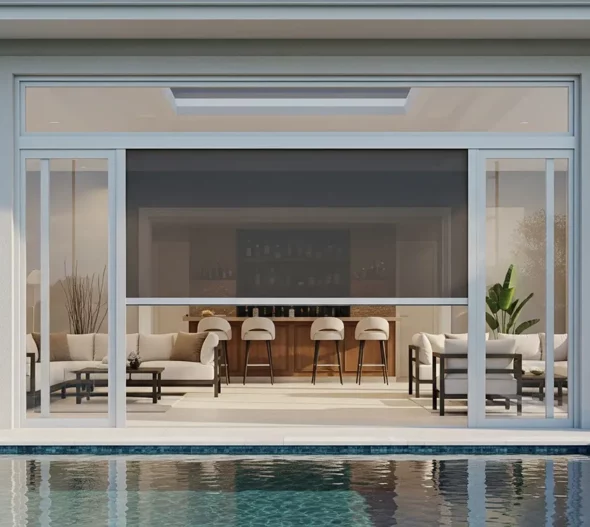
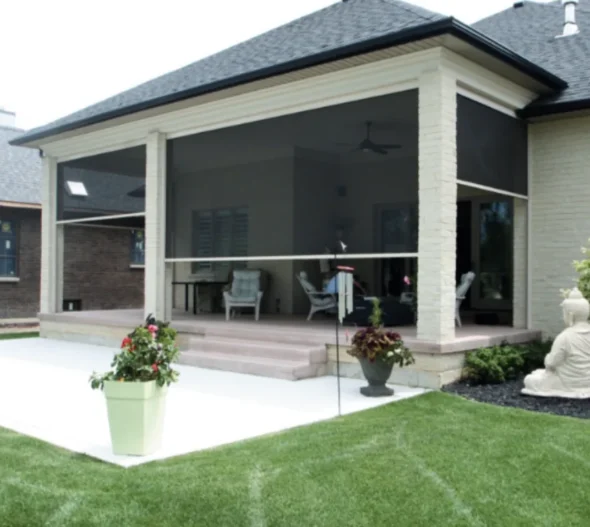
How a retractable screen mounts to a slider frame
A retractable screen does not hang in a track at all. The mesh is wound onto a spring-loaded roller inside a slim aluminum cassette that we mount vertically to one side of your door opening – either on the inside or the outside of the frame, depending on your trim, your door swing and how much depth is available. A lightweight pull bar on the leading edge of the mesh runs in a discreet guide channel fixed to the opposite jamb, so the screen glides across cleanly and retracts into the cassette the moment you let go.
Because the mesh retracts under spring tension rather than sitting exposed in a track, there is nothing for it to jump off, and nothing sitting at ground level to collect ice or grit over winter. The guide channels do need to be fastened square and plumb, which is the part a stock kit usually gets wrong – we measure the opening on site for this reason rather than working off a tape measurement called in over the phone.
Most sliders take the screen on the inside of the frame so the slider itself still operates normally and the screen sits behind it, but some older aluminum-clad frames or deep brick-mould openings work better with an outside mount. We decide that at the measure, not before.
Replacement slider screen vs. retractable screen vs. magnetic curtain
Three ways to keep bugs out of the same opening – they are not solving the same problem.
| Option | Good for | Honest limit |
|---|---|---|
| Replacement slider screen | A single worn-out screen on a budget, same-day fix | Same roller-and-track hardware that failed the first time |
| Retractable screen door | Doors used daily, pets, wide or tall openings, a clean look | Costs more up front and needs a cassette mounted to the frame |
| Hanging magnetic mesh curtain | A cheap temporary fix, renters, doors you rarely use | Flaps in wind, does not retract, snags on furniture and pets push through the seam |
All three keep insects out. Only the retractable version disappears completely when you do not need it.
Two-panel and three-panel sliders, and openings wider than a door
A single-panel retractable screen covers most standard sliders up to a typical door width without a centre post. Two-panel sliders and French-style sliding doors usually need two screens that meet in the middle, each retracting into its own cassette on opposite sides of the opening – this is also how we cover wider multi-track doors where the stationary panel sits in the centre and both sides slide.
For openings wider than a single door – a three-panel slider, a folding wall of glass, or a patio opening with no centre support at all – we either run two wider screens that meet at a mid-point stop, or treat it as a multi-opening job and price each panel separately, because the track, the spring tension and the pull-bar hardware all scale with width and height.
Height matters as much as width. A taller opening needs a longer mesh run and a stiffer spring, and if the top of the frame is more than a standard storey off the ground, the install itself takes longer because of access and safe anchoring, not because the hardware changes.
If you use the door once or twice a week and the only problem is one worn-out screen, buy the same cheap replacement again – a retractable system earns its price on doors you use every day.
The honest answer: when a replacement screen is enough
We will tell you straight when a retractable screen is overkill. If your slider is used occasionally, the frame is still square, and the only issue is a torn or faded mesh panel, a new stock screen from a hardware store or a local screen shop will likely hold up for another couple of seasons and costs far less. There is no reason to pay for a cassette and guide-channel install on a door that sees light use.
Where it stops making sense is when you have replaced the same screen more than once, when a pet keeps tearing through the mesh, when the door gets used daily and the panel keeps jumping its track, or when the opening is wide enough that a standard screen kit does not fit it cleanly. At that point the retractable system is not an upgrade for the sake of it – it is the version that stops the repeat repair bill.
We also get asked whether a retractable screen can simply replace a broken stock screen without touching the slider itself. It can – the cassette and guide channel mount to the frame independent of the slider hardware, so the slider keeps working exactly as it did before.
If your slider needs a real fix rather than another trip to buy the same screen, we measure the opening on site and quote the retractable version in writing.
Frequently Asked Questions
EL
Eugene Ladizinsky
CFO & COO, co-owner of ROLLerUP
Eugene co-owns ROLLerUP, the Newmarket company behind Shading Solutions by ROLLerUP. Every guide on this site is written with our installers and checked against our own job records before it is published. About ROLLerUP.
More about retractable screens
Retractable screens guides
Compare options
Read next
- Are retractable screens worth it? An honest answer
- Balcony privacy screens for condos and apartments
- Deck privacy screens: fixed panels or a retractable screen?
- Garage door screens: turning a garage into a screened room
- How much wind can a retractable screen take?
- How to choose a retractable screen door in Canada
Where we install
- Retractable screens in King City
- Retractable screens in Newmarket
- Retractable screens in Oakville
- Retractable screens in Richmond Hill
- Retractable screens in Stouffville
- Retractable screens, awnings and louvered pergolas in Toronto
- Retractable screens in Uxbridge
- Retractable screens in Vaughan, Woodbridge and Maple
- Retractable screens in Whitby
Get a free on-site estimate
We measure your slider in person and quote the retractable screen in writing before anything is ordered.