
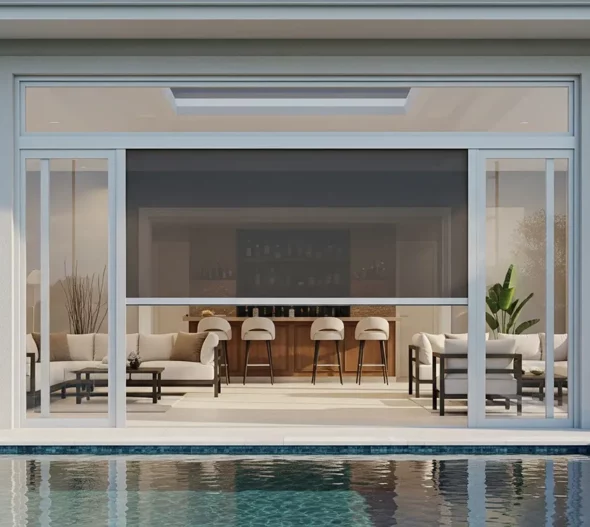
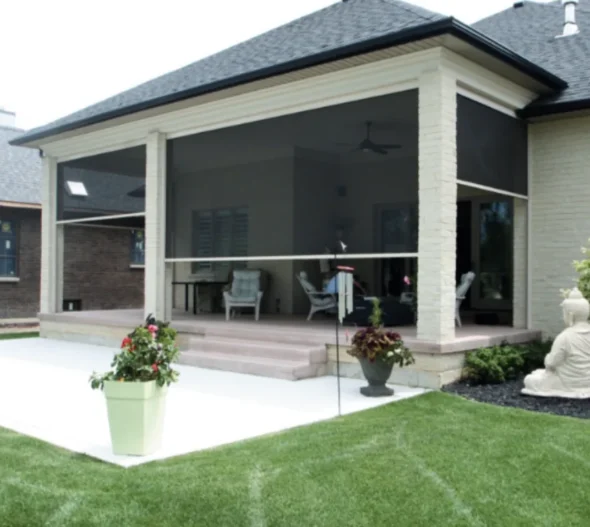
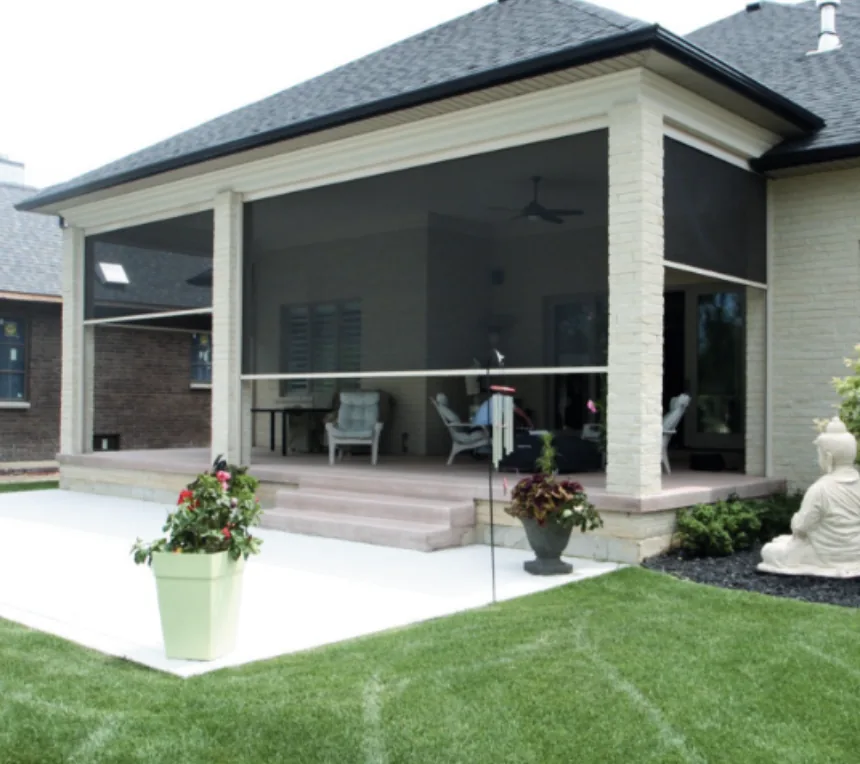
A roll-up privacy screen is a mesh panel stored in a slim aluminum housing above a patio opening, lowered on side tracks by hand crank or motor to block sightlines while letting air through. What keeps it from flapping is a zippered or beaded track edge, tension, and a bottom bar weighted to the frame.












The parts of a roll-up screen and what each does
A roll-up privacy screen is built from five parts that all have a job: a housing, a roller tube, the mesh itself, a pair of side tracks, and a bottom bar. The housing is a slim aluminum box mounted across the top of the opening – it keeps the rolled-up mesh dry and out of sight when the screen is open. Inside it, the roller tube is what the mesh winds around; it is turned either by a spring-loaded manual mechanism or a tubular motor.
The mesh itself is only as good as what holds its edges. Down each side, the mesh runs inside an aluminum side track that stops it billowing sideways in wind and keeps daylight from leaking around the edges. At the bottom, a weighted aluminum bottom bar keeps the mesh under tension as it unrolls and gives you something to grip to pull it down or guide it along the track.
- Housing – keeps the rolled mesh dry and hidden
- Roller tube – the mesh winds around this, spring or motor driven
- Mesh – the fabric itself, chosen for privacy, insect, solar, or clear vinyl use
- Side tracks – hold the edges and control wind flex
- Bottom bar – weights the mesh and keeps it under tension
Manual crank or motor: what each needs
A manual system uses a gear box and a removable crank handle, sometimes with a spring assist to make rolling smoother. It needs no power at all, which makes it a straightforward choice for an opening you can reach comfortably and operate by hand each time you use the space.
A motorized system needs a power run to the housing, built in during install, plus a wall switch or remote, and sometimes an optional sun or wind sensor. The honest limit is that a motor is one more moving part that can fail, and it needs power access we have to confirm on the site visit before we quote the job – not every opening has an easy place to run wiring.
In practice, crank costs less up front and suits reachable, sheltered openings. A motor earns its keep on tall, wide, or hard-to-reach spans where hand-cranking every day gets old fast.
Side tracks and why a zipper edge matters in wind
There are two common track styles. A channel track is a simple groove the bottom bar slides inside – fine for a sheltered opening with little wind exposure. A zipper edge beads the mesh edge itself so it locks into the track along its full height, more like a tent zipper than a loose channel.
This difference shows up the first windy afternoon. A channel track lets the mesh flex away from the groove under gusts, which is how a cheap screen starts to flap, work its edges loose, and eventually tear at the seam. A zipper edge keeps constant contact from top to bottom, so wind has nothing to catch.
Even with a zipper edge, no fabric screen is rated for sustained high wind the way a wall is. We tell customers to retract an exposed screen the same way they'd bring in a patio umbrella before a forecasted windstorm.
Mesh types compared: privacy, insect, solar, clear vinyl
The weave you pick does a specific job – none of them do all four at once.
| Mesh type | What it does | Daytime privacy | Night privacy | Trade-off |
|---|---|---|---|---|
| Privacy weave | Tight weave built to block a sightline | High | Low – visible in silhouette with lights on | Cuts more airflow and view than insect mesh |
| Insect mesh | Standard screen weave, keeps bugs out | Low | Low | Doesn't stop a sightline at all |
| Solar weave | Blocks glare and heat, partly see-through | Medium | Low | Built for sun control, not for hiding movement |
| Clear vinyl | Solid clear panel, blocks wind and rain | None – fully see-through | None | Good for weather, not for privacy |
How we measure and install a roll-up screen
Every install starts with a site visit, not a tape-measure guess over the phone.
Site visit and measure
We measure the exact opening width and height, check that it's square and level, and note any obstruction like a door handle or railing that affects where the housing and tracks can go.
Check the header and mounting surface
We confirm what the housing will mount to – fascia board, soffit, or a structural beam – and whether it needs reinforcing before the bracket goes up.
Confirm power access, if motorized
For a motorized screen we check where power can be run and whether a switch or remote location actually works for daily use.
Mesh and track selection
We walk through mesh openness and track style, channel or zipper edge, based on how exposed the opening is to wind and sun.
Install day
Brackets go up first, then the housing, mesh, and tracks; we run the screen up and down fully before leaving and confirm the 5-year warranty, in writing.
Cleaning, winter, and what breaks first
Cleaning is simple: retract the screen occasionally and wipe the track and bottom bar with mild soap and water. We don't recommend pressure-washing the mesh itself – it can stretch or tear a privacy or solar weave.
For winter, the single most common failure we see is a screen left extended under snow load or an ice storm, not a motor or housing problem. We tell every customer to retract and, where the system has one, lock the screen before the season's first heavy snowfall.
Day to day, the track hinges and bottom bar guides wear out from grit and ice more often than the motor itself. A yearly track clean prevents most of the service calls we get.
A roll-up screen is only as wind-worthy as its weakest edge – if the sides aren't tracked tight, it doesn't matter how good the mesh is.
What a roll-up screen costs, and what moves the number
Supplied and installed, real jobs since 2022 have ranged from $1,400 to $23,500 per screen, drawn from 156 real won jobs on this product line. Every property is different, so where a specific job lands in that range comes down to a handful of things we check on site, not a flat per-foot rate.
- The width and height of the opening – a wider or taller span needs a reinforced track and a bigger motor
- Motorized versus hand-crank operation, which changes both the hardware and the labour
- The mesh grade – a basic insect mesh costs less than a solar-weave or privacy-weave fabric
- How many openings are screened in one visit – several openings on one property share a single measure and install trip
- Access and height of the install – a second-storey or hard-to-reach opening takes longer to mount safely
- The frame and housing colour or finish chosen to match the home
- Whether an existing structure needs modification before the screen can be mounted to it
If blocking a neighbour's sightline is the real reason you're looking at a roll-up screen, our outdoor privacy screens page goes deeper on mesh openness and the day-versus-night visibility trade-off.
Frequently Asked Questions
EL
Eugene Ladizinsky
CFO & COO, co-owner of ROLLerUP
Eugene co-owns ROLLerUP, the Newmarket company behind Shading Solutions by ROLLerUP. Every guide on this site is written with our installers and checked against our own job records before it is published. About ROLLerUP.
More about retractable screens
Retractable screens guides
Compare options
Read next
- Are retractable screens worth it? An honest answer
- Balcony privacy screens for condos and apartments
- Deck privacy screens: fixed panels or a retractable screen?
- Garage door screens: turning a garage into a screened room
- How much wind can a retractable screen take?
- How to choose a retractable screen door in Canada
Where we install
- Retractable screens in King City
- Retractable screens in Newmarket
- Retractable screens in Oakville
- Retractable screens in Richmond Hill
- Retractable screens in Stouffville
- Retractable screens, awnings and louvered pergolas in Toronto
- Retractable screens in Uxbridge
- Retractable screens in Vaughan, Woodbridge and Maple
- Retractable screens in Whitby
Get a free on-site estimate
Call (289) 270-5747 or visit our Newmarket showroom at 1151 Gorham St, Unit 8, open Monday to Friday, 9 to 5.