

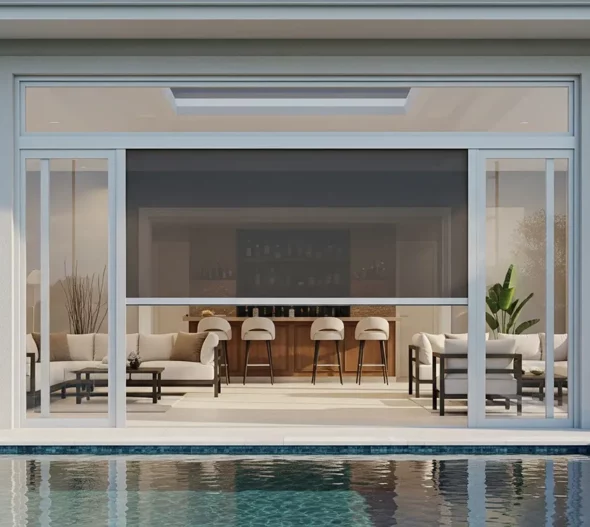
A retractable screen porch uses motorized or manual screens that roll into a housing above each opening and run down tracks on the posts, closing a covered porch against bugs, wind and sun without adding walls. We measure each opening, screen each one separately, and the screens disappear into a slim box when you want the porch open again.












What a porch needs before screens go up
The track housing that holds the rolled-up screen fastens to the underside of the header – the beam that spans across the top of the opening. That beam has to be solid framing, not just a trim board nailed over a post. On older porches we sometimes find a single undersized beam carrying a long span; before we hang a motor and a full-width screen off it, that beam needs reinforcing, and that's a carpentry step we flag or coordinate alongside the screen install, not skip past.
The side columns carry the track channel the screen's edge runs down. They need to be plumb – out of plumb by more than a little and the screen rubs one rail and gaps at the other. Post spacing also matters: screens have a practical width limit before the roll gets too heavy and the track too long to stay straight, so a wide opening without a centre post usually gets split into two narrower screens rather than one oversized one.
At the bottom, the screen's weighted rail needs something to land in – a sill track set into the floor, or at minimum a flat, level threshold it can seal against. Stone, tile and uneven wood decking all need a sill strip scribed to the surface; without it the bottom of the screen never seals and bugs come in under the rail.
How many screens an L-shaped porch needs
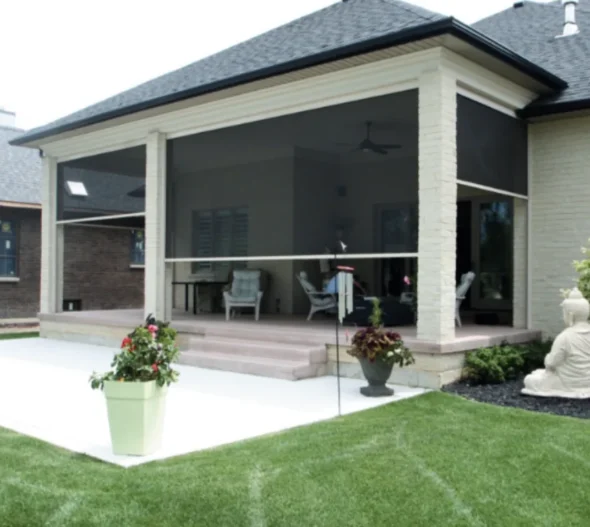
Each open bay between posts gets its own screen – we don't try to span an inside corner with one continuous screen. An L-shaped porch with two openings on the front and one on the return typically needs three separate units, each with its own housing, track and motor or crank.
At an inside corner, the two tracks meet at the shared post and each screen's bottom rail drops down on its own side – they don't interlock with each other, they each seal against that same post. On an outside corner, where two openings meet at a single post with nothing behind it, we add a vertical closure piece so the two screens meet without a gap when both are down.
Where a porch has a very wide single opening and no centre post, we'll either recommend one be added so we can run two screens, or run one wide screen if the housing and motor are rated for that width – but past a certain point, the roll weight and track length tip in favour of two screens over one oversized one.
Matching mesh to what each side of the porch is for
The side facing the garden or the yard is usually about keeping bugs out while keeping the view – a standard insect mesh, which is mostly open and barely visible once it's down, handles that.
The side facing a neighbour's window or a shared daneway is a different problem: privacy. A tighter-weave or solar-weave fabric blocks the sightline and cuts glare at the same time, at the cost of a bit more shade.
We mix mesh types on the same porch without any issue – insect weave on two sides, a privacy weave on the third – because each screen has its own housing and motor and works independently. What we won't do is run a solid, opaque fabric across a side that also needs the view or the breeze, because then the screen stops doing the indoor-outdoor job it was bought for.
What it costs to screen in a porch
Supplied and installed, real jobs since 2022 have ranged from $1,400 to $23,500. That range is per screen, since each opening is priced on its own – a porch with a single opening and a porch with several openings are two different jobs, not a single multiplied number. Every porch is different, and where yours lands depends on a short list of things we check on site:
- Opening width and height – a wider or taller bay needs a reinforced track and a bigger motor
- Motorized versus hand-crank operation, which changes both the hardware and the labour
- Mesh grade – insect mesh costs less than a solar-weave or privacy-weave fabric
- How many openings are screened in one visit – several bays on one porch share a single measure and install trip
- Access and height of the install – a second-storey or hard-to-reach opening takes longer to mount safely
- Whether the header or posts need modification before a screen can be mounted to them
Turning it into a four-season porch
Screens alone extend a porch's usable season – closed in, they block wind and most of the rain that would otherwise blow in sideways, and keep leaves and snow off the furniture. That gets you extra weeks at each end of the year without adding anything else.
Add a radiant heater mounted to the ceiling or a wall, and the porch stays comfortable well into the cold months, since the screens are cutting the wind that would otherwise carry the heat away. We size the heater to the porch and to how it's screened, not the other way around – a small heater in a fully open, unscreened space does very little.
A rug and some soft furniture finish the job, but they're not doing any of the weather work – that's the screens and the heater. We've seen plenty of porches with a heater and no screens, where most of the heat just blows past the open sides.
Retractable screens vs a built screen room vs glass
Three ways to close in the same porch opening, and what changes with each one.
| Retractable screens | Built screen room | Glass enclosure | |
|---|---|---|---|
| Keeps the open-air feel | Yes – rolls away completely | No – panels stay in place | No – panels stay in place |
| Works with existing posts and header | Usually yes | Needs new framing | Needs new framing and footings |
| Bug and wind protection | Yes, when down | Yes, always on | Yes, always on |
| Keeps the porch fully open in summer | Yes – retracts fully | No – screens stay fixed | No – glass stays fixed |
| Permits and approval | Usually none for the screen itself | Often a building permit | Almost always a building permit |
| Relative cost | Lower | Higher | Highest |
Permit requirements vary by municipality; check with your local building department before any structural change.
What we refuse to install
A few lines we won't cross, even if it's what a homeowner asked for.
- A screen mounted to a header or post that hasn't been checked for strength – we'll flag it and bring in or recommend a carpenter first.
- A single oversized screen across a wide opening with no centre support, when two screens would actually hold up over time.
- Opaque fabric across an opening the homeowner wants to keep as their main view and breeze.
- A screen used as a stand-in for a safety rail or a structural wall – it's weather and bug control, not a barrier.
- Any job where the existing structure is out of plumb or deteriorated enough that the screen would be fighting the frame from day one.
Rule of thumb: if a porch has a solid header, plumb posts and a flat sill, retractable screens go on in a day or two; if it doesn't, fix the structure first and the screens will outlast it.
If the porch structure checks out, the next step is picking the screens themselves – mesh, colour, and motorized or hand-crank.
Frequently Asked Questions
EL
Eugene Ladizinsky
CFO & COO, co-owner of ROLLerUP
Eugene co-owns ROLLerUP, the Newmarket company behind Shading Solutions by ROLLerUP. Every guide on this site is written with our installers and checked against our own job records before it is published. About ROLLerUP.
More about retractable screens
Retractable screens guides
Compare options
Read next
- Are retractable screens worth it? An honest answer
- Balcony privacy screens for condos and apartments
- Deck privacy screens: fixed panels or a retractable screen?
- Garage door screens: turning a garage into a screened room
- How much wind can a retractable screen take?
- How to choose a retractable screen door in Canada
Where we install
- Retractable screens in King City
- Retractable screens in Newmarket
- Retractable screens in Oakville
- Retractable screens in Richmond Hill
- Retractable screens in Stouffville
- Retractable screens, awnings and louvered pergolas in Toronto
- Retractable screens in Uxbridge
- Retractable screens in Vaughan, Woodbridge and Maple
- Retractable screens in Whitby
Get a free on-site estimate
We'll measure your porch, check the header and posts, and give you a written price before any work starts.