

A storm door with screen is a hinged glass-and-mesh door that swaps a glass panel for a screen panel, usually covering only half the opening at a time. It is a fine choice for a front entry that needs weather protection and occasional airflow, but it does not give the full, screen-across-the-whole-opening airflow a retractable screen door does.












What a storm door with screen actually is
A storm door with screen is a second, lighter door hinged to the outside of your existing entry door frame. The defining feature is an interchangeable panel: in winter you run it with a glass panel for weather protection, and in warmer months you swap in a mesh panel for airflow. On older storm doors that panel swap is a manual job done once or twice a year. Newer glass storm door with screen models use a sliding glass panel inside the frame that you raise partway to expose a fixed screen section behind it.
That sliding-glass version is what most people picture when they search for a retractable storm door, but it is not retractable in the way a roll-up screen is. The glass panel slides up and locks in place; it does not disappear into a housing. You are left with a visible track, a glass panel sitting at the top of the frame, and a screen section underneath it – usually around half the full door opening.
We want to be upfront: this is not something we install. ROLLerUP designs, measures, sells, installs and services retractable screens and retractable screen doors – the kind that roll up into a slim aluminum housing and disappear completely. We do not install storm doors, hinged screen doors, or anything with a swinging glass-and-mesh panel. If a storm door is genuinely the right fit for your entry, a door and window specialist is the better call.
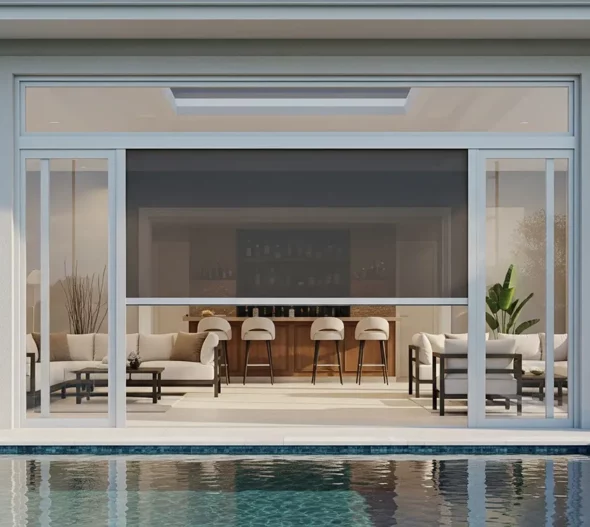
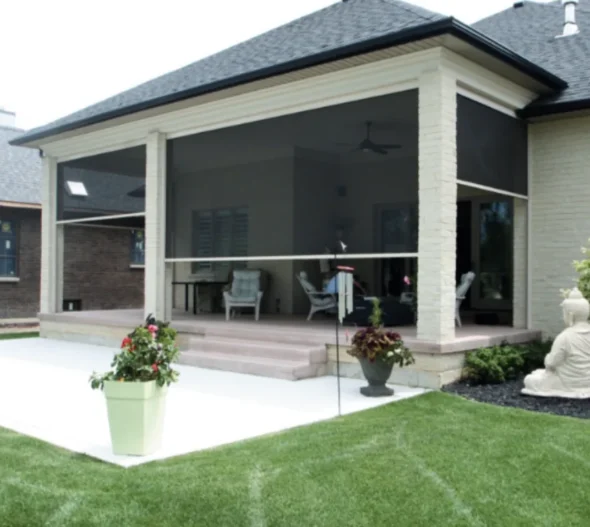
The half-screen trade-off, and what full-view glass changes
The most common complaint we hear about storm doors with screens is airflow – or the lack of it. Because the glass panel has to slide somewhere, it parks at the top or bottom of the frame and blocks part of the opening. On a standard storm door that usually means you get screen across roughly the bottom half or top half, not the whole door. For a front entry that only gets occasional use, that is rarely a problem. For a side or garden door you actually walk a dog through, carry groceries through, or use as a second patio access, half an opening feels tight fast.
Full-view storm doors improve on this by using a single large glass panel that retracts fully, so when it is up, the entire door is screen. They cost more, the hardware is heavier, and the closer and hinges take more load over the years, so they need more frequent adjustment than a half-view model. Either way, you are still opening and closing a swinging door to get airflow, which is a different experience than lowering a screen that was already rolled up out of sight.
None of this makes a storm door a bad product – it does a job a retractable screen does not: it adds a second layer of insulated glass in winter, which a mesh screen never will. The trade-off is that the same door cannot do both jobs equally well at once. It is either in glass mode or screen mode, not both.
Storm door with screen vs. retractable screen door vs. both
Here is how the two approaches actually compare on a typical front or side entry.
| What matters | Storm door with screen | Retractable screen door | Both installed |
|---|---|---|---|
| Airflow when open | Half the opening, or full on a full-view model | The entire opening, floor to header | Full airflow, with winter glass backup |
| Winter weather protection | Yes – glass panel | No – mesh only | Yes, from the storm door |
| Sits out of view when not needed | No, the door frame is always visible | Yes, rolls into a slim top housing | Screen hides, storm door frame stays |
| Moving parts to maintain | Hinges, closer, panel track and latch | Roller, guide rails, spring tension | Both sets of hardware |
| Good fit for sidelights or out-swing doors | Often no – needs swing clearance | Usually yes – no swing required | Only if the storm door fits first |
| Who installs it | A door and window specialist | ROLLerUP, design to install to service | Two separate trades |
A full-view storm door narrows the airflow gap but still swings open and shut – it does not roll away.
Front entries that cannot take a storm door, and what works instead
Storm doors need clearance to swing, and they need a flat, square frame to hinge onto. A few common Ontario entry setups make that difficult or impossible. Doors with sidelights – the narrow glass panels flanking the door – often leave no room for a storm door frame to sit flush without covering part of the sidelight or blocking the opening when it swings. Out-swing entry doors, common on some newer builds and on garden doors, create a conflict: the storm door and the main door both want the same swing path, and you end up with one door blocking the other.
Covered porches with low headroom, decorative transoms, and heritage-district entries with protected trim profiles all add friction too – sometimes a storm door can be custom-ordered to fit, sometimes it genuinely cannot without altering the trim. In condos and townhomes, exterior door alterations including storm doors usually need board approval before anything goes in, which can stall a project for weeks.
A retractable screen door sidesteps most of this. It mounts above the opening in a slim top cassette and the mesh panel pulls down a vertical track on each side – there is no swinging frame competing for space with sidelights or an out-swing door, and it does not change the look of your existing entry door or trim. That is why we tend to steer people with a tricky front entry toward a vertical screen rather than a storm door with a screen panel built in.
If your entry has sidelights, an out-swing door, or condo rules on exterior changes, check whether a storm door will physically fit before you fall for the screen feature – a retractable screen door often solves the airflow problem without any of those conflicts.
If a swinging storm door is not going to work for your entry, a vertical retractable screen door gives you full airflow without changing how your door frame looks or swings.
Frequently Asked Questions
EL
Eugene Ladizinsky
CFO & COO, co-owner of ROLLerUP
Eugene co-owns ROLLerUP, the Newmarket company behind Shading Solutions by ROLLerUP. Every guide on this site is written with our installers and checked against our own job records before it is published. About ROLLerUP.
More about retractable screens
Retractable screens guides
Compare options
Read next
- Are retractable screens worth it? An honest answer
- Balcony privacy screens for condos and apartments
- Deck privacy screens: fixed panels or a retractable screen?
- Garage door screens: turning a garage into a screened room
- How much wind can a retractable screen take?
- How to choose a retractable screen door in Canada
Where we install
- Retractable screens in King City
- Retractable screens in Newmarket
- Retractable screens in Oakville
- Retractable screens in Richmond Hill
- Retractable screens in Stouffville
- Retractable screens, awnings and louvered pergolas in Toronto
- Retractable screens in Uxbridge
- Retractable screens in Vaughan, Woodbridge and Maple
- Retractable screens in Whitby
Get a free on-site estimate
We'll measure your opening, tell you honestly whether a retractable screen door is the right fit, and quote it in writing.