

The main types are retractable mesh screens, fixed aluminum panels, wood or composite slat panels, lattice, fabric sail panels, and planted or living screens. Each trades off differently on wind, winter storage, upkeep and whether you still get the view back in summer. Retractable mesh is the only type built to disappear when you don't need it.












The main types of outdoor privacy screens
"Privacy screen" gets used for six fairly different products, and the differences matter more than the name. Some are permanent structures you build once and live with year-round. Others are attachments that roll up, fold down, or come off the deck entirely once the season ends. Picking the wrong category is the most common regret we hear about, usually from someone who put up a solid wall and then missed the view, or bought something seasonal and wanted it to survive a Newmarket winter.
The honest way to sort them is by what they do when you don't want privacy anymore. A retractable mesh screen rolls into a slim aluminum housing and disappears. A fixed panel, a wood slat wall, or a planted hedge stays exactly where it is, blocking the sightline whether you want it blocked or not. Neither approach is wrong – it depends on whether the opening needs to be open most of the time and closed sometimes, or closed all the time.
- Retractable mesh screen – rolls down on a track, rolls away when not needed
- Fixed aluminum privacy panel – permanent, solid, no moving parts
- Wood or composite slat panel – a built wall, usually on footings
- Lattice panel – partial coverage, lets light and some view through both ways
- Fabric sail or curtain panel – a soft panel strung between posts, usually seasonal
- Planted or living screen – hedging, climbing vines or tall grasses used as a wall
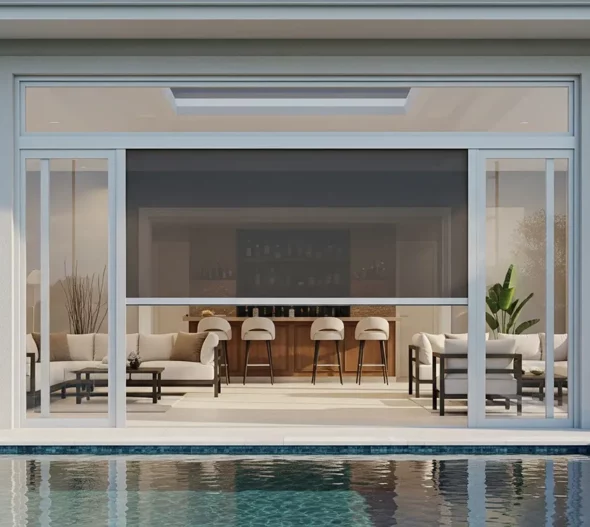
How the six types compare
Short version: what each type does to your view, your winter, and your maintenance list.
| Type | See-through at night | Wind & snow | Maintenance | Retracts | Permit risk |
|---|---|---|---|---|---|
| Retractable mesh screen | Visible in silhouette if lights are on | Side-tracked for wind; rolled up before snow load builds | Hose the mesh, lubricate the track occasionally | Yes, fully | Usually none – it attaches to an existing structure |
| Fixed aluminum panel | Solid, no silhouette either way | Built to stand through snow load, nothing to retract | Occasional wash | No | Can trigger a permit if it's load-bearing or over height |
| Wood or composite slat panel | Solid both ways | Needs footings; wood can warp or heave with frost | Annual stain or sealant | No | Often needs a permit as a freestanding wall over a certain height |
| Lattice panel | Partial, gappy both ways | Light, can rack in wind; some fold flat for winter | Low | Some fold, most don't | Low – usually treated like a fence section |
| Fabric sail or curtain panel | See-through if lit at night | Comes down before the first snow; wind can tear it if left up | Seasonal take-down and wash | Partially, by hand each season | Low |
| Planted or living screen | Natural cover, no silhouette effect | Deciduous plants drop leaves in winter; branches can hold snow | Ongoing pruning and watering | No | Usually none, but check fence-line and easement rules first |
Snow and wind behaviour assumes a typical Southern Ontario winter, not a flood-zone or ravine lot.
Mesh openness: privacy by day, not by night
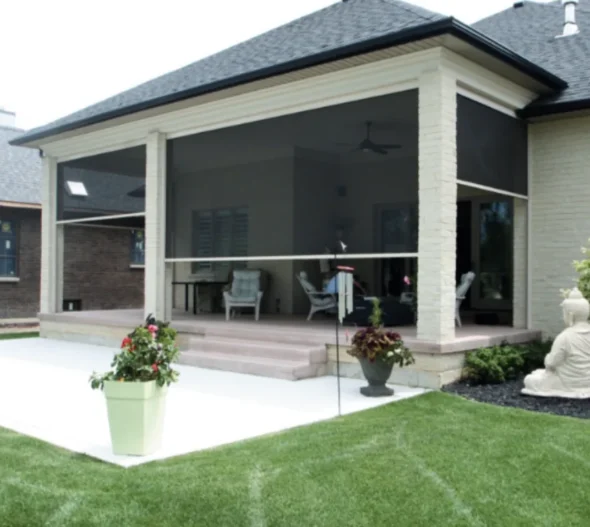
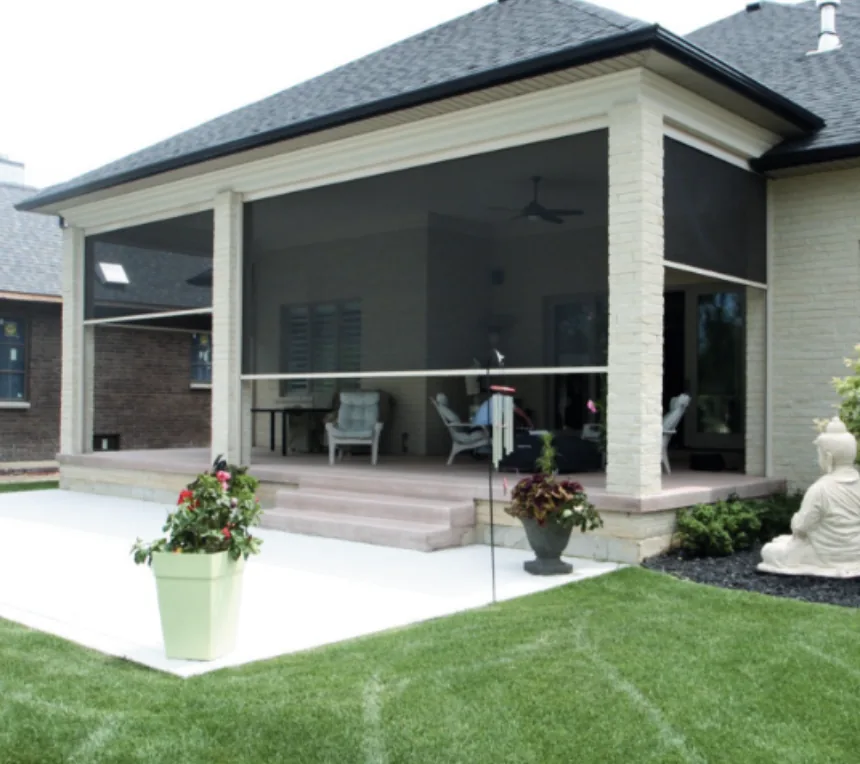
Every mesh-based privacy screen, retractable or sail-style, is rated by openness – how much gap there is between threads. A tighter, privacy-weave mesh reads as close to solid from the outside during the day, because the side with more light reflects back at the viewer and the side with less light is harder to see into. That's the physics behind every privacy screen on this list that isn't a solid panel.
At night that relationship flips. Once the interior lights are on and it's dark outside, the brighter side is now the one being looked at, and a mesh privacy screen shows a silhouette the way a sheer curtain does. We explain this to every customer before they buy a mesh screen for a hot tub or bedroom slider, because it's the single most common misunderstanding about the product. If full privacy after dark matters more than daytime privacy, a solid fixed panel or a built wall section does that job better than any mesh weave.
Where each type belongs: deck, balcony, hot tub, pergola, fence line
Match the type to the opening, not the other way around.
- Deck facing a neighbour's second-storey window – retractable mesh, so you get it back when you want the view
- Balcony or exposed high-rise opening – retractable with a side track, which stops the mesh flapping or bowing in wind
- Hot tub or pool enclosure – retractable, lowered only when in use, since most of the year you want the view open
- Pergola bay or post opening – a fabric sail or an integrated screen built into the post line, matched to the structure
- Fence line or property boundary – lattice or a planted screen, since there's nothing to retract and the boundary doesn't change
- Side yard or utility screening (bins, meters) – a fixed aluminum panel, since it's permanent and low-maintenance by design
A privacy screen blocks a sightline, not a sound – mesh, fabric and lattice all let noise straight through, and even a solid panel only knocks a little off a conversation at close range.
Winter, wind, condos and bylaws in Ontario
Wind and snow are the two things that separate a screen that lasts from one that doesn't, in this climate. A retractable screen needs a reinforced track and, on an exposed balcony, side guides to stop the mesh bowing or tearing in a gust – and it should be rolled up before heavy snow sits on the fabric. A fixed panel or a built slat wall has to be engineered for snow load and frost heave at the footings, which is a different conversation than a summer-only sail panel that simply comes down for the season.
Permits and condo rules follow the same logic as wind and snow: the more permanent the structure, the more scrutiny it gets. A retractable screen that attaches to an existing eave, pergola or railing is usually treated as an accessory, not a new structure. A freestanding wood wall, a tall lattice fence, or anything that changes the footprint of a balcony is more likely to need a permit or condo board sign-off before it goes up. We don't quote permit timelines because every municipality and every condo board handles this differently – it's worth a call to the local building department or property manager before you commit to anything permanent.
If a retractable screen looks like the right category for your deck or balcony, we cover sizing, mesh grades and what drives the price on the outdoor privacy screens page.
Frequently Asked Questions
EL
Eugene Ladizinsky
CFO & COO, co-owner of ROLLerUP
Eugene co-owns ROLLerUP, the Newmarket company behind Shading Solutions by ROLLerUP. Every guide on this site is written with our installers and checked against our own job records before it is published. About ROLLerUP.
More about retractable screens
Retractable screens guides
Compare options
Read next
- Are retractable screens worth it? An honest answer
- Balcony privacy screens for condos and apartments
- Deck privacy screens: fixed panels or a retractable screen?
- Garage door screens: turning a garage into a screened room
- How much wind can a retractable screen take?
- How to choose a retractable screen door in Canada
Where we install
- Retractable screens in King City
- Retractable screens in Newmarket
- Retractable screens in Oakville
- Retractable screens in Richmond Hill
- Retractable screens in Stouffville
- Retractable screens, awnings and louvered pergolas in Toronto
- Retractable screens in Uxbridge
- Retractable screens in Vaughan, Woodbridge and Maple
- Retractable screens in Whitby
Get a free on-site estimate
We measure the actual opening, tell you which type fits it, and put the price in writing before anything is ordered.